
Torque Units Explained for Engineers (Nm, lb-ft & kg-cm Guide)
📅 Published: April 26, 2026 | 🔄 Last Updated: August 6, 2026 | ⏱️ Reading Time: 8 min | ✔️ Reviewed by: Maitenics Editorial Team
Torque units explained helps maintenance engineers, technicians, and mechanical professionals understand the differences between Newton-meters (Nm), pound-feet (lb-ft), pound-inches (lb-in), and kilogram-centimeters (kg-cm). Choosing the correct torque unit is essential for accurate bolt tightening, equipment installation, and safe industrial maintenance.
Many industrial machines used across Saudi Arabia, the UAE, Qatar, and other Gulf countries are imported from Europe, the United States, and Asia. As a result, technicians frequently encounter different torque units in equipment manuals, torque wrenches, and maintenance procedures. Confusing these units can lead to over-tightening, under-tightening, vibration, leakage, damaged fasteners, and unexpected equipment failures.
This guide explains the most common torque units, where each one is used, how they compare, and how to convert them correctly. Whether you're servicing pumps, motors, compressors, gearboxes, or structural fasteners, understanding torque units helps ensure safe and reliable maintenance.
Need to convert torque values instantly? Use our Torque Calculator (Nm ↔ lb-ft) for fast and accurate torque conversions before carrying out maintenance work.
Key Takeaways
- Torque units measure rotational force and are commonly expressed as Newton-meters (Nm), pound-feet (lb-ft), pound-inches (lb-in), and kilogram-centimeters (kg-cm).
- Using the wrong torque unit can result in over-tightening, under-tightening, damaged fasteners, equipment failure, and increased maintenance costs.
- Different countries and manufacturers use different torque units, making accurate unit identification essential before setting a torque wrench.
- Maintenance engineers should always verify the required unit, use the correct conversion method, and follow the equipment manufacturer's recommended torque specification.
- Using a trusted Torque Calculator or verified conversion chart helps eliminate manual calculation errors and improves maintenance accuracy.
What Are Torque Units?
Torque units are used to measure rotational force—the turning force that causes an object to rotate around an axis or pivot point. Since torque is calculated by multiplying the applied force by the distance from the pivot point, every torque unit combines a unit of force with a unit of distance.
For example, when a technician applies force to a wrench, the amount of turning force generated depends on both the applied force and the length of the wrench. This turning force is expressed using different torque units depending on the measurement system and engineering standard.
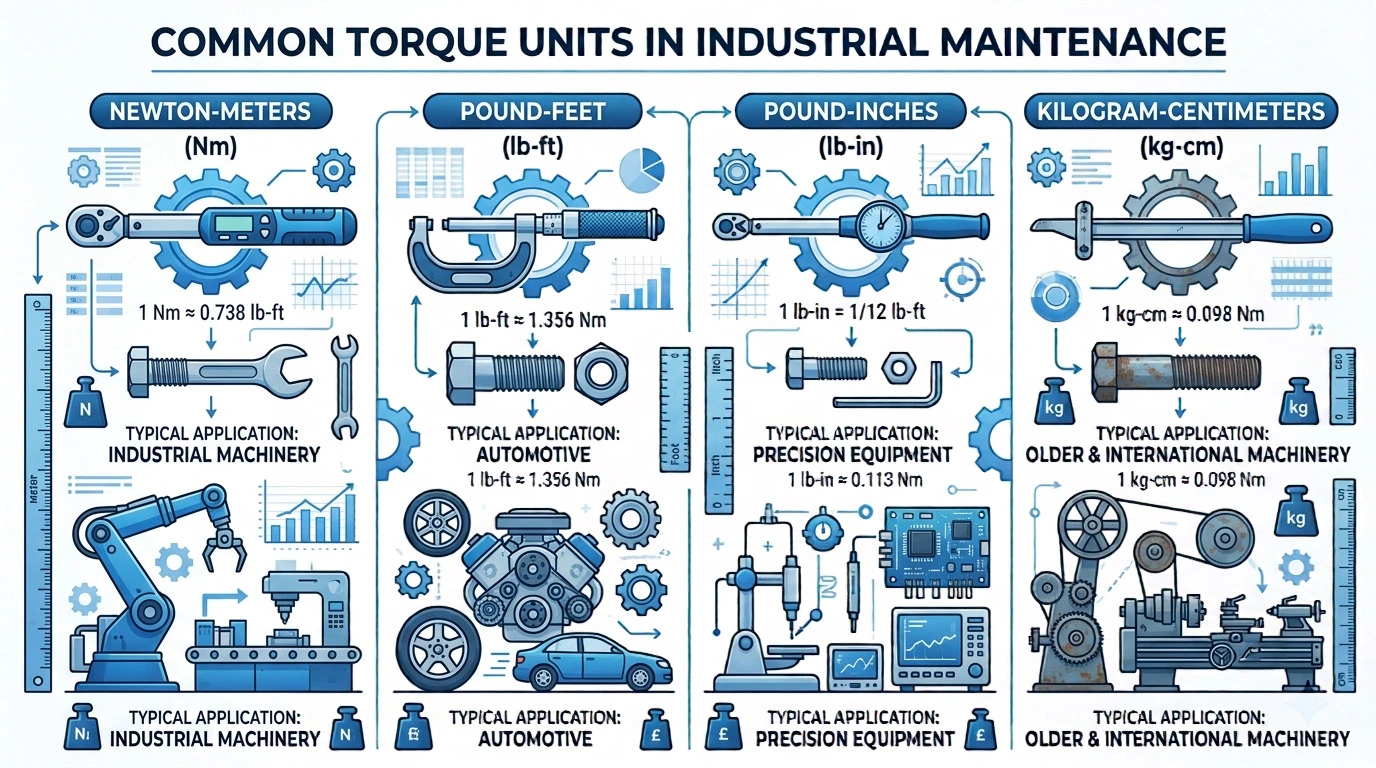
The most common torque units used in industrial maintenance include:
- Newton-meter (Nm) – The international SI unit used in most industrial and engineering applications.
- Pound-foot (lb-ft) – Commonly used in American automotive and industrial equipment.
- Pound-inch (lb-in) – Typically used for precision assemblies, electrical equipment, and small fasteners.
- Kilogram-centimeter (kg-cm) – Found in older machinery, light-duty equipment, and some imported tools.
Understanding these units is essential because maintenance engineers frequently work with equipment imported from different countries, where torque specifications may use different measurement systems.
In Gulf industries, it is common to service European pumps, American compressors, and Asian manufacturing equipment within the same facility. As a result, technicians often switch between metric and imperial torque units during routine maintenance. Identifying the correct unit before setting a torque wrench helps prevent tightening errors and improves equipment reliability.
Why Different Torque Units Are Used
Different torque units exist because countries have adopted different measurement systems over time. Most modern engineering standards use the International System of Units (SI), where torque is expressed in Newton-meters (Nm). However, many American manufacturers continue to use the imperial system, where torque is specified in pound-feet (lb-ft) or pound-inches (lb-in).
As industrial equipment is traded globally, maintenance engineers often work with machines from multiple manufacturers. A single maintenance workshop may service European pumps, American compressors, Japanese machine tools, and locally manufactured equipment on the same day. Each machine may use a different torque unit in its service manual or torque specification chart.
Before setting a torque wrench, always check the unit specified in the equipment manual. Never assume that the displayed value is in Newton-meters (Nm). Verifying the correct unit takes only a few seconds but can prevent expensive maintenance mistakes.
| Measurement System | Common Regions | Typical Torque Units | Where You’ll Commonly Find It |
|---|---|---|---|
| Metric (SI) | Europe, Asia, Middle East | Newton-meter (Nm) | Industrial machinery, pumps, motors, gearboxes, manufacturing plants |
| Imperial | United States, Canada | Pound-foot (lb-ft), Pound-inch (lb-in) | Automotive equipment, heavy machinery, imported industrial equipment, electrical assemblies |
| Legacy Metric | Older Asian equipment | Kilogram-centimeter (kg-cm) | Older machinery, legacy maintenance tools, light-duty mechanical systems |
Common Torque Units Explained
Torque Units Explained helps engineers understand how different measurement systems represent rotational force and how those units are applied in practical maintenance work.
Several torque units are used worldwide because different countries and manufacturers follow different engineering standards. Understanding where each unit is commonly used helps maintenance engineers choose the correct torque value and avoid costly installation errors.
1. Newton-meter (Nm)
Newton-meter (Nm) is the official SI (International System of Units) measurement for torque and the most widely used unit in industrial maintenance. It is commonly found in equipment manuals for pumps, electric motors, gearboxes, compressors, conveyors, and other rotating machinery manufactured in Europe, Asia, and the Middle East.
Most maintenance engineers working in Saudi Arabia, the UAE, Qatar, and other Gulf countries encounter Nm torque specifications daily because many industrial plants follow metric engineering standards.
2. Pound-foot (lb-ft)
Pound-foot (lb-ft) is the standard torque unit used in the imperial measurement system. It is commonly specified in American equipment, heavy machinery, automotive applications, diesel engines, and imported industrial equipment manufactured in the United States.
When servicing imported machines, technicians should always verify whether the manual specifies Nm or lb-ft before adjusting a torque wrench.
3. Pound-inch (lb-in)
Pound-inch (lb-in) is used for lower torque values where greater precision is required. It is commonly found in electrical equipment, instrumentation, control panels, electronics, HVAC components, and small fasteners where using lb-ft would be impractical.
4. Kilogram-centimeter (kg-cm)
Kilogram-centimeter (kg-cm) is an older metric-based torque unit that still appears on some legacy machinery, imported tools, and light-duty mechanical equipment. Although it is less common today, maintenance technicians may still encounter it when servicing older industrial installations.
Before tightening any fastener, verify both the torque value and the torque unit shown in the equipment manual. Two identical numerical values expressed in different units can produce completely different tightening forces and may lead to damaged threads, loose connections, or premature equipment failure.
Nm vs lb-ft vs kg-cm (Key Differences)
Although all torque units measure the same rotational force, they belong to different measurement systems and are commonly used in different industries. Understanding these differences helps technicians choose the correct torque value, use the right torque wrench settings, and avoid costly maintenance errors.
| Torque Unit | Measurement System | Common Applications | Typical Users |
|---|---|---|---|
| Newton-meter (Nm) | Metric (SI) | Industrial machinery, pumps, motors, gearboxes | Maintenance engineers, mechanical engineers |
| Pound-foot (lb-ft) | Imperial | Automotive equipment, heavy machinery, imported US equipment | Automotive technicians, field service engineers |
| Pound-inch (lb-in) | Imperial | Electrical panels, instrumentation, precision assemblies | Electrical technicians, HVAC technicians |
| Kilogram-centimeter (kg-cm) | Older Metric | Legacy equipment, imported tools, light-duty machinery | Maintenance technicians servicing older equipment |
The table shows that no torque unit is inherently better than another. The correct unit depends entirely on the equipment manufacturer's specifications and the measurement system used for the machine or tool.
- ✅ Use Newton-meters (Nm) for most industrial maintenance and engineering applications.
- ✅ Use Pound-feet (lb-ft) when servicing American equipment or following imperial specifications.
- ✅ Use Pound-inches (lb-in) for precision work involving electrical equipment, HVAC components, or small fasteners.
- ✅ Use Kilogram-centimeters (kg-cm) only when specified in older equipment manuals or legacy tools.
If your torque wrench and equipment manual use different units, convert the value before tightening. Use our Torque Calculator or refer to the Torque Conversion Chart (All Units) to ensure accurate and safe maintenance.
How to Convert Torque Units
Maintenance engineers often need to convert torque values when the equipment manual, torque wrench, and engineering drawings use different measurement systems. Understanding the basic conversion factors helps prevent tightening errors and ensures maintenance work meets the manufacturer's specifications.
The most commonly used torque conversion formulas are:
- 1 Nm = 0.737562 lb-ft
- 1 lb-ft = 1.35582 Nm
- 1 Nm = 10.197 kg-cm
- 1 lb-ft = 12 lb-in
Worked Example
Suppose an equipment manual specifies a tightening torque of 100 Nm, but your torque wrench is calibrated in lb-ft.
Step 1
Use the conversion factor:
1 Nm = 0.737562 lb-ft
Step 2
100 × 0.737562
Step 3
100 Nm = 73.76 lb-ft
This means you should set the torque wrench to approximately 73.76 lb-ft to achieve the correct tightening torque specified by the manufacturer.
Manual calculations are useful for understanding the conversion process, but using a verified torque calculator helps eliminate rounding errors and saves time during maintenance work.
Real Industrial Use of Torque Units
Maintenance engineers rarely work with equipment from a single manufacturer. In many industrial facilities, especially across Saudi Arabia, the UAE, Qatar, and other Gulf countries, maintenance teams service European pumps, American compressors, Japanese machine tools, and locally manufactured equipment within the same plant. As a result, technicians frequently encounter different torque units during routine maintenance.
Using the correct torque unit is just as important as applying the correct torque value. Setting a torque wrench in the wrong unit can result in over-tightening or under-tightening, leading to vibration, leakage, damaged threads, premature bearing failure, or loose structural connections.
| Equipment | Common Torque Unit | Typical Maintenance Task |
|---|---|---|
| Industrial Pumps | Newton-meter (Nm) | Coupling alignment, casing bolts, bearing housing |
| Electric Motors | Newton-meter (Nm) | Foundation bolts, terminal connections |
| American Equipment | Pound-foot (lb-ft) | Mechanical assembly, heavy-duty fasteners |
| Electrical & Instrumentation | Pound-inch (lb-in) | Control panels, precision fasteners |

Before applying torque, verify the equipment manual, confirm the required torque unit, and ensure the torque wrench is configured in the same unit. This simple check helps prevent costly maintenance errors and improves equipment reliability.
Common Torque Unit Mistakes
Even experienced maintenance technicians can make mistakes when working with different torque units. Most errors occur not because of incorrect tightening techniques, but because the specified torque value is interpreted using the wrong measurement unit. Understanding these common mistakes helps improve maintenance accuracy and prevents equipment failures.
It is also important to understand that the applied tightening torque is not the same as the preload developed inside the bolt. Learn how torque creates bolt preload and clamp force in our guide to Bolt Torque vs Preload.
| Common Mistake | Possible Consequence | Best Practice |
|---|---|---|
| Confusing Nm with lb-ft | Over-tightening or under-tightening fasteners | Always verify the unit before setting the torque wrench. |
| Ignoring the equipment manual | Incorrect assembly and reduced equipment reliability | Follow the OEM torque specification exactly. |
| Using incorrect conversion values | Improper tightening force | Use a verified torque calculator or conversion chart. |
| Selecting the wrong torque wrench unit | Maintenance errors and possible component damage | Confirm the displayed unit before tightening. |
Recommended Reading
Want to learn how these mistakes happen in real maintenance work and how experienced technicians avoid them? Read our complete guide: 10 Common Torque Conversion Mistakes (And How to Avoid Them).
Before tightening any critical fastener, verify the required torque value, confirm the correct torque unit, and ensure your torque wrench is calibrated and configured to the same unit specified by the equipment manufacturer.
When to Use Each Torque Unit
Choosing the correct torque unit depends on the equipment manufacturer, industry standards, and the type of maintenance work being performed. While all torque units measure the same rotational force, using the wrong unit can result in incorrect torque wrench settings and costly maintenance errors.
The following guide helps maintenance engineers and technicians identify which torque unit is typically used in different applications.
| If You Are Working On... | Recommended Torque Unit | Reason |
|---|---|---|
| Industrial pumps, motors, gearboxes and rotating equipment | Newton-meter (Nm) | Most industrial equipment follows SI (metric) engineering standards. |
| American machinery and automotive equipment | Pound-foot (lb-ft) | Most US manufacturers specify torque using imperial units. |
| Electrical panels, instrumentation and precision assemblies | Pound-inch (lb-in) | Provides better accuracy for lower torque values. |
| Older machinery and legacy maintenance tools | Kilogram-centimeter (kg-cm) | Common on older equipment and imported legacy systems. |
Quick Decision Guide
- ✅ Working on modern industrial equipment? → Use Newton-meters (Nm).
- ✅ Servicing imported American equipment? → Check for lb-ft.
- ✅ Tightening electrical or precision components? → Use lb-in.
- ✅ Maintaining older imported machinery? → Verify whether the specification uses kg-cm.
Never select a torque unit based on habit or previous jobs. Always verify the unit specified in the equipment manual before adjusting a torque wrench. Using the correct torque value in the wrong unit can produce incorrect tightening force and increase the risk of equipment damage or safety incidents.
If you're unsure which torque unit is specified in your equipment manual, compare the unit symbol carefully before applying torque. This simple verification step helps prevent one of the most common maintenance mistakes in industrial environments.
Torque Units in Industrial Maintenance Applications
Understanding torque units is important in everyday industrial maintenance because technicians often work with equipment from different manufacturers, each following its own engineering standards. Using the correct torque unit helps ensure proper bolt tightening, reliable equipment performance, and safe maintenance practices.
In modern industrial facilities, maintenance teams may service pumps, motors, compressors, conveyors, HVAC systems, and structural equipment during the same shift. Since these machines can originate from different countries, technicians frequently encounter both metric and imperial torque specifications.
| Equipment | Common Torque Unit | Typical Maintenance Activity |
|---|---|---|
| Centrifugal Pumps | Newton-meter (Nm) | Pump casing bolts, coupling installation, bearing housing assembly |
| Electric Motors | Newton-meter (Nm) | Foundation bolts, terminal box covers, motor alignment |
| Compressors | Nm or lb-ft | Cylinder head bolts, flange connections, maintenance overhauls |
| HVAC Equipment | lb-in or Nm | Electrical terminals, fan assemblies, control panels |
| Pipeline Flanges | Nm or lb-ft | Flange bolt tightening during installation and shutdown maintenance |
Real Maintenance Scenario
A maintenance technician replaces a coupling on a European centrifugal pump installed in a Gulf manufacturing plant. The pump manual specifies the tightening torque in Newton-meters (Nm), while the available digital torque wrench is currently configured in lb-ft. Before tightening the coupling bolts, the technician confirms the required unit, converts the value if necessary, and then applies the correct torque. This simple verification prevents improper tightening, vibration, and premature coupling failure.

Always verify three things before tightening any critical fastener: the specified torque value, the correct torque unit, and the calibration status of the torque wrench. Following this simple process improves maintenance quality, reduces rework, and helps prevent equipment failures caused by incorrect torque application.
Want to see practical tightening calculations? Read our Torque Calculation Examples (Real-Life) guide to understand how torque values are applied during actual maintenance work.
Continue Your Learning
Expand your knowledge with these practical engineering resources:
- Torque Calculator (Nm ↔ lb-ft) – Instantly convert torque values between metric and imperial units.
- Torque Formula Explained – Learn the engineering principles behind torque calculations.
- How to Calculate Torque – Step-by-step guide with practical worked examples.
Always verify the required torque value, confirm the correct torque unit, and use a properly calibrated torque wrench before tightening any critical fastener. Following the equipment manufacturer's specifications helps improve maintenance quality, equipment reliability, and workplace safety.
Frequently Asked Questions (FAQs)
What is a torque unit?
A torque unit is a measurement used to express rotational force. The most common torque units are Newton-meters (Nm), pound-feet (lb-ft), pound-inches (lb-in), and kilogram-centimeters (kg-cm). The unit used depends on the engineering standard and the equipment manufacturer.
Which torque unit is most commonly used in industrial maintenance?
Newton-meters (Nm) is the most widely used torque unit in industrial maintenance because it follows the International System of Units (SI). Most pumps, motors, gearboxes, compressors, and industrial machinery use Nm in their maintenance manuals.
What is the difference between Nm and lb-ft?
Both units measure the same rotational force but belong to different measurement systems. Nm is the metric SI unit, while lb-ft is part of the imperial system commonly used in the United States and some imported equipment.
Can I use Nm instead of lb-ft?
Only after converting the value correctly. Applying the same numerical value without conversion can result in incorrect tightening torque and may damage fasteners or mechanical components.
Why do torque wrenches support multiple units?
Many technicians work with equipment from different countries. Modern torque wrenches support multiple units so users can switch between metric and imperial specifications without changing tools.
What happens if I use the wrong torque unit?
Using the wrong torque unit may cause over-tightening or under-tightening, resulting in damaged threads, loose fasteners, vibration, leakage, premature equipment failure, or safety risks.
Which torque unit is commonly used in Saudi Arabia and Gulf industries?
Most industrial facilities across Saudi Arabia, the UAE, Qatar, Kuwait, and other Gulf countries primarily use Newton-meters (Nm). However, technicians may also encounter lb-ft when servicing imported American equipment.
What is the easiest way to convert torque units?
The fastest and most reliable method is to use a verified torque calculator. This eliminates manual calculation errors and provides accurate conversions between common torque units.
Final Thoughts
Understanding torque units is more than learning different measurement systems—it is an essential skill for safe and accurate industrial maintenance. Whether you work with pumps, motors, compressors, structural fasteners, or precision equipment, selecting the correct torque unit helps prevent tightening errors and improves equipment reliability.
By verifying the specified torque unit, using a calibrated torque wrench, and following the equipment manufacturer's recommendations, maintenance engineers and technicians can reduce costly failures, improve safety, and achieve consistent maintenance results.
About the Author
Wasim Shahzad is the founder of Maitenics where he publishes practical engineering guides, industrial maintenance calculators, and troubleshooting resources for maintenance engineers, technicians, and reliability professionals. His content focuses on simplifying real-world mechanical maintenance challenges through practical, field-oriented guidance.