
Torque Calculation Examples (Real-Life + Step-by-Step Guide)
Torque calculation examples (real-life) are essential for technicians who want to apply correct force in actual maintenance work instead of guessing.
In real situations, bolts can loosen, machines can vibrate, or components can fail when torque is calculated or applied incorrectly. Other factors such as alignment, fastener condition, loading, and equipment design can also contribute to these problems.
>In this guide, you will learn step-by-step torque calculation examples based on real industrial scenarios so you can apply accurate torque in your daily work.
👉 Instantly calculate torque here: Torque Calculator (Nm to lb ft)
Real-Life Torque Calculation Examples Explained
Torque is calculated using the formula:
T = F × r
For a force applied at an angle, the general torque equation is:
T = F × r × sin(θ)
When the force is perpendicular to the lever arm, θ = 90°, so sin(90°) = 1 and the equation simplifies to T = F × r.
But in real maintenance work, this is not always straightforward. Technicians often deal with:
- Limited space
- Different wrench lengths
- Varying force application
👉 Learn basics: Torque Formula Explained
In real maintenance work, I have seen many technicians apply torque based on experience rather than calculation. This often leads to repeated failures and unnecessary downtime. In Gulf industries, where equipment operates under heavy load, accurate torque calculation is critical for safety and long-term performance.
A common mistake I’ve seen is technicians applying force without considering distance, which leads to incorrect torque values.
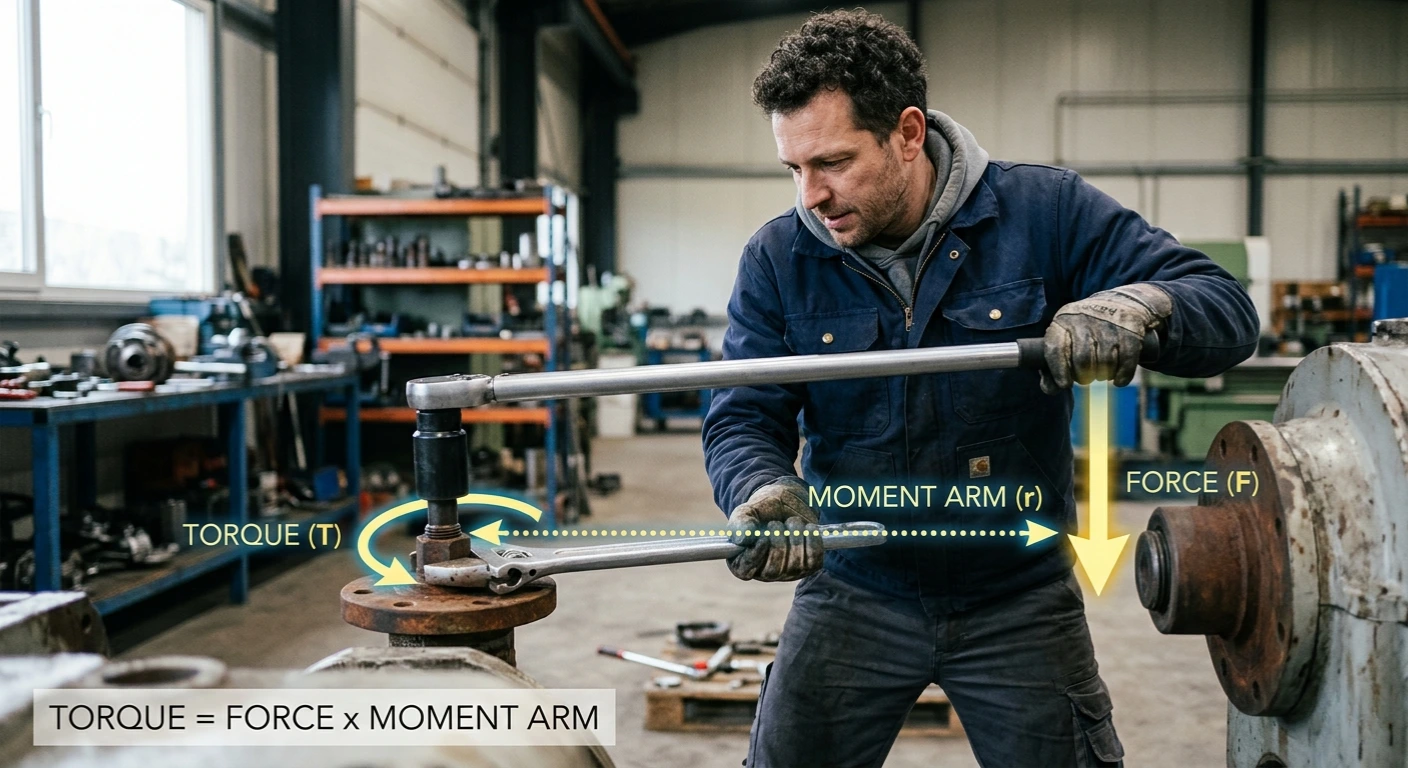
Figure: Torque depends on force and distance.
Example 1: Tightening a Bolt Using a Wrench
In real maintenance work, one of the most common tasks is tightening bolts.
Example:
- Force applied = 100 N
- Wrench length = 0.5 m
Torque = 100 × 0.5 = 50 Nm
Bolt Torque Chart (Standard Values)
In Gulf industries, technicians often use torque wrenches for this purpose to ensure accuracy.
Technicians often face issues when using shorter tools, which reduces torque without realizing it.
Example 2: Increasing Torque Using Longer Lever
In real industrial scenarios, when bolts are tight or rusted, technicians increase torque by increasing the lever length.
Example:
- Force = 80 N
- Distance = 1 m
Torque = 80 × 1 = 80 Nm
👉 Learn step-by-step method: How to Calculate Torque
This shows that even with less force, increasing distance increases torque.
A common mistake I’ve seen is applying excessive force instead of increasing leverage, which can damage tools or bolts.
Example 3: Torque Conversion in Field Work
In Gulf industries, equipment may use different units such as Nm and lb-ft.
Example:
100 Nm ≈ 73.76 lb-ft
Technicians often face confusion when switching between metric and imperial systems.
👉 Conversion guide: Nm to lb-ft Conversion
👉 For quick reference values:
Incorrect conversion can lead to under-tightening or over-tightening.
These torque calculation examples real life help technicians understand practical torque application in daily maintenance work.

Figure: Torque wrench used in industrial maintenance.
👉 Need quick torque calculation for this example? Use this: Torque Calculator Tool
Illustrative Torque Examples for Different Applications
| Application | Torque (Nm) | Use Case |
|---|---|---|
| Small bolts | 10–20 Nm | Light machinery |
| Medium bolts | 40–60 Nm | Automotive & maintenance |
| Heavy bolts | 80–120 Nm | Industrial equipment |
These values are illustrative examples only, not universal tightening specifications. Always use the equipment or fastener manufacturer's specified torque value for actual maintenance work.
👉 See more real scenarios: Torque vs RPM Explained
Common Mistakes in Torque Calculation
Technicians often make these mistakes:
- Ignoring wrench length
- Using wrong units
- Applying uneven force
- Not using torque wrench
👉 Avoid errors: Common Torque Mistakes
In real maintenance work, these mistakes lead to equipment failure or safety risks.
When to Apply Torque Calculation in Practice
Torque calculation is required in:
- Machine assembly
- Pipeline maintenance
- Motor installation
- Flange tightening
👉 Related: Motor Torque Calculation Explained
Understanding when and how to apply torque ensures proper operation and reduces maintenance issues.
Final Summary
These torque calculation examples – real-life help technicians apply theoretical knowledge in practical situations. Understanding how force and distance affect torque allows better decision-making in maintenance work.
In Gulf industries, proper torque application ensures safety, reliability, and long equipment life.
👉 Stop guessing torque values. Calculate accurately for real work: Torque Calculator (Nm to lb ft)
Frequently Asked Questions (FAQs)
What is torque calculation in real life?
It is the application of torque formula in practical situations such as tightening bolts or operating machinery.
Why is torque calculation important?
It ensures correct tightening and prevents equipment damage.
How do technicians calculate torque?
By multiplying applied force with distance using T = F × r.
What happens if torque is incorrect?
It can lead to loose bolts, leaks, or equipment failure.
Where is torque calculation used?
It is used in maintenance, assembly, and industrial operations.