Belt Length Calculator (Pulley & V-Belt Formula)

Belt length calculator for two-pulley open belt drives helps maintenance engineers and technicians estimate the required belt pitch length from pulley diameters and center distance.

This calculator is useful for V-belt and other open belt-drive applications where the pulley geometry is known. Enter the large pulley diameter, small pulley diameter, and center distance using the same unit system to calculate the approximate belt length.

Important: For V-belts, use the pulley pitch diameter required by the belt manufacturer’s specification. The calculated result is a geometric estimate and should be checked against the manufacturer’s standard belt length and allowable center-distance adjustment before installation.

Use the calculator below for a quick calculation, then verify the selected belt against the equipment and belt manufacturer’s specifications.

Enter Pulley Values

⚠️ Ensure all values are in the same unit for accurate results.

✔ Instant results
✔ No signup required
✔ Works for open belt systems


Enter pulley diameters and center distance to calculate belt length instantly.

Use this belt length calculator to quickly calculate belt size between two pulleys using diameter and center distance.

Enter Values

No signup required • Works instantly

✔ Instant calculation • No manual formula needed

Why Use a Belt Length Calculator?

Choosing the correct belt length is important for reliable power transmission and proper belt tension. A belt that is too short, too long, or incorrectly specified can cause installation problems, slipping, excessive vibration, and premature wear.

  • Calculate belt length quickly from pulley dimensions
  • Reduce manual calculation errors
  • Check belt requirements during replacement
  • Support maintenance and troubleshooting work
  • Compare calculated length with standard belt sizes

For industrial maintenance, the calculator provides a quick starting point. Final belt selection should always consider belt type, cross-section, manufacturer’s specifications, pulley condition, alignment, and the available center-distance adjustment.

When to Use a Belt Length Calculator

A belt length calculator is useful whenever a two-pulley belt drive needs to be installed, replaced, checked, or redesigned.

  • Replacing a worn or damaged belt
  • Installing a new pulley and belt arrangement
  • Checking belt length after changing pulley sizes
  • Estimating belt length during machine modification
  • Verifying measurements before ordering a replacement belt

For complete belt-drive analysis, belt length should be considered together with pulley speed, torque, belt speed, pulley alignment, and the required power transmission.

Torque Calculator  |  Pulley RPM Calculator

What Is Belt Length in a Pulley System

“Belt length” is the entire length of the belt that is needed to connect two pulleys in a belt drive system. This has a direct impact on how well equipment performs in real factories, as well as on power transfer and belt tension.

In the Gulf, where machines often work all the time in hot, dusty circumstances, even a tiny miscalculation in the length of the belt might make it overheat, slip, or break down too soon.

A belt that fits well keeps everything moving smoothly, keeps them in line, and puts less stress on shafts and bearings.

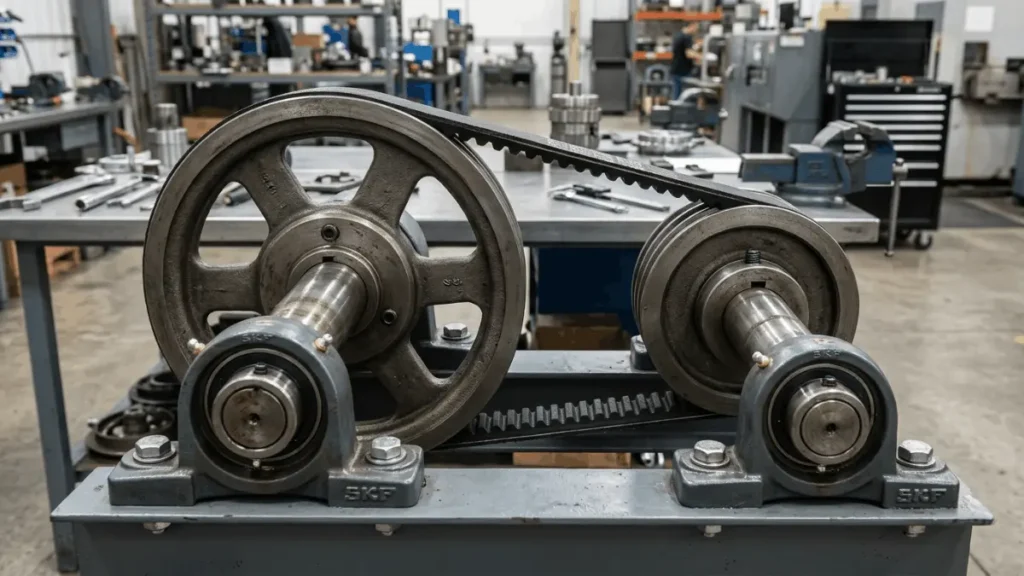
Belt length refers to the total length required to connect two pulleys in a belt drive system. Using a belt length calculator helps ensure accurate pulley alignment and proper belt tension in industrial systems.

belt drive system with two pulleys and belt diagram

Belt Length Formula Explained

For a standard open two-pulley belt drive, an approximate belt pitch-length formula is used to estimate the required belt length from the center distance and pulley pitch diameters.

L = 2C + (π/2)(D + d) + ((D − d)² / 4C)

Where:

Symbol Meaning
L Approximate belt pitch length
C Center distance between pulley shaft centers
D Large pulley pitch diameter
d Small pulley pitch diameter

Engineering note: For V-belt applications, pulley pitch diameter should be used where the belt manufacturer’s specification calls for pitch-length calculations. Do not automatically substitute outside diameter for pitch diameter.

This formula is an approximation for an open two-pulley drive. Actual belt selection also depends on the belt construction, cross-section, standard available lengths, pulley geometry, wrap angle, and manufacturer’s specifications.

Variable Meaning
L Belt Length
C Center distance between pulleys
D Diameter of large pulley
d Diameter of small pulley

This formula is widely used in maintenance calculations and engineering design.

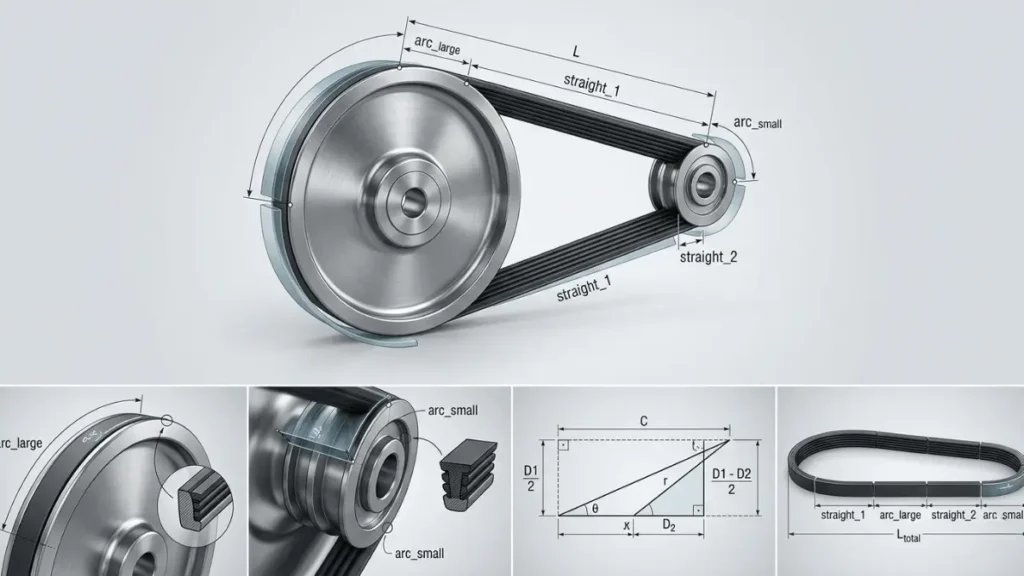
Belt and Pulley System Diagram

This diagram shows how belt length is distributed across pulleys and straight sections.

"belt length calculation diagram pulley system"

Example Belt Length Calculation

Let's calculate the approximate belt pitch length for a two-pulley open belt drive.

Given:

  • Large pulley pitch diameter (D) = 120 mm
  • Small pulley pitch diameter (d) = 80 mm
  • Center distance (C) = 400 mm

Step 1: Calculate 2C

2C = 2 × 400 = 800 mm

Step 2: Calculate the pulley diameter component

(π/2)(D + d)

= 1.5708 × (120 + 80)

= 314.16 mm

Step 3: Calculate the correction factor

(D − d)² / 4C

= (120 − 80)² / (4 × 400)

= 1,600 / 1,600

= 1.00 mm

Step 4: Calculate the final belt length

L = 800 + 314.16 + 1.00

Approximate belt pitch length = 1,115.16 mm

Important: This is the calculated geometric pitch length. The actual replacement belt should be selected from the manufacturer's standard belt-length range and verified against the required belt section and allowable center-distance adjustment.

For a quick calculation using your own pulley measurements, use the calculator above.

How Technicians Measure Belt Length in the Field

In real maintenance work, technicians may use direct measurement, existing belt information, or pulley measurements depending on the condition of the drive.

Method 1: Use the Existing Belt Information

If the existing belt is still identifiable, check its printed identification, manufacturer's part number, belt section, and specified length before ordering a replacement.

Method 2: Rope or Flexible Measuring Method

For an open belt drive, a flexible rope or suitable measuring method can be used to trace the belt path around both pulleys. Mark the measured length and compare it with the manufacturer's belt-length convention.

Method 3: Measure Pulley Geometry

Measure the center distance between the pulley shaft centers and obtain the correct pulley pitch diameters. Enter the measurements into the belt length calculator using the same unit system.

Important V-Belt Measurement Note

Do not assume that the outside length of a V-belt is the same as its pitch length. V-belts are specified using length conventions associated with their cross-section and manufacturer. Always verify the correct length designation before ordering a replacement.

Field tip: Before removing an old belt, record its identification and inspect the belt, pulley grooves, alignment, and tensioning arrangement. A new belt will not solve the underlying problem if the pulley system is worn or misaligned.

 In Gulf plants, due to dust and wear, old belts may stretch. Always verify before reuse.
technician measuring belt length using rope method in an industrial setting

Figure: Technician measuring belt length around an industrial pulley system using the rope method.

Common Belt Length Calculation Mistakes

These mistakes cause most failures:

  • Using outer diameter instead of pitch diameter
  • Incorrect center distance measurement
  • Ignoring pulley alignment
  • Mixing units (mm vs inches)
  • Not accounting for belt type

👉 One wrong input = wrong belt = downtime

Types of Belts Used in Belt Drives

Different belt types require slightly different calculation considerations.

V-Belt

Most common in industrial machines. Handles high load and friction.

Timing Belt

Used where synchronization is required. No slip allowed.

Flat Belt

Used in older or light-duty applications.

👉 Each belt type has slightly different measurement considerations.

Maintenance & Troubleshooting Insights

Belt performance depends on more than belt length. During maintenance, technicians should also inspect tension, pulley alignment, groove condition, contamination, temperature, and bearing condition.

Common Field Conditions

  • High temperature: Can accelerate belt aging and reduce service life.
  • Dust and contamination: Can contribute to slipping, wear, and reduced grip.
  • Pulley misalignment: Can increase belt wear, vibration, and tracking problems.
  • Excessive belt tension: Can increase loads on shafts, bearings, and other drive components.
  • Worn pulley grooves: Can prevent the belt from seating correctly and affect transmission performance.

In hot and dusty industrial environments such as plants in Saudi Arabia and the UAE, these checks are especially useful during planned preventive maintenance. Inspection frequency should follow the equipment manufacturer's recommendations and the site's maintenance program.

How to Use the Belt Length Calculator

  1. Select the required unit, such as millimeters or inches.
  2. Measure or obtain the large pulley pitch diameter.
  3. Measure or obtain the small pulley pitch diameter.
  4. Measure the center distance between the pulley shaft centers.
  5. Enter all three values using the same unit.
  6. Click Calculate to obtain the estimated belt length.
  7. Compare the result with available standard belt lengths and manufacturer specifications.

Before ordering: Confirm the belt type, belt section, length designation, pulley condition, and center-distance adjustment range. The calculator provides a geometric estimate; it does not replace the belt manufacturer's selection data.

Related Maintenance Calculators

Use these tools together when analyzing a belt-drive system:

Using belt length, pulley speed, and torque together gives a more complete view of belt-drive performance.

Related Belt Calculation Guides

Continue learning with these practical belt-drive guides:

Practical Belt Drive Maintenance Checklist

Use this checklist during routine belt-drive inspection:

Inspection Why It Matters
Check belt tension Helps prevent slipping and excessive belt loading
Inspect pulley alignment Reduces tracking problems and uneven wear
Inspect belt for cracks, glazing, or wear Helps identify deterioration before failure
Check pulley grooves Ensures proper belt seating and contact
Check contamination and dust Helps maintain grip and reduce abrasive wear
Monitor abnormal temperature or noise Can reveal overload, misalignment, or bearing problems

Always follow the equipment manufacturer's maintenance instructions and the site's preventive-maintenance procedure.

Frequently Asked Questions

How do you calculate belt length between two pulleys?

For an open two-pulley drive, the approximate belt pitch length can be calculated using L = 2C + (π/2)(D + d) + ((D − d)² / 4C), where C is center distance and D and d are the large and small pulley pitch diameters.

What measurements are needed to calculate belt length?

You generally need the large pulley pitch diameter, small pulley pitch diameter, and center distance between the pulley shaft centers. All measurements must use consistent units.

What happens if the belt length is wrong?

An incorrect belt length can cause poor tension, slipping, vibration, installation problems, accelerated wear, and unreliable power transmission.

How do I measure V-belt length?

Check the belt identification or manufacturer's specification when possible. You can also determine the required pitch length from pulley pitch diameters and center distance, then verify the result against the available standard belt sizes.

Does pulley size affect belt length?

Yes. For the same center distance, changing either pulley diameter changes the calculated belt length. The difference between the pulley diameters also affects the correction term in the formula.

Is calculated belt length the same as the belt I should order?

Not necessarily. The calculated value is a geometric estimate. The final belt should be selected using the correct belt type, cross-section, length designation, manufacturer specifications, and available center-distance adjustment.

Final Takeaway

A belt length calculator makes two-pulley belt-drive calculations faster, but accurate belt selection requires more than a single length value.

Measure the pulley geometry correctly, use the appropriate pitch diameter where required, keep all units consistent, and verify the calculated length against the manufacturer's standard belt specifications.

For industrial maintenance, also inspect pulley alignment, belt condition, tension, groove wear, contamination, and operating temperature before installing a replacement belt.

Calculate Belt Length Now

Scroll to Top