
Torque and Power Relationship Explained (Simple + Practical Guide)
Torque and power relationship is critical in real maintenance work, especially when machines underperform even with high torque.
Many engineers and technicians assume torque alone defines performance, but in real industrial systems, power depends on both torque and speed. Ignoring this relationship leads to wrong motor selection, overheating, and efficiency loss.
👉 Calculate torque instantly: Torque Calculator (Nm to lb ft)
What is Torque and Power Relationship?
Torque and power relationship explained shows that torque provides force while power depends on how quickly that force is applied through rotational speed.
In simple terms, torque and power are connected through rotational speed. Torque represents the turning force, while power represents how fast that force is applied.
The basic relationship is:
Power = Torque × Speed
In real maintenance work, technicians often face confusion because they focus only on torque values and ignore speed (RPM). A machine can have high torque but still produce low power if speed is low.
👉 Learn basics: What is Torque in Engineering
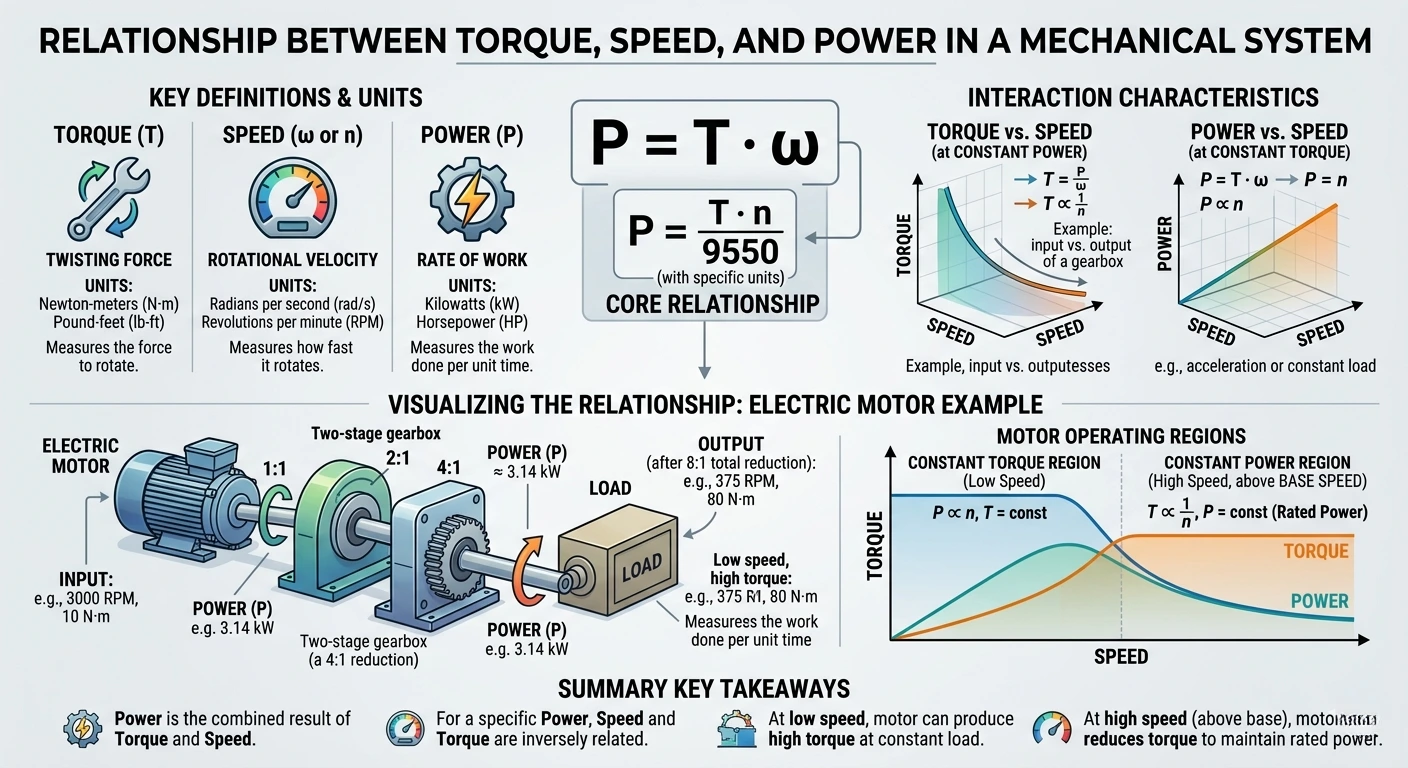
Diagram showing how torque and speed combine to produce power.
How Torque and Power Work Together (Step-by-Step)
In real maintenance work, understanding this relationship is critical when dealing with motors, pumps, and rotating equipment.
- Step 1: Torque provides the turning force
- Step 2: Speed (RPM) determines how fast rotation happens
- Step 3: Power is the result of torque applied at that speed
Technicians often face situations where increasing torque alone does not improve performance because speed drops under load.
👉 Related concept: Torque vs RPM Explained
A common mistake I’ve seen is selecting a motor based only on torque rating without considering RPM, leading to inefficient operation.
Real Industrial Example (Gulf Maintenance Scenario)
In Gulf industries like oil & gas and manufacturing plants, this concept becomes very practical.
In real maintenance work, consider a pump motor:
- High torque motor → can handle heavy load
- But if RPM is low → output flow is reduced
Technicians often face issues where:
- Motor runs but output is weak
- Machine overheats due to overload
The real issue is not torque alone — it’s the torque and power relationship.
👉 Practical reference: Motor Torque Calculation Explained
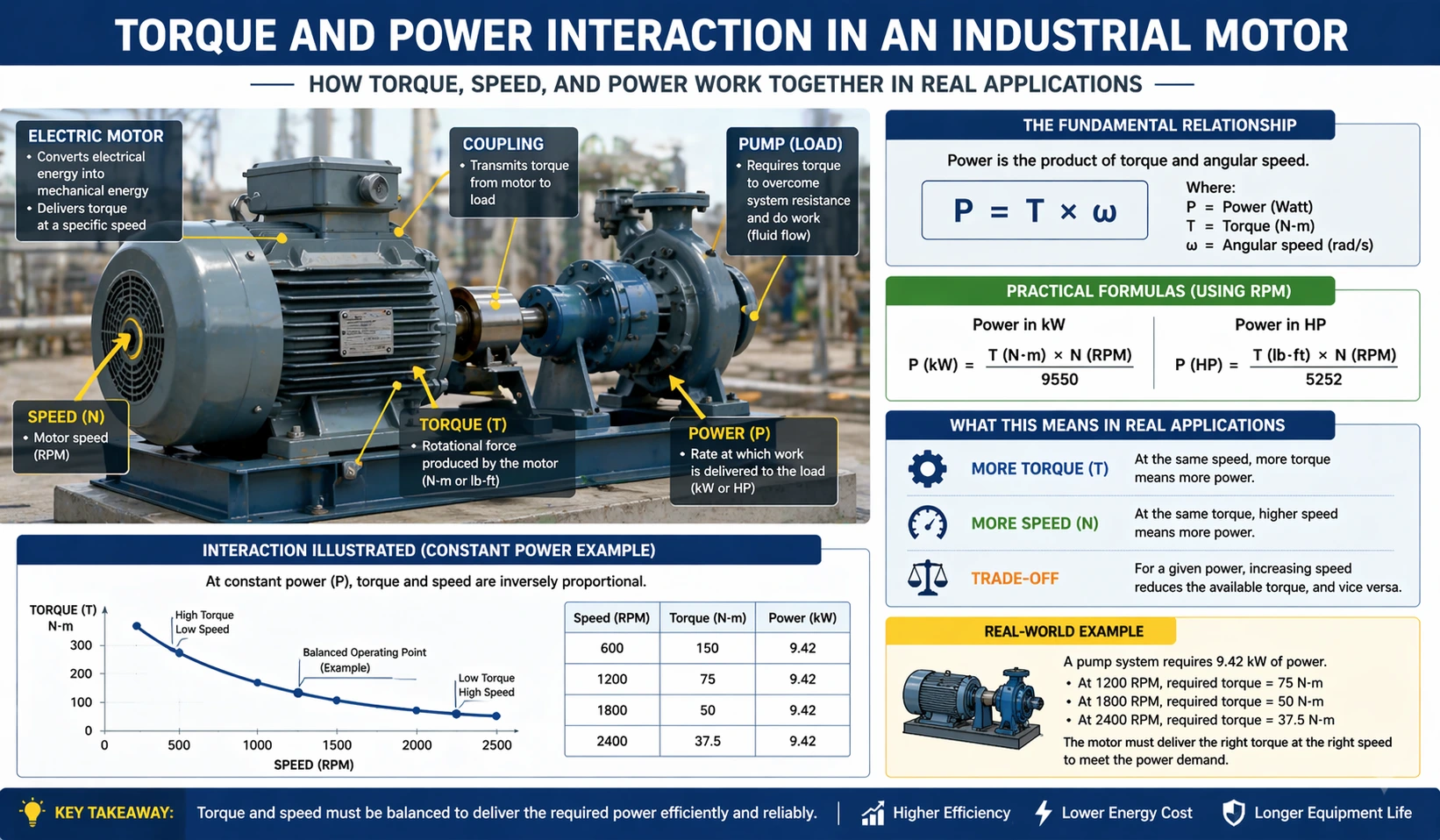
Industrial motor where torque and power directly affect performance.
Practical Use Cases in Maintenance Work
In real maintenance work, torque and power relationship is used in:
- Motor selection
- Gearbox design
- Pump performance analysis
- Conveyor systems
In Gulf industries, technicians often need to decide whether to increase torque or speed depending on application.
👉 Conversion reference: Torque Conversion Chart
For example:
- Heavy load → high torque needed
- High speed operation → power becomes critical
Common Mistakes in Understanding Torque and Power
A common mistake I’ve seen in field work is assuming torque alone determines machine performance.
- Ignoring RPM effect
- Wrong unit conversion
- Using incorrect torque values
👉 Troubleshooting guide: Common Torque Problems and Solutions
Technicians often face repeated failures because they do not consider the full relationship.
👉 Ensure tool accuracy: Torque Wrench Calibration Guide
Torque vs Power Decision Table
| Condition | Focus | Action | Use Case |
|---|---|---|---|
| Heavy Load | Torque | Increase torque | Lifting systems |
| High Speed | Power | Increase RPM | Fans, pumps |
| Balanced Operation | Both | Optimize system | Conveyors |
When to Focus on Torque vs Power
In real maintenance work, decision-making depends on application:
- Use torque when load is heavy
- Use power when speed is critical
- Use both when efficiency matters
👉 Learn performance impact: How Torque Affects Machine Performance
Technicians often face confusion when machines underperform, but the real issue is imbalance between torque and power.
In real maintenance work, I have seen many cases where motors were replaced unnecessarily because technicians focused only on torque values. In Gulf industries, especially in pumps and compressors, ignoring the torque and power relationship leads to energy loss, overheating, and repeated failures.
Final Summary
Torque and power relationship is essential for understanding machine performance. Torque alone does not define efficiency — speed plays an equal role.
In real maintenance work, correct understanding helps avoid equipment failure, improve efficiency, and ensure proper system design.
👉 Stop guessing machine performance. Calculate accurately: Use Torque Calculator Tool
Frequently Asked Questions (FAQs)
What is the relationship between torque and power?
Power is the product of torque and rotational speed, meaning both must work together.
Can high torque mean high power?
No, power depends on both torque and speed.
Why is RPM important in power calculation?
RPM determines how fast torque is applied, directly affecting power.
Where is torque more important than power?
In heavy load applications like lifting and machinery.
How can I calculate torque easily?
You can use an online torque calculator for quick and accurate results.