
How to Calculate Belt Speed Step by Step
A conveyor that suddenly starts spilling material or an HVAC blower that no longer delivers the expected airflow often has a hidden cause: incorrect belt speed. Many maintenance teams spend hours troubleshooting motors, bearings, and vibration issues before discovering that the belt drive is operating at the wrong speed.
Knowing how to calculate belt speed correctly helps technicians identify performance losses before they become costly downtime events. If you need a quick result, you can use the Belt Speed Calculator to instantly determine belt velocity from pulley diameter and RPM values.
What Is Belt Speed?
Belt speed is the linear velocity at which a belt travels around rotating pulleys. In industrial machinery, belt speed directly affects production output, airflow, equipment efficiency, power transmission, and component life.
A belt drive system typically consists of motors, shafts, pulleys, bearings, couplings, and transmission belts working together to transfer power from one rotating component to another. If the belt speed is too high or too low, equipment performance can suffer significantly.
Technicians commonly verify belt speed during equipment commissioning, preventive maintenance inspections, vibration investigations, and troubleshooting activities involving rotating machinery.
Why Belt Speed Matters in Industrial Equipment
Belt speed influences much more than belt movement alone. It affects machine performance throughout the entire power transmission system.
- Conveyor throughput and production rate
- HVAC airflow and ventilation efficiency
- Pump and compressor performance
- Bearing operating temperature
- Shaft loading and alignment behavior
- Motor efficiency and torque transfer
- Vibration levels throughout machinery
For example, increasing pulley diameter without considering belt velocity may improve production output but can also increase vibration, accelerate bearing wear, and shorten belt life.
Many engineers investigating performance problems also compare findings with topics such as Belt Speed Formula Explained, Conveyor Belt Speed Calculation, and Pulley Diameter and Belt Speed Relationship to understand the root cause of speed-related failures.
Belt Speed Formula Explained
The calculation itself is straightforward. Belt speed depends on two primary variables:
- Pulley diameter
- Rotational speed (RPM)
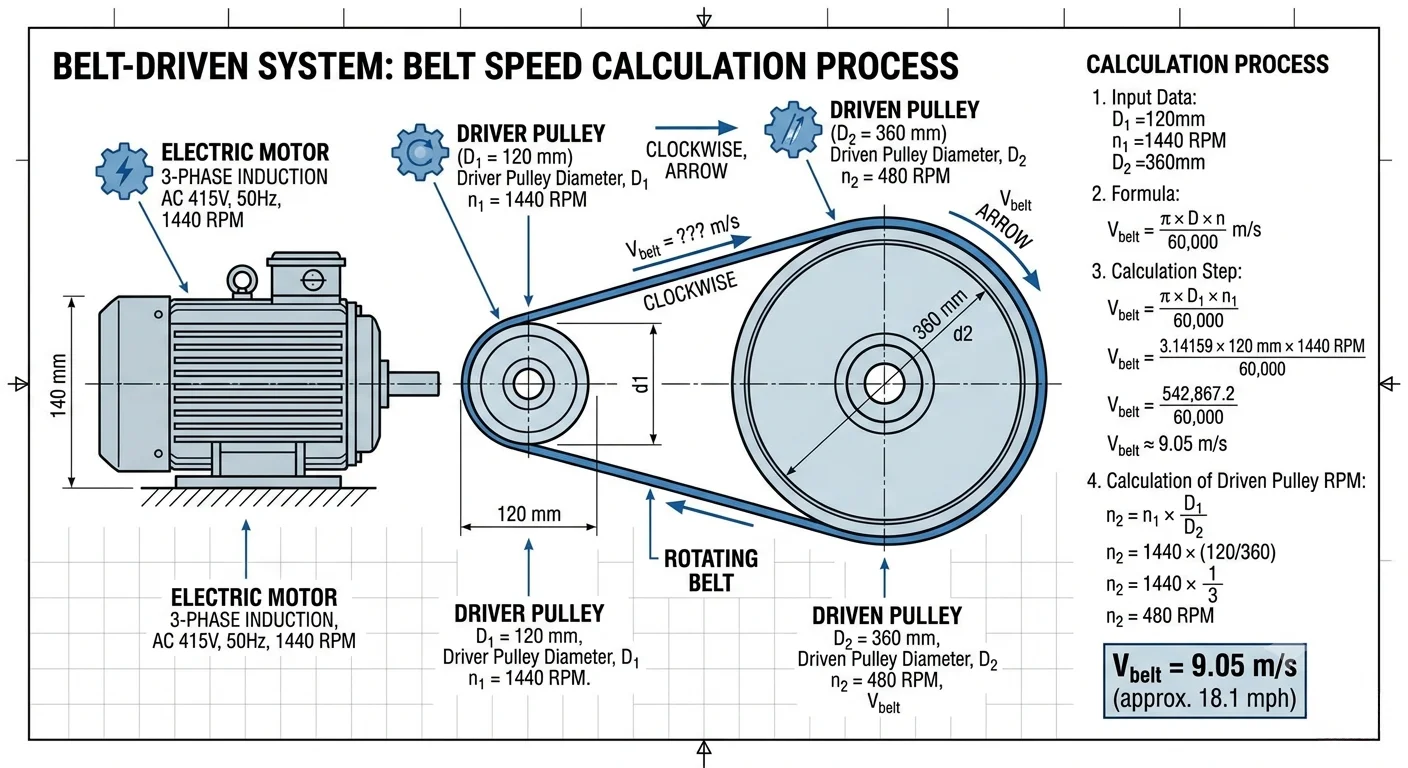
The standard engineering formula is:
The formula calculates the distance traveled by the pulley circumference during each revolution and converts that movement into velocity per second.
Before performing the calculation, ensure pulley diameter is converted into meters if measurements are taken in millimeters or inches.
How to Calculate Belt Speed Step by Step
- Measure the driver pulley diameter.
- Identify motor or shaft RPM from the nameplate or tachometer.
- Convert pulley diameter into meters if required.
- Apply the belt speed formula.
- Verify the result against equipment operating requirements.
- Inspect actual operating conditions for slip or mechanical losses.
- Energy consumption and operating costs
- Belt service life and maintenance intervals
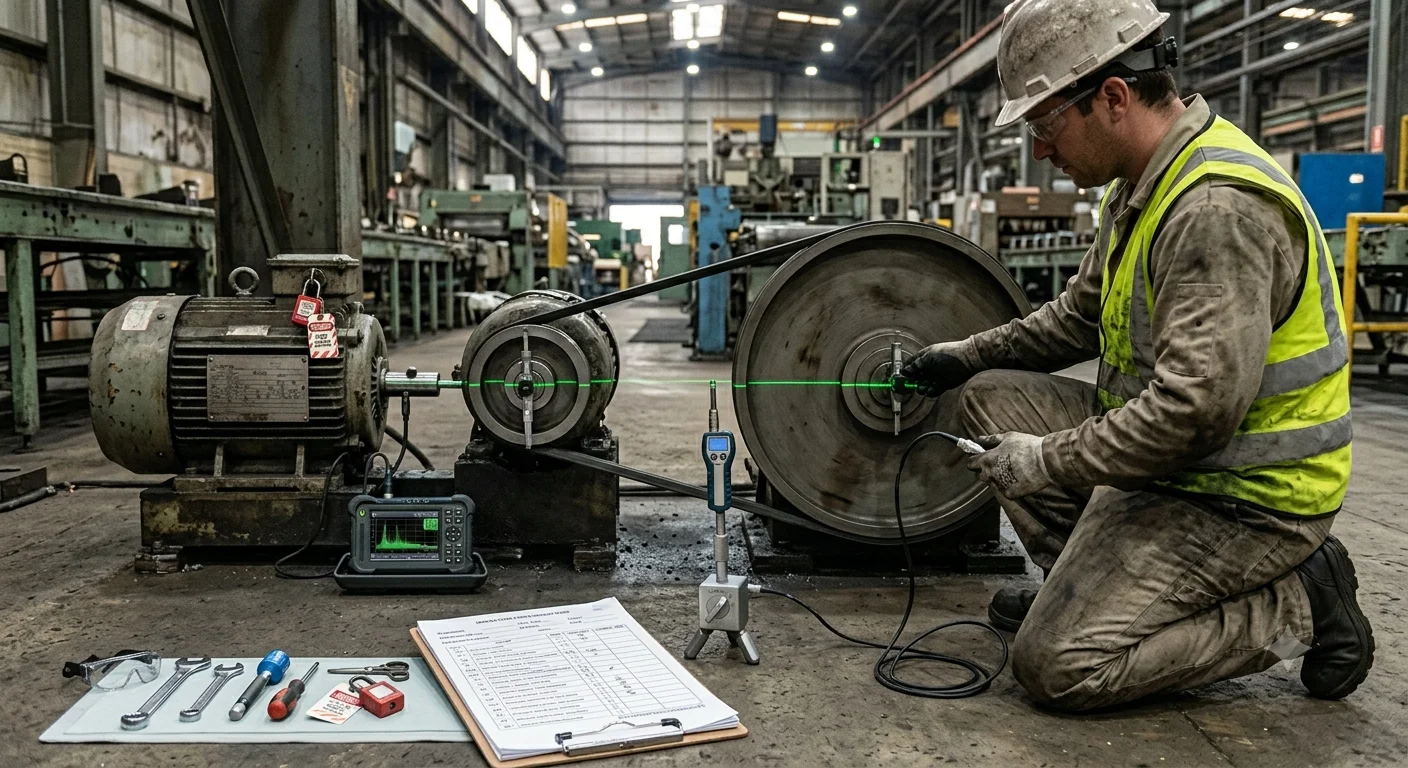
Maintenance technicians often use digital calipers, laser tachometers, alignment tools, and vibration analyzers when validating field measurements.
When measuring belt drives in the field, always verify pulley wear, shaft alignment, lubrication condition, and belt tension before trusting calculated values. These factors can affect actual operating speed.
Example Belt Speed Calculation
Let's calculate the belt speed for a common industrial drive system.
- Pulley Diameter = 200 mm
- RPM = 1450
Convert diameter to meters:
200 mm = 0.2 m
Apply the formula:
Belt Speed = (3.1416 × 0.2 × 1450) ÷ 60
Result:
15.18 m/s
The table below shows typical industrial examples.
| Equipment | Pulley Diameter | RPM | Belt Speed | Use Case |
|---|---|---|---|---|
| Packaging Conveyor | 150 mm | 900 | 7.07 m/s | Material Transfer |
| HVAC Blower | 200 mm | 1450 | 15.18 m/s | Airflow Generation |
| Industrial Fan | 250 mm | 1750 | 22.91 m/s | Ventilation System |
Common Belt Speed Calculation Mistakes
Many failures occur because technicians make small measurement errors that create large speed deviations.
- Using driven pulley diameter instead of driver pulley diameter
- Mixing millimeters and meters
- Ignoring belt slip
- Using unloaded RPM values
- Failing to verify pulley wear
- Ignoring shaft misalignment
Incorrect belt speed can create hidden symptoms such as excessive vibration, abnormal bearing temperatures, motor overload, airflow imbalance, and reduced production capacity.
These issues often appear long before equipment failure becomes visible.
If repeated calculations still don't match the measured operating speed, investigate the complete drive system rather than assuming the calculation is incorrect. Inspect belt tension, pulley alignment, shaft condition, bearings, and motor RPM before replacing components.
For a structured diagnostic process, read the Belt Speed Troubleshooting Guide.
Continue Learning About Belt Speed
After learning how to calculate belt speed, the next step is understanding whether the calculated value is appropriate for your application, how pulley dimensions influence speed, and how to diagnose performance problems in the field.
Calculation Fundamentals
- Belt Speed Formula Explained – Understand the engineering formula behind belt speed calculations.
- RPM to Belt Speed Formula and Calculation – Convert shaft RPM into belt speed using practical examples.
- Pulley Diameter and Belt Speed Relationship – Learn how pulley size changes belt velocity.
Performance Optimization
Troubleshooting
Engineering Tools
Real-World Engineering Insight
In Gulf industrial facilities across Saudi Arabia, UAE, Qatar, and Kuwait, belt speed verification is often included during shutdown maintenance activities because extreme heat and airborne dust accelerate wear on belts, pulleys, bearings, and couplings.
Field technicians frequently encounter situations where a conveyor, blower, or pump appears mechanically healthy, yet performance continues to decline. In many cases, the root cause is incorrect belt speed caused by pulley wear, improper replacement parts, tension loss, or accumulated contamination.
Experienced maintenance engineers rarely rely on visual inspection alone. They verify RPM, check pulley condition, inspect alignment, review lubrication practices, measure vibration levels, and compare actual operating speed against calculated values.
A practical recommendation is to record baseline belt speed immediately after commissioning. This provides a reference point for future inspections and helps identify gradual performance deterioration before unplanned downtime occurs.
Frequently Asked Questions
How do you calculate belt speed manually?
Multiply π by pulley diameter in meters and RPM, then divide the result by 60.
What is the formula for belt speed?
Belt Speed (m/s) = (π × Pulley Diameter × RPM) ÷ 60.
Does pulley diameter affect belt speed?
Yes. Increasing pulley diameter increases belt speed if RPM remains constant.
Why is actual belt speed lower than calculated speed?
Belt slip, pulley wear, contamination, and load conditions can reduce actual operating speed.
What tools are used to measure belt speed?
Technicians commonly use laser tachometers, contact tachometers, digital calipers, and vibration monitoring equipment.
What is a good belt speed for industrial equipment?
The ideal belt speed depends on the application. Conveyors, fans, pumps, and compressors all operate within different recommended ranges.
Should belt speed be verified after replacing pulleys?
Yes. Even small changes in pulley diameter can significantly affect belt speed. After replacing pulleys, always verify pulley dimensions, calculate the new belt speed, and compare it with the equipment manufacturer's recommended operating range.
Recommended Next Steps
Now that you know how to calculate belt speed, continue with these practical engineering resources to optimize performance and diagnose belt drive problems.