
Pulley Diameter and Belt Speed Relationship
A conveyor, fan, or other belt-driven machine can suddenly begin performing differently even though the motor RPM has not changed. In many industrial facilities, the real cause is neither motor failure nor belt damage—it is a change in pulley diameter that directly affects belt speed, equipment output, and overall system performance.
Understanding the pulley diameter and belt speed relationship helps maintenance technicians, engineers, and reliability teams diagnose speed-related issues, optimize production systems, and avoid costly mistakes during pulley replacement projects. If you need an instant calculation, use the Belt Speed Calculator to quickly determine how pulley size affects belt velocity.
Whether you are troubleshooting a conveyor system, HVAC blower, industrial fan, compressor, pump, or manufacturing machine, pulley diameter is one of the most important variables affecting belt drive performance.
What Is Pulley Diameter?
Pulley diameter is the distance measured across the pulley from one outer edge to the opposite edge through its center. In belt-driven systems, pulley diameter directly determines how much belt travels during each revolution.
A larger pulley moves more belt per revolution, while a smaller pulley moves less. Because of this relationship, pulley diameter plays a major role in determining belt speed, driven RPM, airflow, conveyor throughput, and overall machine performance.
Most industrial belt drive systems include components such as motors, shafts, pulleys, bearings, couplings, belts, and alignment devices working together to transfer power efficiently.
Maintenance personnel frequently measure pulley diameter during:
- Pulley replacement projects
- Belt drive troubleshooting
- Preventive maintenance inspections
- Equipment upgrades
- Speed optimization studies
- Production improvement initiatives
Accurate pulley measurements are essential because even small diameter changes can significantly affect operating speed.
How Pulley Diameter Affects Belt Speed
The relationship between pulley diameter and belt speed is direct and proportional. When RPM remains constant, increasing pulley diameter increases belt speed. Reducing pulley diameter decreases belt speed.
This happens because a larger pulley has a greater circumference. Each revolution moves a longer section of belt, resulting in higher linear velocity.
For example:
- Same RPM + Larger Pulley = Higher Belt Speed
- Same RPM + Smaller Pulley = Lower Belt Speed
This principle is used throughout industrial maintenance and machine design. Engineers often modify pulley diameters to increase conveyor throughput, improve fan airflow, optimize pump performance, or adjust machine operating speed without replacing motors.
Many technicians investigating speed-related problems first review resources such as How to Calculate Belt Speed Step by Step, Belt Speed Formula Explained, and Conveyor Belt Speed Calculation before making pulley changes.
Pulley Diameter and Belt Speed Formula
The pulley diameter and belt speed relationship can be calculated using the standard belt speed formula:
Where:
- π (Pi) = 3.1416
- Pulley Diameter = Diameter of the driving pulley in meters
- RPM = Rotational speed of the pulley
- 60 = Conversion from minutes to seconds
The formula shows that pulley diameter directly affects belt speed. If RPM stays constant and pulley diameter doubles, belt speed also doubles.
This relationship explains why pulley sizing is such an important consideration during equipment design, maintenance planning, and performance troubleshooting.
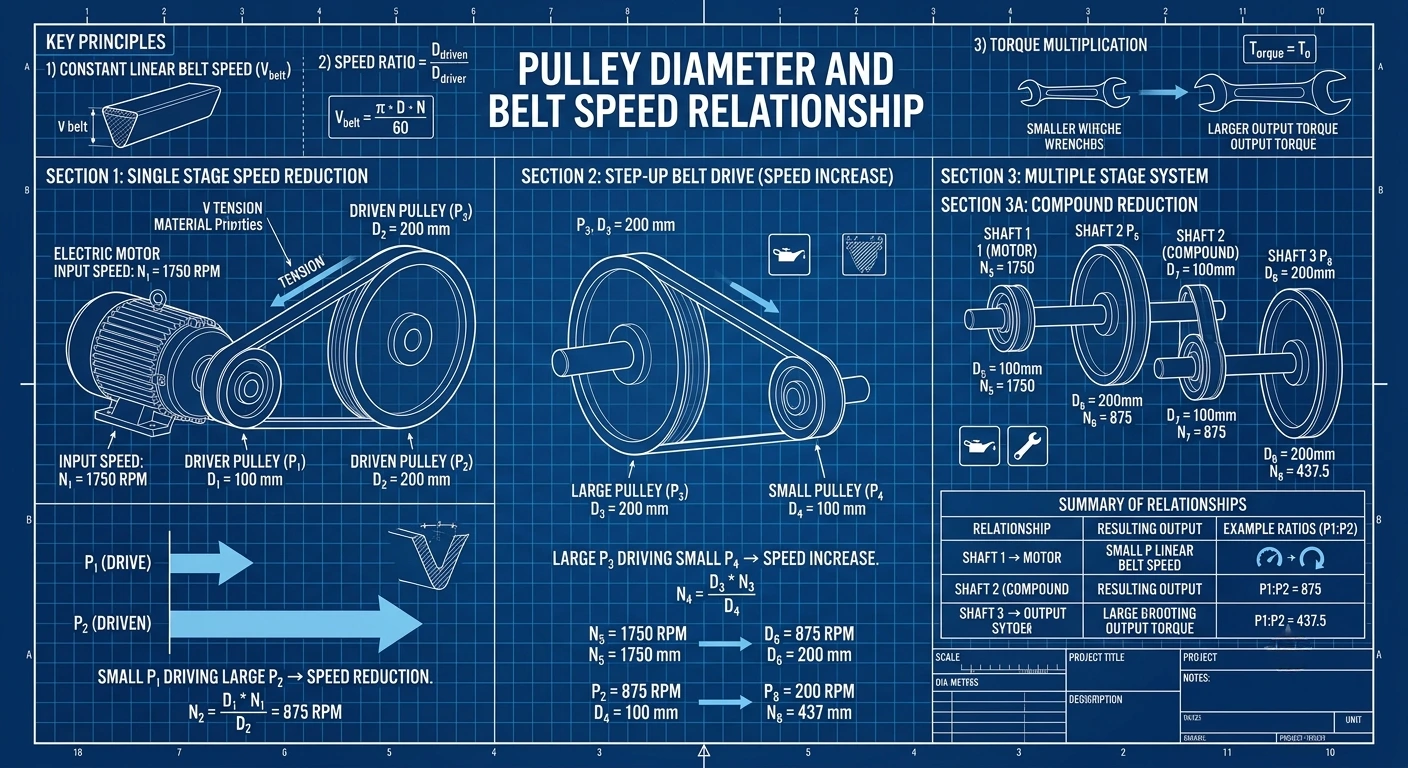
Pulley Diameter vs Belt Speed Comparison
The table below demonstrates how pulley diameter influences belt speed when RPM remains constant. This comparison helps maintenance teams understand why even small pulley size changes can significantly affect machine performance.
| Pulley Diameter | RPM | Belt Speed | Typical Application |
|---|---|---|---|
| 100 mm | 1450 | 7.59 m/s | Small Machinery |
| 150 mm | 1450 | 11.39 m/s | Packaging Equipment |
| 200 mm | 1450 | 15.18 m/s | HVAC Systems |
| 300 mm | 1450 | 22.77 m/s | Conveyor Systems |
The comparison clearly shows that larger pulleys generate higher belt speeds at the same RPM. This relationship is frequently used by engineers when optimizing conveyor systems, HVAC blowers, industrial fans, and production equipment.
Real Calculation Examples
Consider a conveyor system operating at 1500 RPM with a 150 mm drive pulley.
Using the formula:
Belt Speed = (3.1416 × 0.15 × 1500) ÷ 60
Result:
11.78 m/s
Now assume the pulley is replaced with a 250 mm pulley while RPM remains unchanged.
New Belt Speed = (3.1416 × 0.25 × 1500) ÷ 60
Result:
19.63 m/s
This single pulley change increases belt speed by more than 66%. In a conveyor application, throughput would increase significantly. In an HVAC application, airflow could rise enough to alter system balancing and energy consumption.
This example demonstrates why pulley diameter verification is a critical part of maintenance inspections and troubleshooting procedures.
Instead of performing manual calculations repeatedly, technicians often use the Belt Speed Calculator to instantly evaluate how pulley diameter changes affect belt velocity and machine performance.
Common Pulley Sizing Mistakes
Many speed-related equipment problems originate from incorrect pulley sizing decisions rather than motor failures or belt defects.
One common mistake occurs when replacement pulleys are ordered using nominal dimensions instead of verified field measurements. A pulley that appears identical may have a slightly different effective diameter, creating unexpected speed changes.
Another issue is pulley groove wear. Over time, V-belt grooves wear deeper, altering the effective pitch diameter. Although the physical pulley size appears unchanged, actual belt speed may gradually drift away from design specifications.
Technicians should also avoid assuming that a larger pulley is always beneficial. Excessive belt speed can increase vibration, bearing loads, heat generation, and belt wear.
During preventive maintenance activities, it is good practice to verify pulley dimensions using calibrated measuring tools, compare findings against design specifications, and inspect belts, bearings, shafts, and alignment conditions at the same time.
Maintenance teams investigating speed-related issues often discover that pulley sizing errors create symptoms similar to belt slip, motor problems, bearing failures, or alignment issues.
Production and Maintenance Impact
The relationship between pulley diameter and belt speed extends far beyond simple calculations. In real industrial environments, pulley sizing directly affects production output, equipment reliability, energy consumption, and maintenance requirements.
In conveyor systems, increasing pulley diameter can improve throughput by moving more material within the same operating period. However, excessive speed may also increase material spillage, transfer point wear, and maintenance demands.
In HVAC applications, pulley diameter adjustments directly affect fan speed and airflow. A larger pulley may increase airflow, while a smaller pulley can reduce system performance and cooling capacity.
Industrial fans, pumps, compressors, and manufacturing machinery also rely on correct pulley sizing to maintain design operating conditions. Even minor diameter changes can affect process stability, equipment efficiency, and product quality.
For this reason, maintenance teams should always verify pulley dimensions whenever unexpected speed changes, vibration issues, or production losses occur.
Engineers often combine pulley sizing analysis with other maintenance calculations available in the Mechanical Calculators Hub to evaluate overall belt drive performance and troubleshoot speed-related equipment issues.
Continue Learning About Pulley Diameter and Belt Speed
Understanding how pulley diameter affects belt speed is only one part of belt drive optimization. Continue with the following engineering resources to calculate belt speed accurately, evaluate pulley sizing decisions, and troubleshoot real-world performance problems.
Calculation Fundamentals
- Belt Speed Calculator – Instantly calculate belt speed using pulley diameter and RPM.
- How to Calculate Belt Speed – Learn the complete calculation process.
- Belt Speed Formula Explained – Understand the engineering formula behind belt speed calculations.
Performance Optimization
Troubleshooting
Real-World Engineering Insight
Across Gulf manufacturing facilities, HVAC installations, cement plants, logistics centers, and process industries, pulley sizing mistakes are more common than many maintenance teams realize.
During shutdown inspections, technicians frequently discover replacement pulleys that differ slightly from original equipment specifications. While the difference may appear minor, it can significantly affect belt speed, airflow, throughput, and equipment performance.
Experienced maintenance personnel therefore verify pulley dimensions before replacing motors or redesigning systems. In many cases, correcting pulley size restores equipment performance without requiring major mechanical modifications.
During preventive maintenance programs, teams commonly inspect bearings, shafts, couplings, lubrication condition, pulley alignment, vibration levels, and motor performance to determine whether pulley diameter changes are affecting equipment reliability.
One practical recommendation is to record pulley dimensions during equipment commissioning and maintain these values as part of maintenance documentation. Historical records often simplify troubleshooting years later.
Frequently Asked Questions
Does pulley diameter affect belt speed?
Yes. Increasing pulley diameter increases belt speed when RPM remains constant. Reducing pulley diameter decreases belt speed.
Can pulley wear change belt speed?
Yes. Worn pulley grooves alter the effective pitch diameter, which can gradually change belt speed and system performance.
Why did conveyor speed change after pulley replacement?
The replacement pulley may have a different effective diameter than the original pulley, resulting in a change in belt speed and throughput.
How do technicians measure pulley diameter?
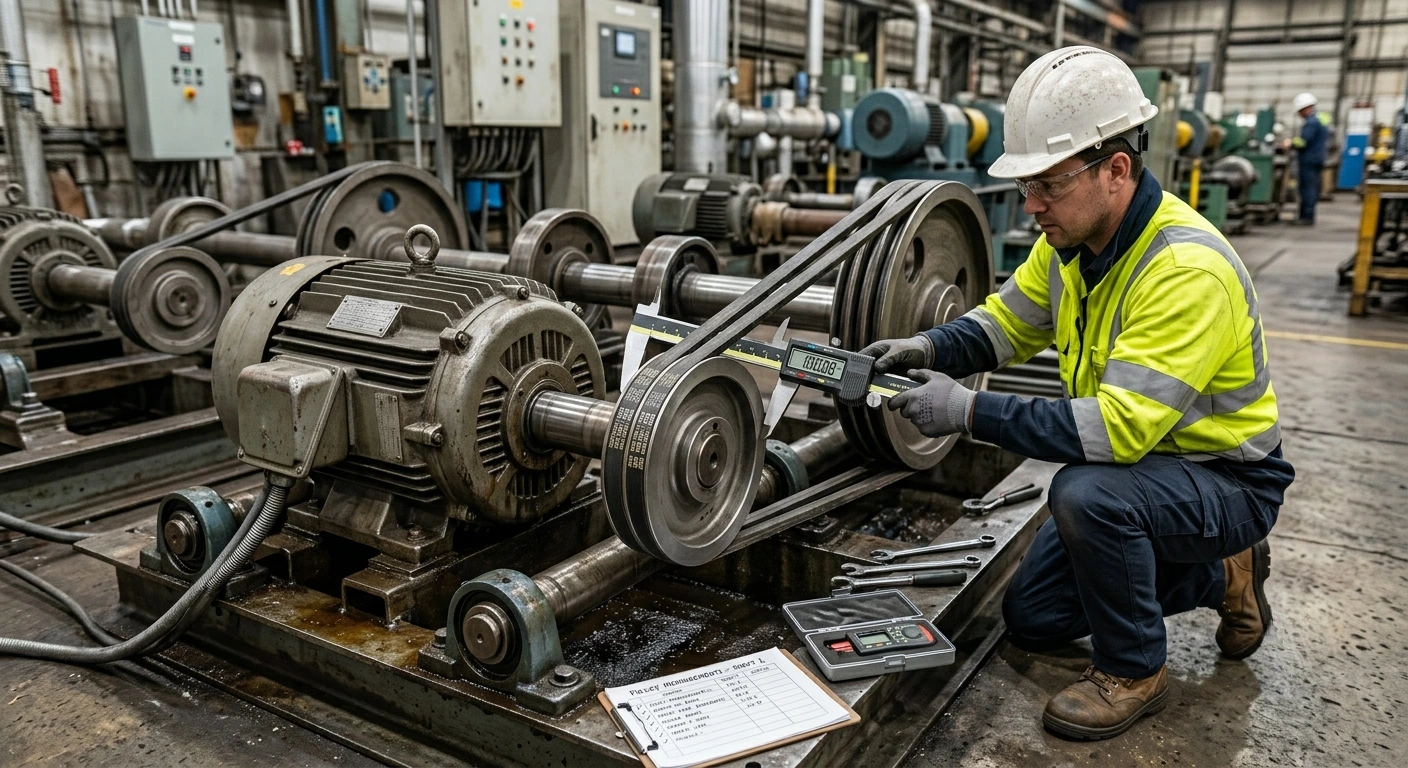
Technicians commonly use calipers, measuring tapes, and engineering drawings to verify pulley dimensions during inspections and maintenance activities.
Does pulley diameter affect HVAC airflow?
Yes. Pulley diameter directly influences fan speed, which affects airflow, cooling performance, and system balancing.
When should a pulley be replaced?
A pulley should be replaced when excessive groove wear, cracking, damage, misalignment, or performance issues are identified during inspection.
Should pulley diameter be measured before replacing a pulley?
Yes. Always verify the original pulley diameter before ordering or installing a replacement. Even small differences in pulley size can change belt speed, driven equipment performance, and overall system efficiency.
Recommended Next Steps
Continue exploring these engineering resources to better understand pulley sizing, belt speed calculations, and industrial belt drive optimization.