
Belt Speed in ft/min Conversion Guide
Belt speed ft/min conversion guide is essential for engineers and maintenance technicians who work with conveyor systems, HVAC drives, and industrial belt-driven equipment. A conveyor can be running at the correct speed while maintenance reports still show incorrect performance data because of unit conversion mistakes.
Understanding belt speed in ft/min conversion helps engineers, technicians, and maintenance planners interpret equipment specifications correctly, compare operating data across different systems, and avoid costly unit conversion mistakes. For quick calculations, use the Belt Speed Calculator to instantly calculate belt velocity and verify performance.
This guide explains how belt speed is converted into feet per minute (ft/min), why imperial units are still widely used, and how technicians apply these values in real industrial environments.
What Does ft/min Mean?
ft/min stands for feet per minute. It is a unit of linear speed that describes how many feet of belt travel past a fixed point within one minute.
Although many engineering calculations use metric units such as meters per second (m/s), numerous industrial systems, equipment manuals, and manufacturer specifications still rely on ft/min.
The unit is commonly used in:
- Conveyor systems
- HVAC fan drives
- Material handling equipment
- Mining conveyors
- Manufacturing machinery
- Packaging systems
Because many international facilities operate with both metric and imperial standards, technicians often convert between m/s and ft/min during inspections, troubleshooting, and reporting activities.
This belt speed ft/min conversion guide helps maintenance teams convert metric speed measurements into imperial units used by many equipment manufacturers and engineering standards.
Why Belt Speed Is Often Measured in ft/min
Many OEM (Original Equipment Manufacturer) equipment manufacturers continue using imperial units in engineering documentation, particularly in North America and industries that follow older equipment standards.
As a result, maintenance teams frequently encounter conveyor specifications, belt recommendations, and operating limits expressed in feet per minute rather than meters per second.
For example:
- Conveyor throughput ratings may use ft/min
- Fan drive specifications may use ft/min
- Belt manufacturer recommendations often reference ft/min
- Maintenance manuals may provide inspection limits in ft/min
Understanding both measurement systems helps technicians compare equipment performance accurately and avoid specification errors.
Engineers evaluating belt drive performance often review resources such as How to Calculate Belt Speed Step by Step, Belt Speed Formula Explained, and RPM to Belt Speed Formula and Calculation when validating belt speed measurements.
How to Convert Belt Speed to ft/min
Converting belt speed into feet per minute is straightforward once the metric value is known.
The standard conversion factor is:
To convert meters per second into feet per minute:
ft/min = m/s × 196.85
For example:
10 m/s × 196.85 = 1,968.5 ft/min
This conversion is commonly used when comparing metric calculations against manufacturer recommendations that use imperial units.
Technicians also reference the Conveyor Belt Speed Calculation guide and the Pulley Diameter and Belt Speed Relationship article when validating conversion results during troubleshooting.
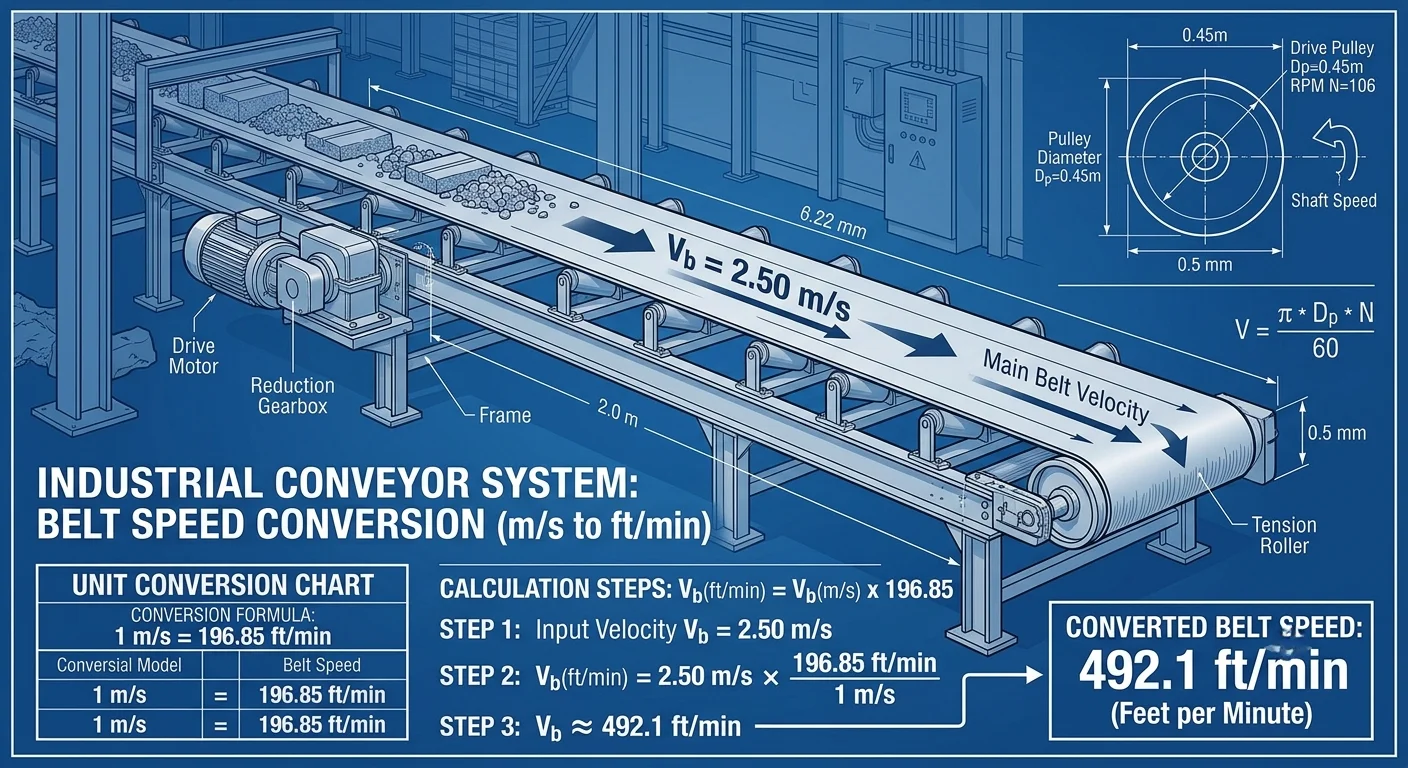
m/s to ft/min Conversion Examples
Understanding real conversion examples helps technicians quickly interpret manufacturer specifications and compare equipment performance across different measurement systems.
Suppose a conveyor belt is operating at 5 m/s.
Using the conversion factor:
5 × 196.85 = 984.25 ft/min
Result:
984.25 ft/min
Now consider a high-speed conveyor operating at 12 m/s.
12 × 196.85 = 2,362.2 ft/min
Result:
2,362.2 ft/min
These examples demonstrate why technicians frequently convert belt speed units when comparing operating conditions against OEM specifications and maintenance guidelines.
m/s to ft/min Conversion Table
The following table provides quick conversion values commonly used in industrial maintenance and conveyor system evaluations.
| Belt Speed (m/s) | Belt Speed (ft/min) | Typical Application | Use Case |
|---|---|---|---|
| 2 | 393.7 | Small Conveyors | Material Handling |
| 5 | 984.3 | Packaging Lines | Production Transport |
| 8 | 1,574.8 | HVAC Drives | Airflow Systems |
| 12 | 2,362.2 | High-Speed Conveyors | Bulk Material Transfer |
Maintenance teams often keep similar conversion references available during equipment inspections, commissioning activities, and performance audits.
Common Unit Conversion Mistakes
One of the most common mistakes is comparing metric calculations directly against imperial specifications without performing a proper conversion.
For example, a technician may calculate belt speed as 8 m/s and incorrectly compare that value against a manufacturer recommendation of 1,500 ft/min. Although both values describe the same operating condition, the different units can create confusion and lead to incorrect conclusions.
Another frequent problem occurs when outdated maintenance records use ft/min while newer inspection reports use m/s. Without clear unit labeling, speed trends may appear inconsistent even when equipment performance has remained stable.
Incorrect spreadsheet formulas and manual calculation errors can also introduce reporting inaccuracies. For this reason, many engineers use automated tools such as the Belt Speed Calculator to verify results quickly and reduce the risk of conversion mistakes.
Using ft/min in Conveyor and HVAC Systems
Feet per minute remains a common measurement unit in many conveyor and HVAC applications. Equipment manufacturers frequently publish operating recommendations, airflow requirements, and performance limits using ft/min values.
In conveyor systems, ft/min is often used to evaluate material throughput, transfer efficiency, and production capacity. Higher belt speeds generally increase throughput, although excessive speeds can also increase wear, spillage, and maintenance requirements.
In HVAC systems, belt speed calculations help technicians evaluate fan performance and airflow delivery. Accurate conversions are essential when comparing field measurements against OEM design specifications.
Engineers troubleshooting conveyor performance often cross-reference data with resources such as Conveyor Belt Speed Calculation and RPM to Belt Speed Formula and Calculation to identify unit-related discrepancies.
Understanding both metric and imperial measurement systems improves communication between maintenance teams, equipment suppliers, and engineering departments.
Engineers often use the Mechanical Calculators Hub to access belt speed, pulley, RPM, and maintenance calculation tools from a single location when troubleshooting industrial equipment.
Related Calculators and Troubleshooting Guides
Unit conversion is only one part of belt drive analysis. Maintenance teams typically combine conversion data with belt speed calculations, pulley evaluations, RPM verification, and troubleshooting procedures to gain a complete understanding of equipment performance.
- Belt Speed Calculator
- Mechanical Calculators Hub
- How to Calculate Belt Speed Step by Step
- Belt Speed Formula Explained
- Conveyor Belt Speed Calculation
- Pulley Diameter and Belt Speed Relationship
- RPM to Belt Speed Formula and Calculation
Engineers researching belt speed conversions also investigate topics such as What Is a Good Belt Speed and Common Belt Speed Calculation Mistakes. Many also compare results with the Belt Speed Calculator when validating conveyor and HVAC system performance.
Real-World Engineering Insight
Across Gulf manufacturing facilities, cement plants, logistics centers, packaging lines, and HVAC installations, technicians frequently encounter situations where equipment specifications use different measurement systems. One manual may list conveyor speed in ft/min, while another maintenance report uses m/s.
During shutdown maintenance, these inconsistencies often create confusion when engineers compare historical operating data against OEM recommendations. Incorrect unit interpretation can lead to unnecessary troubleshooting, inaccurate performance assessments, and incorrect replacement decisions.
Experienced maintenance professionals therefore standardize unit conversions before evaluating machine performance. They compare belt speed values alongside pulley diameter, RPM measurements, vibration data, lubrication records, shaft condition, bearing health, and alignment inspections to ensure accurate diagnostics.
A practical field recommendation is to include both m/s and ft/min values in maintenance reports whenever possible. This reduces communication errors between operations personnel, contractors, reliability engineers, and equipment suppliers.

By following this belt speed ft/min conversion guide, technicians can avoid reporting errors, verify equipment specifications, and improve troubleshooting accuracy.
Frequently Asked Questions
What does ft/min mean in belt speed calculations?
ft/min means feet per minute. It represents the distance a belt travels in one minute and is commonly used in conveyor and HVAC applications.
How do I convert m/s to ft/min?
Multiply the belt speed value in meters per second by 196.85. For example, 5 m/s equals approximately 984.25 ft/min.
Why do conveyor manufacturers use ft/min?
Many conveyor manufacturers follow imperial engineering standards and publish equipment specifications using feet per minute rather than metric units.
Can incorrect unit conversions affect troubleshooting?
Yes. Comparing m/s values against ft/min specifications without conversion can lead to incorrect conclusions about equipment performance and operating conditions.
Is ft/min still used in modern industrial facilities?
Yes. Many OEM manuals, conveyor specifications, and HVAC performance documents continue to use ft/min, especially in North American industries.
How do technicians verify belt speed conversions?
Technicians use belt speed calculators, RPM measurements, pulley diameter verification, and manufacturer specifications to confirm conversion accuracy.
Recommended Next Steps
Continue learning how belt speed affects equipment performance with these engineering resources.