
Common Belt Length Calculation Mistakes (Avoid These Errors)
Common belt length calculation mistakes can lead to serious issues in industrial systems, including belt slipping, vibration, and premature equipment failure. Engineers and maintenance technicians must ensure accurate belt calculations to maintain efficiency and reliability in pulley-driven systems.
In this guide, you will learn the most common belt length calculation mistakes, how to avoid them, and practical tips used in real industrial maintenance. For accurate results, you can also use our belt length calculator.

Why Accurate Belt Length Calculation Matters
Correct belt length ensures proper tension, alignment, and power transmission. Even small errors can reduce system performance and increase maintenance costs.
- Prevents belt slippage
- Reduces wear on pulleys and bearings
- Improves energy efficiency
- Extends equipment life
Most Common Belt Length Calculation Mistakes
1. Incorrect Pulley Diameter Measurement
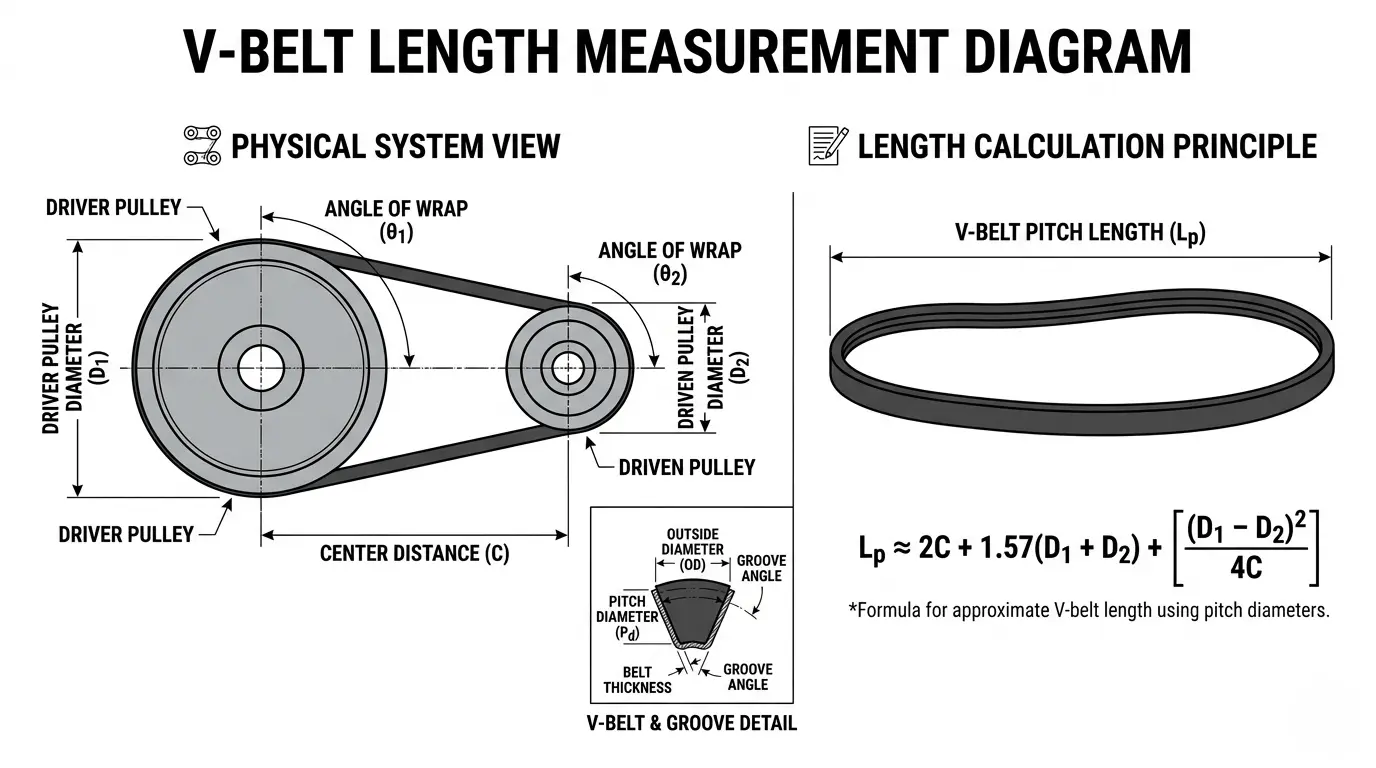
Using the wrong pulley diameter is one of the most common belt length calculation mistakes. Always measure the pitch diameter instead of the outer diameter for accurate results.
2. Ignoring Center Distance Accuracy
Incorrect center distance between pulleys leads to wrong belt size selection. Always measure center-to-center distance carefully.
3. Mixing Units (mm, inches)
Using different units in calculations can produce incorrect results. Ensure all values are in the same unit before applying formulas.
4. Ignoring Belt Thickness
Belt thickness can affect the effective length, especially in high-precision systems.
5. Using Approximate Values
Estimations instead of accurate measurements can lead to improper belt fitting and system inefficiency.
Step-by-Step Guide to Avoid Mistakes
Follow these steps to avoid common belt length calculation mistakes:
Step 1: Measure Pulley Diameters Correctly
Use proper tools to measure pulley diameters accurately.
Step 2: Measure Center Distance
Ensure precise measurement between pulley centers.
Step 3: Use Standard Formula
Apply the correct belt length formula for accurate results.
Step 4: Verify Units
Check that all values are in the same unit system.
Step 5: Double-Check Results
Always verify calculations before installation.
Practical Example
Consider a system with:
- Large pulley: 250 mm
- Small pulley: 120 mm
- Center distance: 700 mm
If measurements are incorrect or units are mixed, the final belt length will be wrong, causing installation issues.
To avoid such problems, use our belt length calculator for quick and accurate results.
Tips to Prevent Belt Calculation Errors
- Always use precise measuring tools
- Maintain consistent units
- Follow standard formulas
- Check alignment before installation
- Use calculators for verification
To better understand the correct calculation process, see this belt length calculation example with real numbers.
Related Mechanical Calculations
- Torque Calculator – calculate rotational force
- Pulley RPM Calculator – calculate system speed
More Belt Calculation Resources
- How to Calculate Belt Length Manually
- V Belt Size Chart & Calculation Guide
- Explore Mechanical Calculators Hub
Avoiding common belt length calculation mistakes is essential for maintaining efficiency and preventing system failures in industrial environments.
Frequently Asked Questions
What are the most common belt length calculation mistakes?
Common mistakes include incorrect pulley measurement, wrong center distance, and mixing units.
Why is accurate belt calculation important?
Accurate calculation ensures proper tension, reduces wear, and improves system efficiency.
Can I avoid mistakes using a calculator?
Yes, using a belt length calculator reduces manual errors and provides accurate results.
What happens if belt length is wrong?
It can cause slippage, vibration, overheating, and equipment damage.