
Last Updated: August 2026 • 8 min read
10 Common Torque Conversion Mistakes (And How to Avoid Them)
Torque conversion mistakes are one of the most common causes of incorrect bolt tightening, equipment damage, and maintenance failures. Whether you're converting Newton-meters (Nm) to pound-feet (lb-ft) or working with other torque units, even a small calculation error can result in under-tightened or over-tightened fasteners.
This guide explains the most common torque conversion mistakes made by maintenance engineers, technicians, and mechanical professionals. You'll also learn practical ways to avoid these errors and improve the accuracy of your maintenance work.
If you need to convert torque values instantly, use our Torque Calculator to calculate accurate torque values before applying them in real-world maintenance applications.

Key Takeaways
- Incorrect torque conversion can cause equipment failures, loose fasteners, damaged threads, and expensive downtime.
- Always verify whether the specified torque value is in Nm, lb-ft, or another unit before tightening any component.
- Use a reliable torque calculator or verified conversion chart instead of estimating conversion values manually.
- Never rely on rounded conversion factors when working on safety-critical equipment or precision maintenance tasks.
- Always compare converted values with the equipment manufacturer's recommended torque specifications.
- Using a calibrated torque wrench is just as important as calculating the correct torque value.
Why Torque Conversion Accuracy Matters
Torque is the rotational force used to tighten bolts, couplings, flanges, shafts, bearings, and many other mechanical components. In industrial maintenance, equipment manuals often use different unit systems depending on the manufacturer. European and Middle Eastern equipment generally uses Newton-meters (Nm), while many American machines specify torque values in pound-feet (lb-ft).
Problems occur when technicians confuse these units or use the wrong conversion factor. Even a small conversion mistake can produce significantly different tightening forces, leading to vibration, leakage, premature bearing wear, bolt failure, or complete equipment breakdown.
For example, converting a torque value incorrectly before setting a torque wrench may result in over-tightening a flange bolt or under-tightening a motor mounting bolt. Both situations can reduce equipment reliability and increase maintenance costs.
In many industrial facilities across Saudi Arabia, UAE, Qatar, and other Gulf countries, maintenance teams work with equipment imported from Europe, the United States, and Asia. This means technicians frequently encounter both metric and imperial torque specifications during routine maintenance. Understanding torque conversion is therefore an essential engineering skill rather than simply a mathematical exercise.
The safest approach is to verify the specified torque unit first, perform the conversion using a trusted engineering calculator, and then confirm the final value before applying torque with a calibrated torque wrench.
In the following sections, we'll explore the 10 most common torque conversion mistakes and explain how maintenance professionals can avoid them using proven engineering practices.
10 Common Torque Conversion Mistakes (And How to Avoid Them)
Even experienced maintenance professionals can make torque conversion mistakes when working with different unit systems or equipment manuals. Understanding these common errors will help you apply the correct tightening force, improve equipment reliability, and avoid costly maintenance failures.
| Common Mistake | Possible Impact | Best Practice |
|---|---|---|
| Using the wrong torque unit | Incorrect tightening force, damaged fasteners, or loose assemblies. | Always verify whether the specification is in Nm, lb-ft, lb-in, or kg-cm. |
| Using an incorrect conversion factor | Calculation errors that may exceed OEM torque limits. | Use verified engineering formulas or a trusted torque calculator. |
| Confusing lb-ft with lb-in | Torque may become 12 times higher or lower than required. | Always double-check the unit shown in manuals and torque wrench settings. |
| Rounding values too early | Loss of calculation accuracy on precision assemblies. | Round only the final calculated value. |
| Ignoring manufacturer specifications | Premature equipment failure and warranty issues. | Always follow OEM torque specifications whenever available. |
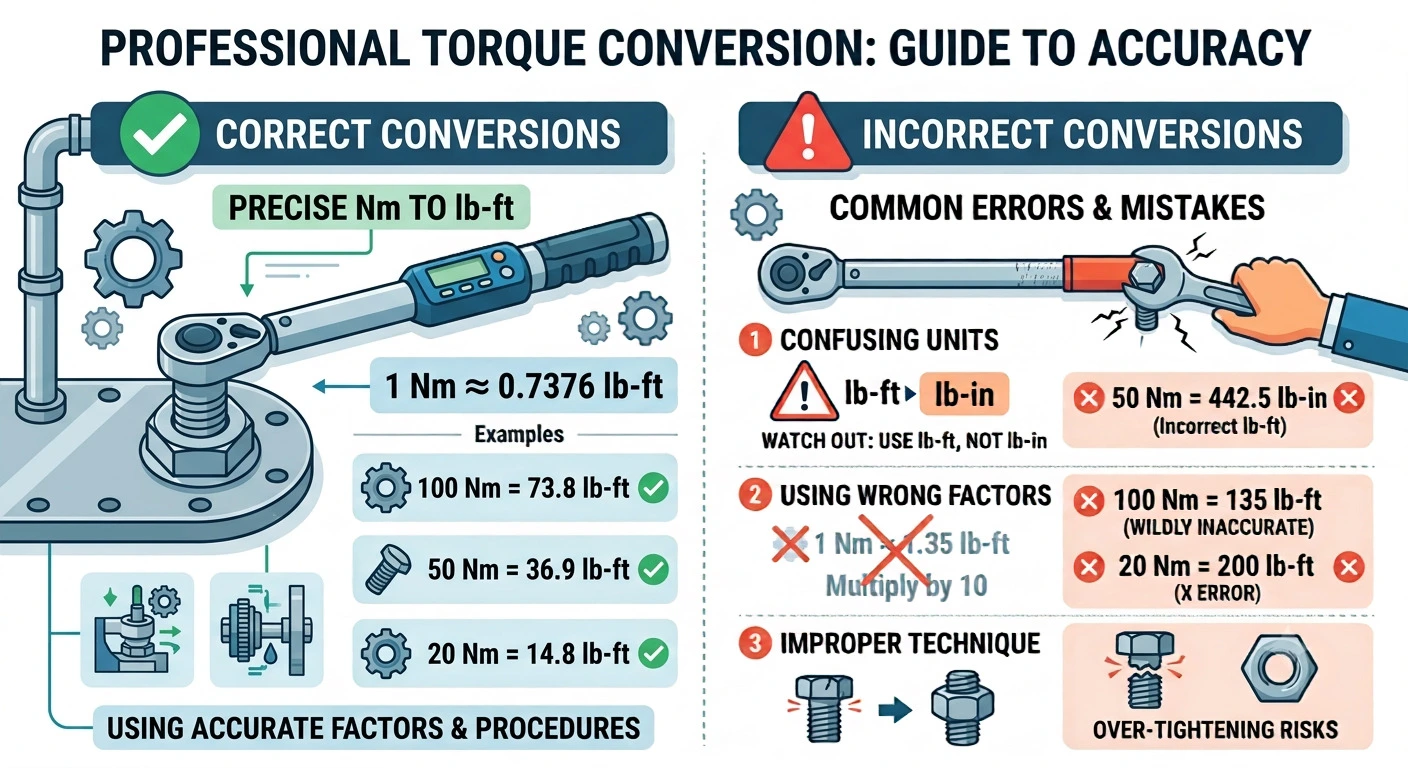
1. Using the Wrong Torque Unit
One of the most common mistakes is assuming that every torque value is expressed in the same unit. Maintenance manuals may specify torque in Newton-meters (Nm), pound-feet (lb-ft), pound-inches (lb-in), or kilogram-centimeters (kg-cm). Applying a value without checking the unit can result in severe over-tightening or under-tightening.
Before adjusting a torque wrench, always confirm the required unit in the equipment manual. If conversion is required, use the Torque Calculator to obtain an accurate value.
2. Using the Wrong Conversion Factor
Many technicians remember approximate conversion values from memory. While this may be acceptable for rough estimates, using an incorrect factor during equipment assembly can create significant errors.
For example, converting Nm to lb-ft requires multiplying by 0.737562. Even a small mistake becomes critical when tightening high-load flanges, rotating equipment, or structural fasteners.
Instead of memorizing conversion factors, keep a verified torque conversion chart or use a trusted online calculator to eliminate manual calculation errors.
3. Confusing lb-ft with lb-in
This mistake is surprisingly common when working on imported equipment. Although the abbreviations appear similar, lb-ft and lb-in are completely different units. Since one foot equals twelve inches, confusing these units can produce an error of up to twelve times the intended torque.
Such mistakes frequently damage small fasteners, electrical terminals, instrumentation panels, and precision mechanical assemblies.
4. Rounding Conversion Values Too Early
Some technicians round converted values before completing the calculation. While this may seem insignificant, repeated rounding introduces unnecessary error, especially in precision maintenance or quality-controlled assembly work.
Complete the full calculation first and round only the final result according to the required engineering tolerance.
5. Ignoring Manufacturer Torque Specifications
Even a perfectly calculated conversion is meaningless if it does not match the manufacturer's recommended torque specification. Every machine is designed with specific bolt grades, lubrication conditions, gasket materials, and tightening procedures.
Always treat OEM torque specifications as the highest authority. Perform conversions only when the specification must be expressed in another unit for your torque wrench or maintenance documentation.
6. Using an Uncalibrated Torque Wrench
Even if the torque conversion is correct, an uncalibrated torque wrench can still apply the wrong tightening force. Over time, torque wrenches lose accuracy due to frequent use, improper storage, or accidental impacts.
Using an inaccurate torque wrench may result in bolts being tightened above or below the specified value, increasing the risk of leakage, vibration, and premature equipment failure.
Follow your organization's calibration schedule and periodically verify torque wrench accuracy using certified calibration equipment or an approved calibration laboratory.
7. Mixing Metric and Imperial Fasteners
Maintenance teams often work with imported equipment that combines metric and imperial components. Assuming all fasteners use the same torque specification can lead to incorrect tightening and damaged threads.
Always identify the bolt standard before selecting torque values or performing any unit conversion.
8. Copying Torque Values from Unverified Sources
Many technicians search online for torque values without confirming the original source. Unfortunately, incorrect charts and unofficial conversion tables are common on the internet.
Always verify torque specifications using the equipment manufacturer's documentation or trusted engineering references before applying converted values.
9. Ignoring Lubrication Conditions
Torque specifications are often based on specific lubrication conditions. Applying the same torque to dry and lubricated fasteners can produce significantly different clamping forces.
Before converting or applying torque values, confirm whether the manufacturer's specification applies to dry, lubricated, or coated threads.
10. Skipping Final Verification
One of the simplest yet most overlooked mistakes is failing to verify the converted value before tightening the component. A quick review can prevent costly maintenance errors and improve overall equipment reliability.
Develop a habit of checking the original specification, converted value, torque wrench setting, and fastener condition before beginning any tightening procedure.
Real Industrial Example
During routine maintenance on a centrifugal pump, the manufacturer's manual specified a tightening torque of 95 Nm for the casing bolts. A technician mistakenly interpreted the value as 95 lb-ft and adjusted the torque wrench accordingly.
As a result, the bolts were over-tightened, causing gasket deformation and uneven flange loading. After startup, the pump developed a minor leakage that required shutdown and reassembly.
A simple unit verification before tightening would have prevented unnecessary downtime, additional labor costs, and production delays.
Always verify both the torque value and the unit before setting your torque wrench. A correct calculation using the wrong unit is still an incorrect tightening procedure.

Before You Tighten Any Bolt
Technician Checklist
- ✅ Verify the required torque unit (Nm, lb-ft, lb-in, or kg-cm).
- ✅ Confirm the conversion using a trusted torque calculator or conversion chart.
- ✅ Check the manufacturer's torque specification.
- ✅ Ensure the torque wrench has been calibrated.
- ✅ Inspect fasteners and threads for wear or damage.
- ✅ Confirm lubrication requirements before tightening.
- ✅ Apply torque using the recommended tightening sequence.
- ✅ Perform a final verification before returning equipment to service.
Best Practices to Prevent Torque Conversion Errors
- Use a verified engineering calculator instead of estimating conversion values.
- Keep an updated torque conversion chart available in maintenance workshops.
- Train technicians to recognize the differences between common torque units.
- Always document converted values in maintenance reports.
- Use calibrated torque wrenches for all critical tightening applications.
- When in doubt, verify the value with the equipment manufacturer's documentation.
Following these best practices can reduce maintenance errors, improve equipment reliability, and help maintenance teams achieve more consistent tightening results across industrial applications.
Torque Conversion Golden Rules
- Always verify the torque unit before making any conversion or adjusting your torque wrench.
- Use the correct conversion factor or a trusted engineering calculator instead of estimating values manually.
- Never confuse lb-ft with lb-in, as they represent very different torque values.
- Follow the equipment manufacturer's torque specifications whenever available.
- Use a calibrated torque wrench for all safety-critical and precision maintenance work.
- Double-check the converted value before tightening bolts, flanges, couplings, or rotating equipment.
Related Torque Resources
Continue improving your maintenance knowledge with these practical engineering resources available on Maitenics.
- Torque Calculator – Instantly calculate and convert torque values.
- Torque Formula Explained – Learn the engineering principles behind torque calculations.
- Torque Conversion Chart – Quick reference for common torque unit conversions.
- Torque Units Explained – Understand Nm, lb-ft, lb-in, and other torque units.
- Torque Specifications Explained – Learn how manufacturers determine recommended tightening values.
- Common Torque Problems and Solutions – Troubleshoot common torque-related maintenance issues.
Frequently Asked Questions (FAQs)
What is the most common torque conversion mistake?
The most common mistake is confusing different torque units, such as Newton-meters (Nm), pound-feet (lb-ft), and pound-inches (lb-in). Applying the correct value in the wrong unit can result in over-tightening or under-tightening.
Can incorrect torque conversion damage equipment?
Yes. Incorrect torque conversion may damage fasteners, deform gaskets, strip threads, increase vibration, or cause premature equipment failure. Always verify the converted value before tightening mechanical components.
Should I trust online torque conversion charts?
Only use reliable engineering references or trusted calculators. Always compare converted values with the manufacturer's torque specifications whenever possible.
Why is torque wrench calibration important?
A torque wrench that is out of calibration may apply more or less torque than indicated, even when the conversion is correct. Regular calibration helps maintain tightening accuracy and equipment reliability.
Is Nm the same as lb-ft?
No. They measure the same physical quantity (torque) but use different unit systems. Newton-meters (Nm) belong to the metric system, while pound-feet (lb-ft) belong to the imperial system.
How can I avoid torque conversion mistakes?
Verify the torque unit, use a trusted torque calculator, follow OEM specifications, keep your torque wrench calibrated, and perform a final verification before applying torque.
Final Thoughts
Torque conversion may appear straightforward, but small mistakes can have significant consequences in industrial maintenance. Incorrect unit selection, inaccurate conversion factors, or uncalibrated torque tools can all lead to equipment damage, safety risks, and unnecessary downtime.
By understanding these common torque conversion mistakes and following proven engineering best practices, maintenance professionals can improve tightening accuracy, extend equipment life, and reduce costly maintenance errors.
Whenever you need to convert torque values quickly and accurately, use the Maitenics Torque Calculator to verify your calculations before carrying out maintenance work.
Successful maintenance is not only about applying the correct torque, it is about applying the correct torque in the correct unit, using calibrated tools, and following the manufacturer's specifications every time.
Always consult the original equipment manufacturer's (OEM) documentation before applying converted torque values to safety-critical components.
About the Author
Wasim Shahzad is the founder of Maitenics and creates practical engineering resources for maintenance engineers, technicians, and industrial professionals. His content focuses on maintenance calculations, troubleshooting, rotating equipment, and real-world mechanical engineering best practices to help readers solve everyday maintenance challenges.