
Torque Specifications Explained – Avoid Failures with Correct Torque
Torque Specifications Explained is critical if you want to avoid bolt failure, leaks, and equipment damage in real maintenance work. Many technicians apply torque by feel, but even small errors can lead to serious problems.
In real maintenance work, I have seen systems fail not because of weak parts, but because torque specifications were ignored or misunderstood. In Gulf industries, this leads to downtime, safety risks, and costly repairs.
If you’ve ever tightened a bolt “by feel” and later faced failure, then torque specification was the missing factor. This guide explains torque specifications in a simple, practical way so technicians, operators, and engineers can apply them correctly in real industrial environments.
👉 Quickly calculate accurate torque values: Torque Calculator (Nm ↔ lb-ft)
What Are Torque Specifications Explained in Simple Terms?
Torque Specifications Explained helps technicians and engineers understand how to apply the correct tightening force for safe and reliable operation.
Torque specifications refer to the exact amount of rotational force required to properly tighten a bolt, nut, or fastener. These values are provided by manufacturers to ensure safe and efficient operation.
👉 Learn calculation basics: How to Calculate Torque
In real maintenance work, technicians often face confusion when torque values are given in different units or when specifications are ignored completely.
👉 Basic concept: What is Torque in Engineering
For example:
- Too little torque → loose connection
- Too much torque → bolt damage or breakage
A common mistake I’ve seen is applying “extra tight” thinking it increases safety — but it actually causes failure.
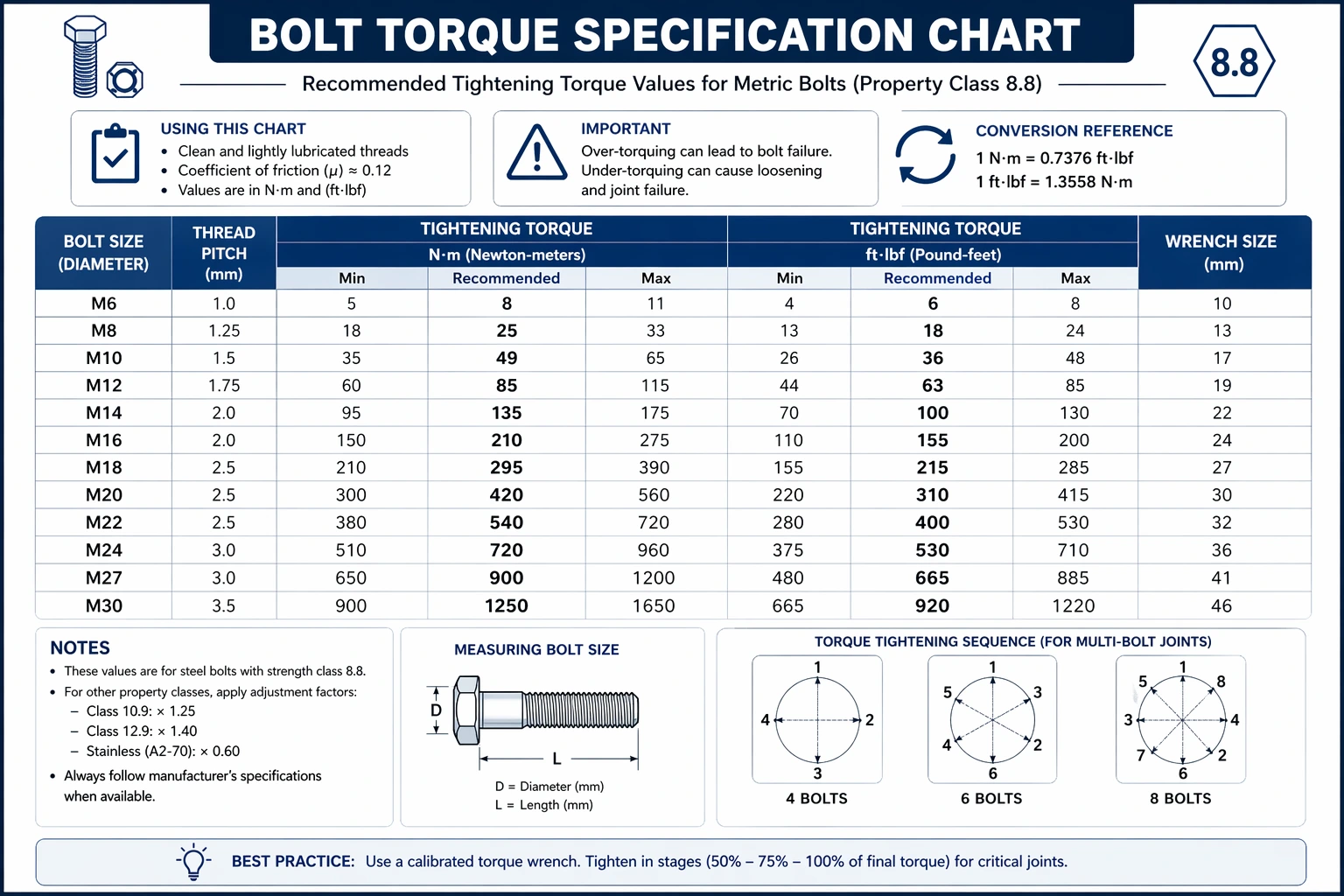
Example of torque specification values for proper bolt tightening.
👉 Avoid wrong torque values, calculate instantly: Torque Calculator Tool
How to Read Torque Specifications (Step-by-Step)
In real maintenance work, torque specs are usually found in manuals, charts, or equipment labels.
- Step 1: Identify bolt size and material
- Step 2: Check torque value in correct unit
- Step 3: Use a properly calibrated torque wrench (verified accuracy)
- Step 4: Apply torque gradually
Technicians often face issues because they skip steps or use incorrect tools.
👉 Calibration guide: Torque Wrench Calibration Guide
A common mistake I’ve seen is reading torque values in Nm but applying them in lb-ft without conversion.
👉 Conversion help: Torque Conversion Chart
Real Industrial Scenario (Gulf Maintenance Work)
In Gulf industries such as oil plants, HVAC systems, and heavy machinery maintenance, torque specifications are critical.
In real maintenance work:
- Flange bolts require exact torque sequences
- Motors require proper fastening torque
- Pipes leak if torque is incorrect
Technicians often face repeated failures due to ignoring torque specifications or using guesswork.
👉 Practical impact: How Torque Affects Machine Performance

Technician applying correct torque using a torque wrench in industrial setup.
Where Torque Specifications Are Used (Practical Applications)
Torque specifications are used in almost every industrial system. In real maintenance work, they are essential for:
- Bolt tightening in machinery
- Engine assembly
- Structural connections
- Pipeline systems
👉 Real examples: Torque Calculation Examples (Real-Life)
👉 Related concept: Torque and Power Relationship
Technicians often face performance issues when torque is not applied according to specification.
Common Mistakes in Torque Specifications
A common mistake I’ve seen in field work is ignoring torque values completely or applying them incorrectly.
- Using uncalibrated tools
- Applying torque unevenly
- Ignoring tightening sequence
- Using wrong units
👉 Troubleshooting: Common Torque Problems and Solutions
These mistakes lead to serious issues like vibration, leakage, and mechanical failure.
Torque Specification Table (Quick Reference)
| Bolt Size | Torque (Nm) | Torque (lb-ft) | Use Case |
|---|---|---|---|
| M8 | 25 | 18.4 | Light machinery |
| M10 | 50 | 36.9 | General industrial |
| M12 | 85 | 62.7 | Heavy load systems |
Decision Guide: When Torque Specifications Matter Most
In real maintenance work, torque specifications are critical when:
- Safety is involved
- High-pressure systems are used
- Precision assembly is required
Technicians often face situations where ignoring torque specifications leads to repeated breakdowns. The correct approach is to always follow manufacturer values.
👉 Physics concept: Torque in Physics (Simple Explanation)
In real maintenance work, I have seen many failures caused by ignoring torque specifications or applying incorrect values. In Gulf industries, even small torque errors can lead to leakage, vibration, and complete system failure.
Final Summary
Torque Specifications Explained is not just a theoretical concept — it is a practical requirement for safe and efficient machine operation. Proper torque ensures reliability, prevents damage, and improves equipment life.
Do not rely on guesswork when applying torque specifications. Even small mistakes can lead to major failures.
👉 Calculate accurate torque instantly: Torque Calculator Tool
Frequently Asked Questions (FAQs)
What are torque specifications?
Torque specifications are the recommended force values used to tighten bolts and fasteners correctly.
Why are torque specifications important?
They prevent under-tightening and over-tightening, ensuring safety and performance.
What happens if torque is too high?
Excess torque can damage threads or break bolts.
Can I tighten bolts without torque specs?
It is not recommended as it can lead to failure or unsafe conditions.
How do I apply correct torque?
Use a calibrated torque wrench and follow manufacturer specifications.