
How to Calculate Torque (Step-by-Step + Real Examples)
How to calculate torque correctly is essential if you want to avoid loose bolts, equipment failure, or incorrect machine performance.
Technicians often face a common problem. They apply force, but the result is not accurate because the torque calculation is wrong. This leads to either over-tightening or under-tightening, both of which can cause serious issues in real maintenance work.
In this guide, you will learn the exact steps to calculate torque, understand the formula, and apply it in real industrial situations.
👉 Calculate instantly here: Torque Calculator (Nm to lb ft)
What is Torque and Why It Matters
Torque is the rotational force applied to an object. It determines how much force is needed to rotate or tighten something.
In industrial environments, torque is critical for:
- Bolt tightening
- Motor performance
- Equipment safety
👉 Learn more: Torque Formula Explained
Incorrect torque can cause:
- Loose connections
- Over-tightening damage
- Mechanical failure
Torque Formula Explained
The basic formula used to calculate torque is:
Torque (T) = Force (F) × Distance (r) × sin(θ)
When the force is applied perpendicular to the lever arm, the angle is 90°, so sin(90°) = 1 and the formula simplifies to:
T = F × r
- T = Torque
- F = Force applied
- r = Distance from pivot point
This means torque increases when either force or distance increases.
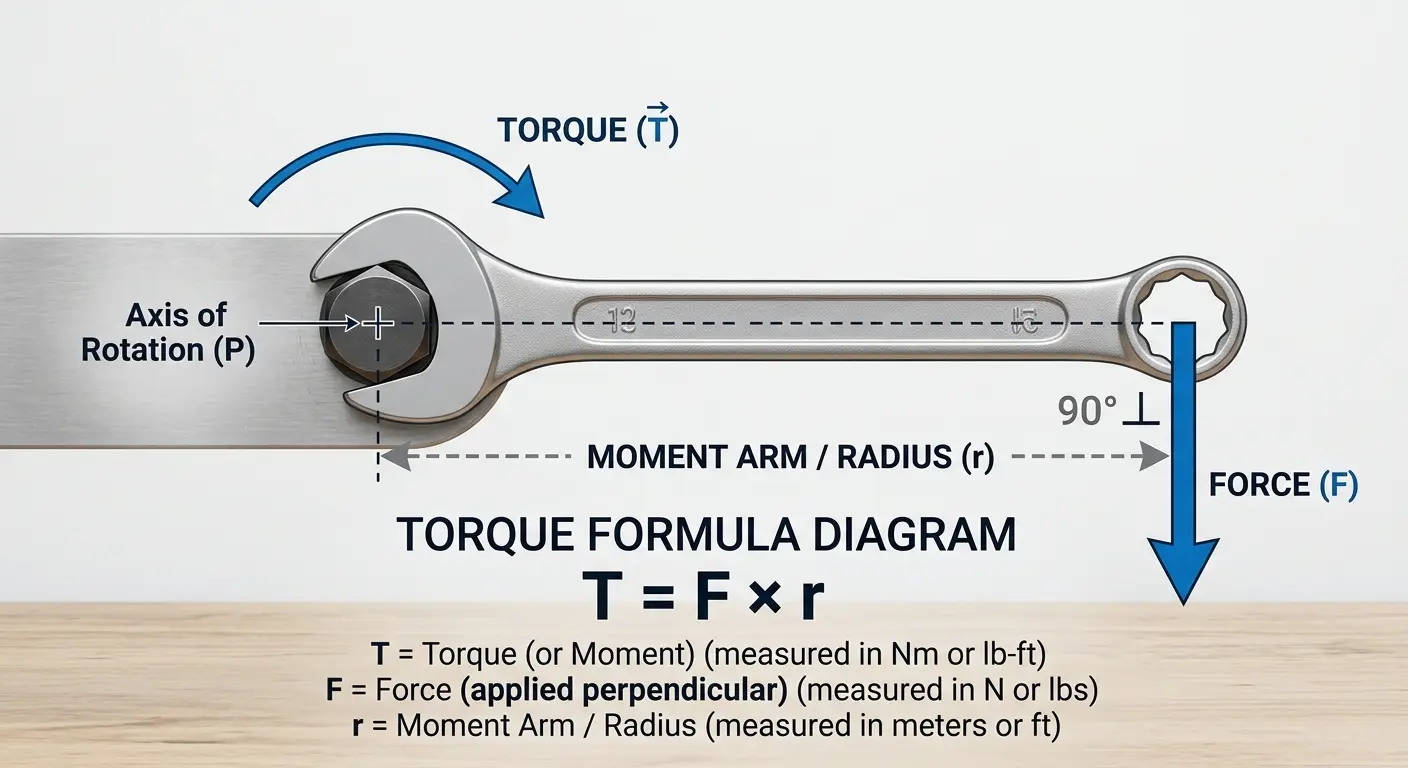
Figure: Visual representation of torque formula (T = F × r).
Figure: Torque depends on applied force and distance from the pivot point.
How to Calculate Torque (Step-by-Step)
- Measure the applied force (Newtons or pounds)
- Measure the distance from pivot (meters or feet)
- Multiply both values
Example:
Force = 100 N, Distance = 0.5 m
Torque = 100 × 0.5 = 50 Nm
👉 For conversion: Nm to lb-ft Conversion
Torque Calculation Table (Quick Reference)
Quick Reference: Common torque values and applications.
| Force (N) | Distance (m) | Torque (Nm) | Application |
|---|---|---|---|
| 50 | 0.2 | 10 | Light fittings |
| 100 | 0.5 | 50 | Medium bolts |
| 200 | 0.5 | 100 | Industrial use |
Real Industrial Examples
In maintenance work:
- Bolts in pipelines require precise torque
- Motors need correct torque to avoid overload
- Flanges must be tightened evenly
In Gulf industries, incorrect torque often leads to safety hazards and shutdowns.
👉 Learn method: Torque Calculation Examples Real Life

Figure: Torque depends on applied force and distance from the pivot point.
Common Torque Calculation Mistakes
- Wrong distance measurement
- Ignoring angle of force
- Using incorrect units
👉 Avoid these issues: Common Torque Mistakes
Related Guides
Bolt Torque Chart (Standard Values)
Frequently Asked Questions (FAQs)
What is the formula to calculate torque?
The formula is T = F × r, where force is multiplied by distance.
What units are used in torque?
Torque is measured in Nm, lb-ft, and kg-cm.
Why is torque important?
It ensures proper tightening and prevents equipment failure.
Can torque be increased?
Yes, by increasing force or using a longer lever.
What tool measures torque?
A torque wrench is used for accurate measurement.
Final Thoughts
Understanding how to calculate torque is essential for technicians and engineers. It ensures safe operation, accurate maintenance, and long equipment life.
👉 Stop guessing torque values. Calculate accurately here: Torque Calculator (Nm to lb ft)