
How to Calculate Belt Length Manually (Step-by-Step Guide)
Calculating belt length manually is an important skill for technicians and engineers working with pulley systems.
While online tools can give quick results, manual calculation helps you understand the process and verify accuracy in real-world applications.
In this guide, you’ll learn how to calculate belt length step by step using the standard formula, along with practical examples and tips.
👉 For quick and accurate results, use our belt length calculator.

Belt Length Formula
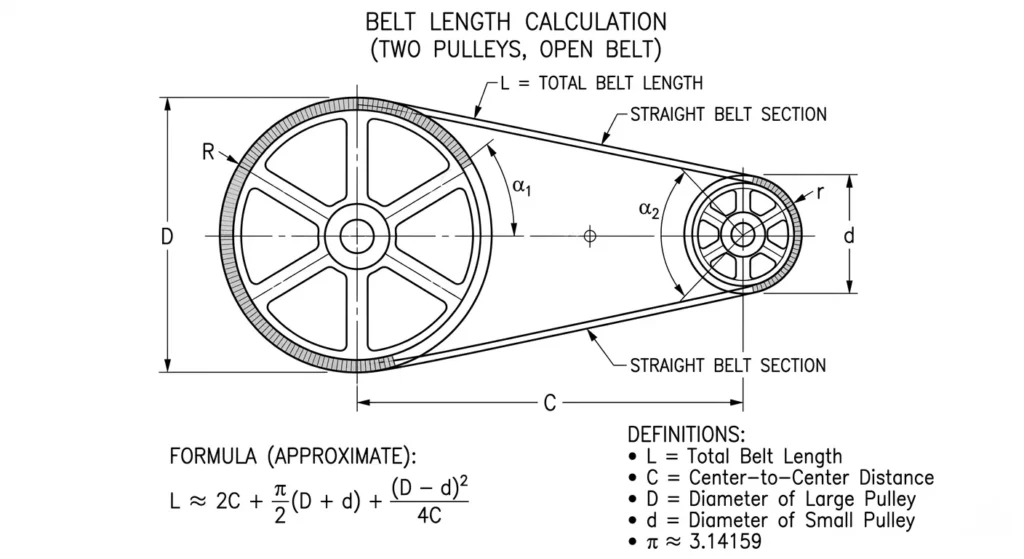
The standard formula for calculating belt length between two pulleys is:
L = 2C + (π/2)(D + d) + (D − d)² / (4C)
- L = Belt length
- C = Center distance between pulleys
- D = Diameter of larger pulley
- d = Diameter of smaller pulley
Step-by-Step Belt Length Calculation
Follow these steps to calculate belt length manually:
Step 1: Measure Pulley Diameters
Measure the diameter of both pulleys. Identify which one is larger (D) and which is smaller (d).
Step 2: Measure Center Distance
Measure the distance between the centers of both pulleys (C).
Accurate measurement is critical. Learn how in our pulley center distance measurement guide.
Step 3: Apply the Formula
Insert the values into the formula and calculate step by step.
Step 4: Verify the Result
Double-check your measurements and calculations to ensure accuracy.
Practical Example (Fully Solved)
Let’s calculate belt length:
- D = 200 mm
- d = 100 mm
- C = 500 mm
Now apply the formula:
L = 2(500) + (π/2)(200 + 100) + (200 − 100)² / (4 × 500)
L = 1000 + (1.57 × 300) + (10000 / 2000)
L = 1000 + 471 + 5
👉 Final Belt Length ≈ 1476 mm
By applying the formula, you can calculate the belt length accurately for installation.
For a real-world example, see our belt length calculation step-by-step example guide.
Types of Belt Systems
The formula works best for:
- Open belt drive systems
- Standard pulley arrangements
When the Formula May Not Be Accurate
In real-world applications, results may vary due to:
- Belt stretch
- Installation tension
- Pulley wear
- Misalignment
Practical Adjustment Tip
In industrial use, it is common to allow a 1–2% adjustment in belt length to ensure proper fitting and performance.
Manual Calculation vs Belt Length Calculator
Manual calculation helps you understand the concept, but it can be time-consuming and prone to error.
Common Belt Length Calculation Mistakes
Some common errors include:
- Incorrect measurement of pulley diameters
- Wrong center distance
- Ignoring belt tension
👉 Learn more in our belt calculation mistakes guide.
Related Mechanical Calculations
Belt systems are part of a larger mechanical setup. For complete analysis, you should also calculate torque and rotational speed.
- Torque Calculator – calculate rotational force
- Pulley RPM Calculator – calculate speed and ratio
Explore all tools in our mechanical calculators hub for complete system analysis.
Frequently Asked Questions
How do you calculate belt length manually?
By using the formula L = 2C + (π/2)(D + d) + ((D − d)² / 4C) and inserting measured values.
Is manual calculation accurate?
Yes, but small variations can occur due to real-world conditions.
Can this method be used for all belt types?
It works for most standard pulley systems, but adjustments may be needed.
Conclusion
Learning how to calculate belt length manually gives you better control over installation and troubleshooting.
While the formula provides a solid base, combining it with practical adjustments and tools ensures the best results.