
Common Belt Speed Calculation Mistakes
Common belt speed calculation mistakes are responsible for many equipment performance problems that technicians mistakenly blame on motors, bearings, belts, or alignment issues. In industrial facilities, a small calculation error can lead to incorrect troubleshooting decisions, reduced production output, unnecessary maintenance costs, and avoidable downtime.
The problem is that belt speed calculations often appear simple on paper. However, real-world operating conditions rarely match ideal assumptions. Worn pulleys, belt slip, inaccurate RPM measurements, unit conversion errors, and incorrect field data can all produce misleading results that affect maintenance decisions.
Understanding these common mistakes helps engineers and technicians improve calculation accuracy, identify hidden performance losses, and prevent costly troubleshooting errors. Before evaluating system performance, many maintenance teams verify results using the Belt Speed Calculator and compare findings against actual operating conditions rather than relying solely on theoretical values.
Why Belt Speed Calculations Go Wrong
Most belt speed calculation errors occur because technicians rely on assumptions rather than verified measurements. A formula may be correct, but if one input value is inaccurate, the final result becomes unreliable.
For example, a conveyor may appear to be operating at the expected speed according to calculations, while actual production output continues to decline. In many cases, the issue is not the formula itself but the quality of the data being used.
Common sources of inaccurate data include:
- Incorrect pulley measurements
- Worn pulley diameters
- Unverified motor RPM values
- Belt slip
- Unit conversion mistakes
- Outdated equipment specifications
- Assumptions made during troubleshooting
Experienced maintenance engineers therefore treat belt speed calculations as part of a larger diagnostic process rather than as a standalone answer.
Before investigating calculation errors, many technicians first review What Is a Good Belt Speed to determine whether the equipment is operating within a reasonable speed range for its application.
Mistake #1: Using Incorrect Pulley Diameter
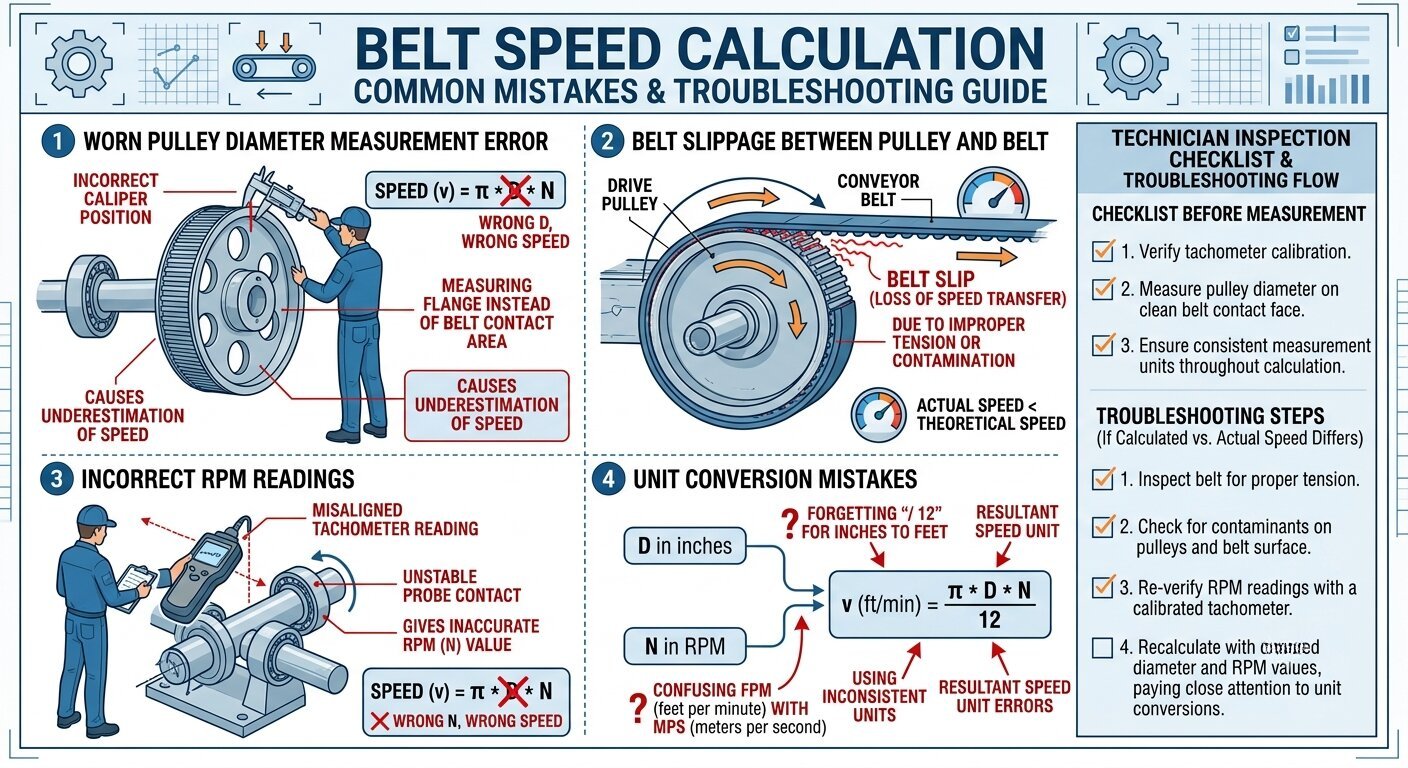
One of the most common belt speed calculation mistakes involves using the wrong pulley diameter. Many technicians measure a pulley once, record the value, and continue using it for years without verifying whether wear has changed the actual diameter.
Pulley wear is particularly common in abrasive industrial environments such as cement plants, mining operations, aggregate facilities, and bulk material handling systems. Over time, wear can reduce pulley dimensions enough to affect calculated belt speed values.
A small diameter difference may appear insignificant, but it can create noticeable discrepancies when calculating conveyor speed, airflow performance, or production throughput.
When evaluating pulley dimensions, technicians often reference the Pulley Diameter and Belt Speed Relationship guide to understand how diameter changes affect belt velocity and system performance.
Best practice is to physically measure critical pulleys during inspections rather than relying solely on historical records or equipment drawings.
Mistake #2: Ignoring Belt Slip
Many belt speed calculations assume that the belt and pulley move together without any loss of motion. In reality, belt slip occurs in many industrial systems and can significantly affect actual operating speed.
Belt slip commonly results from:
- Insufficient belt tension
- Pulley wear
- Contamination
- Misalignment
- Excessive load conditions
- Improper maintenance practices
When belt slip occurs, calculated speed based on RPM and pulley diameter may differ from the speed actually delivered to the equipment.
This often creates confusion during troubleshooting because calculations appear correct while production performance suggests otherwise.
Engineers frequently compare calculated values against actual measurements obtained from tachometers and field observations before concluding that a speed-related issue has been resolved. Many also perform a full Conveyor Belt Speed Calculation to verify whether production performance matches expected operating conditions.
| Mistake | Consequence | Production Impact | Prevention |
|---|---|---|---|
| Incorrect Pulley Diameter | Wrong Speed Calculation | Reduced Throughput | Measure Actual Diameter |
| Ignoring Belt Slip | Speed Mismatch | Performance Loss | Verify Tension and Condition |
The most common belt speed calculation mistakes include using incorrect pulley diameters, ignoring belt slip, relying on nameplate RPM, mixing units, measuring the wrong pulley, and overlooking actual operating conditions. These errors can lead to inaccurate troubleshooting decisions and reduced equipment reliability.
Mistake #3: Using Nameplate RPM Instead of Actual RPM
Another common mistake occurs when technicians use motor nameplate RPM instead of measuring actual operating RPM. While nameplate values provide a useful reference, they do not always represent real operating conditions.
Motor performance can vary because of load changes, Variable Frequency Drives (VFDs), power quality issues, mechanical losses, and operating conditions. As a result, actual RPM may differ from the value printed on the motor nameplate.
For example, a motor labeled at 1,450 RPM may operate at a different speed depending on load and system conditions. If calculations use nameplate RPM instead of measured RPM, the resulting belt speed value may be inaccurate.
Experienced technicians therefore verify actual RPM using laser tachometers before calculating belt speed. This approach reduces troubleshooting errors and improves confidence in maintenance decisions.
When evaluating RPM-related issues, engineers often reference the RPM to Belt Speed Formula and Calculation guide to verify whether measured operating speeds match expected performance.
Mistake #4: Mixing Units and Conversions
Unit conversion mistakes are among the easiest errors to make and among the most difficult to identify during troubleshooting. Belt speed may be reported in meters per second (m/s), feet per minute (ft/min), meters per minute, or other units depending on the equipment manufacturer and industry standards.
Problems occur when technicians compare values expressed in different units without performing proper conversions. A speed value may appear incorrect when the only issue is a mismatch between measurement systems.
For example, a maintenance report may use m/s while an Original Equipment Manufacturer (OEM) specification uses ft/min. Comparing the two values directly can lead to incorrect conclusions regarding equipment performance.
Maintenance teams frequently use the Belt Speed ft/min Conversion Guide to avoid unit-related errors and ensure that calculations remain consistent across departments and equipment documentation.
Clear unit labeling should be considered a standard practice for all maintenance reports, inspections, and troubleshooting records.
Mistake #5: Measuring the Wrong Pulley
In belt-driven systems with multiple pulleys, technicians occasionally measure the wrong pulley when collecting data. This mistake often occurs during shutdown inspections, equipment modifications, or troubleshooting activities performed under time pressure.
Confusion is particularly common when systems contain:
- Multiple drive stages
- Intermediate pulleys
- Reduction drives
- Variable-speed arrangements
- Complex conveyor systems
Using an incorrect pulley diameter can significantly distort belt speed calculations and may result in unnecessary troubleshooting efforts.
Best practice is to confirm pulley identification using equipment drawings, maintenance records, and physical inspection before collecting measurements.
Technicians who understand the Pulley Diameter and Belt Speed Relationship are far less likely to make this type of error during field inspections.
Mistake #6: Ignoring Operating Conditions
A belt speed calculation may be mathematically correct while still failing to reflect actual operating performance. This usually occurs when environmental and operational factors are ignored during analysis.
Common operating conditions that affect belt performance include:
- Dust accumulation
- High temperatures
- Heavy loads
- Moisture contamination
- Belt wear
- Misalignment
- Poor lubrication practices
These conditions can influence belt slip, vibration levels, component wear, and system efficiency. As a result, actual performance may differ from what theoretical calculations predict.
This issue is particularly important in Gulf industrial environments where heat, dust, and continuous operation place additional stress on belt-driven equipment.
Maintenance engineers therefore combine calculations with physical inspections, vibration analysis, lubrication reviews, alignment checks, and operational observations before making recommendations.
The strongest troubleshooting results come from integrating calculation data with real-world operating evidence rather than relying on formulas alone.
In some applications, incorrect belt speed calculations can also affect transmitted torque requirements, leading technicians to investigate mechanical loading issues that are actually caused by inaccurate speed assumptions.
How Technicians Verify Belt Speed Calculations
Experienced maintenance technicians do not assume that a belt speed calculation is correct simply because the formula has been applied properly. Instead, they verify calculation results using multiple sources of information before making maintenance decisions.
A typical verification process includes:
- Measuring actual motor RPM using a laser tachometer
- Confirming pulley diameters through physical inspection
- Checking belt condition and tension
- Reviewing vibration analysis data
- Inspecting alignment condition
- Comparing production performance against design expectations
- Verifying calculations using independent methods
This approach helps eliminate assumptions and ensures that maintenance teams are working with accurate information. A calculation should support troubleshooting, not replace it.
Engineers often compare results against guidance from How to Calculate Belt Speed Step by Step and use the Belt Speed Calculator to verify calculations before recommending corrective actions.
Related Calculators and Troubleshooting Guides
Belt speed calculations are most effective when combined with accurate measurements, troubleshooting procedures, and supporting engineering references. The following resources will help you verify calculations, diagnose performance problems, and improve maintenance decisions.
- Belt Speed Calculator
- Mechanical Calculators Hub
- How to Calculate Belt Speed Step by Step
- Belt Speed Formula Explained
- Conveyor Belt Speed Calculation
- Pulley Diameter and Belt Speed Relationship
- RPM to Belt Speed Formula and Calculation
- Belt Speed ft/min Conversion Guide
- What Is a Good Belt Speed
Maintenance professionals investigating recurring performance problems may also benefit from learning How to Measure Pulley Diameter Correctly, particularly when troubleshooting conveyor systems and belt-driven equipment.
Real-World Engineering Insight
During shutdown maintenance projects in Gulf manufacturing facilities, one of the most common findings is that calculations performed during previous troubleshooting activities were technically correct but based on inaccurate field measurements.
I have seen conveyor systems operating below production targets for months because technicians continued using outdated pulley dimensions recorded years earlier. In other cases, maintenance teams relied on motor nameplate RPM values while actual operating RPM had changed because of Variable Frequency Drive (VFD) settings or equipment modifications.
Dust, heat, continuous operation, and limited shutdown windows can all contribute to gradual performance changes that are not immediately obvious during routine inspections. Over time, these small deviations can significantly affect calculated belt speed values.
The most effective reliability engineers treat belt speed calculations as one piece of evidence rather than the final answer. They verify RPM, inspect belts, review vibration trends, evaluate alignment conditions, and compare current operating performance against Original Equipment Manufacturer (OEM) recommendations before making recommendations.
One lesson consistently reinforced in the field is that accurate measurements are often more important than complex calculations. A simple calculation using verified data will almost always outperform an advanced calculation built on incorrect assumptions.
When troubleshooting recurring speed-related issues, maintenance teams often compare actual measurements with values obtained using the Belt Speed Calculator and verify calculations using the procedures explained in How to Calculate Belt Speed Step by Step.

Accurate belt speed calculations depend on verified field measurements rather than assumptions. By checking pulley diameter, actual RPM, belt condition, operating environment, and unit consistency, maintenance teams can reduce troubleshooting errors and improve equipment reliability.
Frequently Asked Questions
What is the most common belt speed calculation mistake?
Using incorrect pulley diameter values is one of the most common mistakes because pulley wear can gradually change dimensions and affect calculation accuracy.
Does belt slip affect belt speed calculations?
Yes. Belt slip can cause actual operating speed to differ from calculated values, particularly when tension, alignment, or pulley condition problems exist.
Why should technicians measure actual RPM?
Actual RPM may differ from motor nameplate RPM because of load conditions, VFD settings, and operating factors. Measuring RPM improves calculation accuracy.
Can unit conversion errors affect troubleshooting?
Absolutely. Mixing m/s, ft/min, and other units can create misleading results and lead to incorrect maintenance decisions.
How do engineers verify belt speed calculations?
They combine calculations with RPM measurements, pulley inspections, belt condition checks, vibration analysis, and operational performance reviews.
Can incorrect belt speed calculations cause downtime?
Yes. Incorrect calculations can lead technicians toward the wrong root cause, delaying repairs and increasing downtime risk.
Recommended Next Steps
Now that you understand the most common belt speed calculation mistakes, continue with these engineering resources to troubleshoot speed-related problems, understand their impact on conveyor performance, and verify your calculations accurately.