
How to Increase Belt Speed
Production demand has increased, but the conveyor has become the bottleneck. The operations team wants higher throughput without replacing the entire conveyor system, so the first suggestion is usually, "Let's make the belt run faster." While increasing belt speed can improve production in some situations, experienced maintenance engineers know that changing conveyor speed without proper planning can create new problems instead of solving the original one.
Before making any mechanical or electrical modifications, engineers first confirm that the conveyor itself is limiting production. In many plants, the real issue is poor material loading, transfer point restrictions, or downstream equipment that cannot handle additional throughput. Increasing belt speed without identifying the actual bottleneck often results in more dust, higher belt wear, and increased maintenance costs.
The safest approach is to calculate the existing operating speed using the Belt Speed Calculator before making any adjustments. Accurate calculations help maintenance teams evaluate whether increasing belt speed is the right solution or whether another part of the system requires attention.
This guide explains the safest methods to increase belt speed, compares different engineering solutions, and highlights the inspections that should always be completed before changing pulley sizes, motor speed, or gearbox ratios.
Why You May Need to Increase Belt Speed
Increasing belt speed is usually considered when production requirements change or when process improvements demand higher conveyor throughput. However, the goal should never be to make the belt run faster simply because it is possible. The objective is to improve productivity while maintaining equipment reliability and safe operating conditions.
Maintenance engineers commonly increase belt speed to:
- Increase conveyor throughput.
- Match higher production targets.
- Synchronize multiple conveyors.
- Improve material flow between production stages.
- Reduce process bottlenecks.
- Optimize upgraded production lines.
Before approving any speed increase, engineers should compare the existing operating conditions with Maximum Recommended Belt Speed to ensure the conveyor can safely operate at a higher speed.
Is Belt Speed Really the Problem?
One of the biggest mistakes in conveyor troubleshooting is assuming that increasing belt speed will automatically increase production. In reality, the conveyor may not be the component limiting system performance.
Before modifying conveyor speed, experienced engineers investigate the complete material handling process.
Typical checks include:
- Is the conveyor already operating near its recommended speed?
- Are transfer chutes restricting material flow?
- Is the feed rate sufficient to support higher speed?
- Can downstream equipment process additional material?
- Are belt cleaners and tracking systems functioning correctly?
- Is material spillage already occurring?
If one of these issues is limiting production, increasing belt speed may only increase maintenance costs without improving overall output.
The relationship between conveyor speed and production is explained in more detail in Belt Speed vs Conveyor Capacity, which helps engineers determine whether higher speed will actually improve throughput.
Safe Methods to Increase Belt Speed
Once engineers confirm that additional belt speed is both necessary and safe, several proven methods can be used to increase conveyor speed.
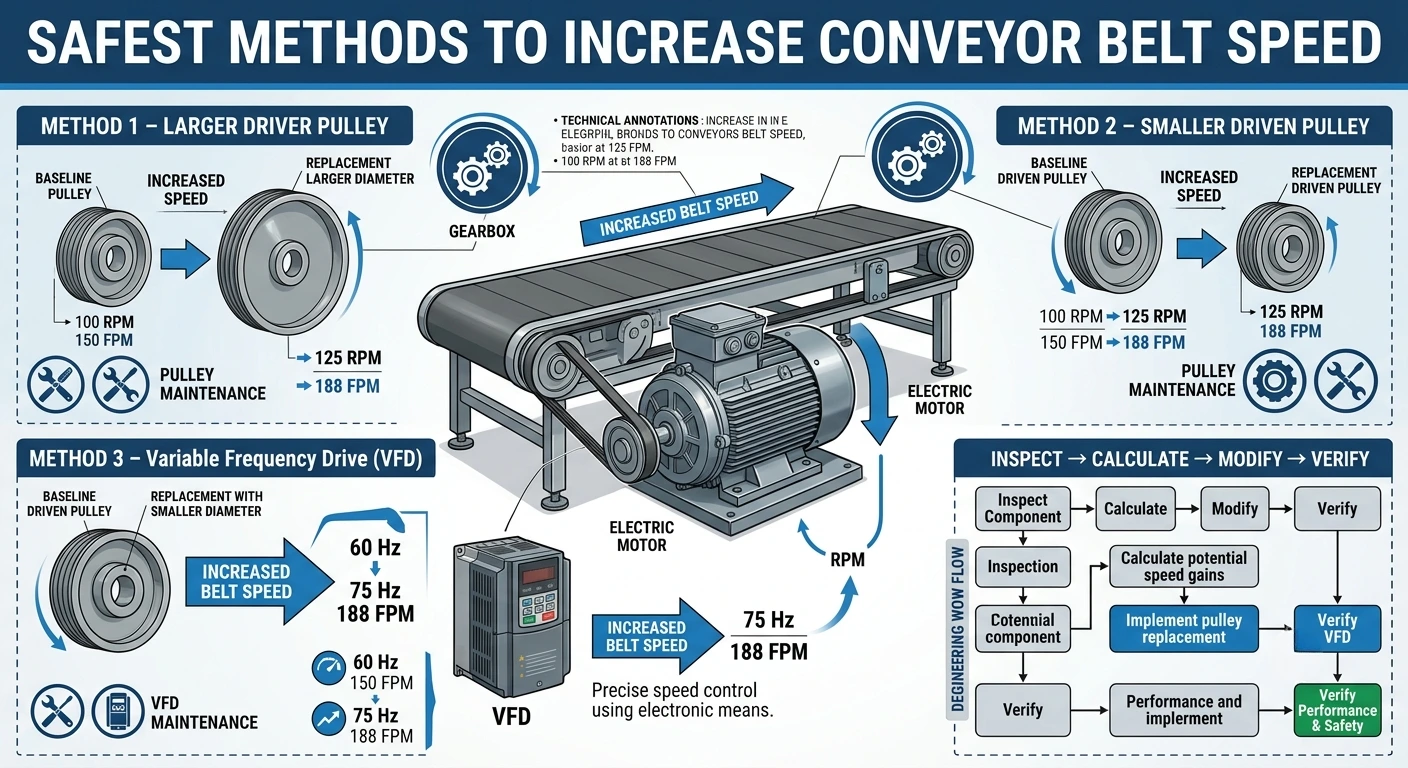
The most common options include:
- Install a larger driver pulley.
- Install a smaller driven pulley.
- Increase motor speed using a Variable Frequency Drive (VFD).
- Modify the gearbox ratio.
- Upgrade the conveyor drive system where required.
Each method changes conveyor performance differently. Pulley modifications provide a permanent mechanical solution, while a Variable Frequency Drive (VFD) offers adjustable speed control without changing the pulley arrangement.
Regardless of the selected method, engineers should always recalculate the expected belt speed and verify that all conveyor components can safely operate at the higher speed.
| Method | Speed Increase | Advantages | Best Application |
|---|---|---|---|
| Larger Driver Pulley | High | Simple mechanical upgrade | Fixed production lines |
| Smaller Driven Pulley | High | Maintains existing motor | Pulley ratio modifications |
| Variable Frequency Drive (VFD) | Adjustable | Flexible speed control | Processes requiring variable speed |
| Gearbox Ratio Change | Medium to High | Reliable long-term solution | Major conveyor upgrades |
Pulley Changes vs Variable Frequency Drive (VFD) vs Gearbox
Once you've confirmed that increasing belt speed is the right solution, the next step is deciding how to achieve it. This is where many maintenance teams make costly mistakes. They replace components without comparing the available options or considering how each change will affect the rest of the conveyor system.
In practice, engineers usually choose between three methods: changing pulley sizes, adjusting motor speed with a Variable Frequency Drive (VFD), or modifying the gearbox ratio. Each method has advantages, limitations, and suitable applications.
Pulley modifications are often the simplest solution for conveyors that operate at one fixed speed. Installing a larger driver pulley or a smaller driven pulley increases belt speed without changing the motor itself.
Variable Frequency Drives (VFDs) are better suited to production lines where operating speed needs to change throughout the day. Instead of replacing mechanical components, the VFD adjusts the motor speed electronically, giving operators greater flexibility.
Gearbox modifications are usually considered only during major equipment upgrades because they require more planning, downtime, and investment than pulley or VFD adjustments.
Before selecting any option, engineers should review Pulley Diameter and Belt Speed Relationship to understand how pulley size directly influences conveyor speed.
Real Industrial Example
During an expansion project at a manufacturing facility, production demand increased by nearly 15%. The operations department suggested installing a larger motor because one conveyor was struggling to keep up with the upgraded production line.
Instead of ordering new equipment immediately, the maintenance team inspected the conveyor and reviewed the operating data. They discovered that the existing motor still had sufficient capacity, but the conveyor had been designed with a conservative pulley ratio to match the original production requirements.
After recalculating the belt speed, engineers recommended installing a slightly larger driver pulley rather than replacing the motor. The modification increased conveyor speed enough to meet the new production target while avoiding the cost of purchasing and installing a larger motor.
Before restarting production, the team checked bearing temperatures, verified belt tracking, inspected the transfer points, and confirmed that downstream equipment could handle the increased material flow.
The project was completed during a scheduled shutdown, production targets were achieved, and no additional reliability issues were introduced.
This example highlights an important lesson: increasing belt speed should always be part of a complete engineering evaluation rather than a quick mechanical modification.
Mistakes to Avoid When Increasing Belt Speed
Increasing conveyor speed without a proper engineering review can create problems that are far more expensive than the original production bottleneck.
Common mistakes include:
- Increasing belt speed without confirming that the conveyor is the actual bottleneck.
- Changing pulley sizes without recalculating the new operating speed.
- Ignoring the maximum recommended operating speed.
- Overlooking belt tracking after mechanical modifications.
- Failing to inspect transfer points and belt cleaners.
- Increasing speed without verifying downstream equipment capacity.
- Skipping post-maintenance inspections before returning the conveyor to service.
Many of these issues can be prevented by reviewing Common Belt Speed Calculation Mistakes and comparing the proposed operating speed with the guidance provided in Maximum Recommended Belt Speed.
When Increasing Belt Speed Is Not the Best Solution
Not every production problem can be solved by making the conveyor run faster. In many cases, increasing belt speed simply moves the bottleneck to another part of the process.
Before approving any speed increase, maintenance engineers should inspect the complete material handling system and ask a few simple questions:
- Is the conveyor fully loaded already?
- Can the loading system supply more material?
- Will the discharge conveyor handle the additional throughput?
- Are transfer chutes causing restrictions?
- Is excessive dust or material spillage already occurring?
- Will higher speed reduce equipment life?
If the answer to any of these questions raises concerns, increasing belt speed may not be the right solution. Improving loading efficiency, eliminating transfer point restrictions, or optimizing material flow can often deliver better results without increasing operating speed.
Maintenance teams should also review Belt Speed vs Conveyor Capacity to understand whether higher belt speed will actually increase production or simply increase maintenance requirements.
Real-World Engineering Insight
One lesson I've learned from working on conveyor upgrades is that production teams and maintenance teams often look at the same problem from different angles. Production wants higher throughput as quickly as possible, while maintenance is responsible for keeping the equipment reliable long after the modification has been completed.
I remember a project where management requested a 20% increase in conveyor capacity before the installation of a new production line. The initial proposal was to replace the existing motor with a larger one. On paper, that looked like the fastest solution, but the maintenance team decided to investigate before approving the purchase.
After reviewing the conveyor design, measuring the existing belt speed, and checking the motor load, it became clear that the motor still had enough capacity. The real opportunity was to optimize the pulley ratio. A slightly larger driver pulley increased belt speed without overloading the motor or exceeding the conveyor's safe operating limits.
Before restarting production, the team carried out a complete inspection of the conveyor. Belt tracking was adjusted, pulley alignment was verified, bearing temperatures were monitored, and material flow was observed at every transfer point. The conveyor reached the new production target, and several months later it was still operating reliably without abnormal wear or repeated maintenance issues.
That project reinforced an important principle: increasing belt speed should never be treated as a shortcut to higher production. It should be the result of careful engineering, accurate calculations, and a full understanding of how every part of the conveyor system works together.
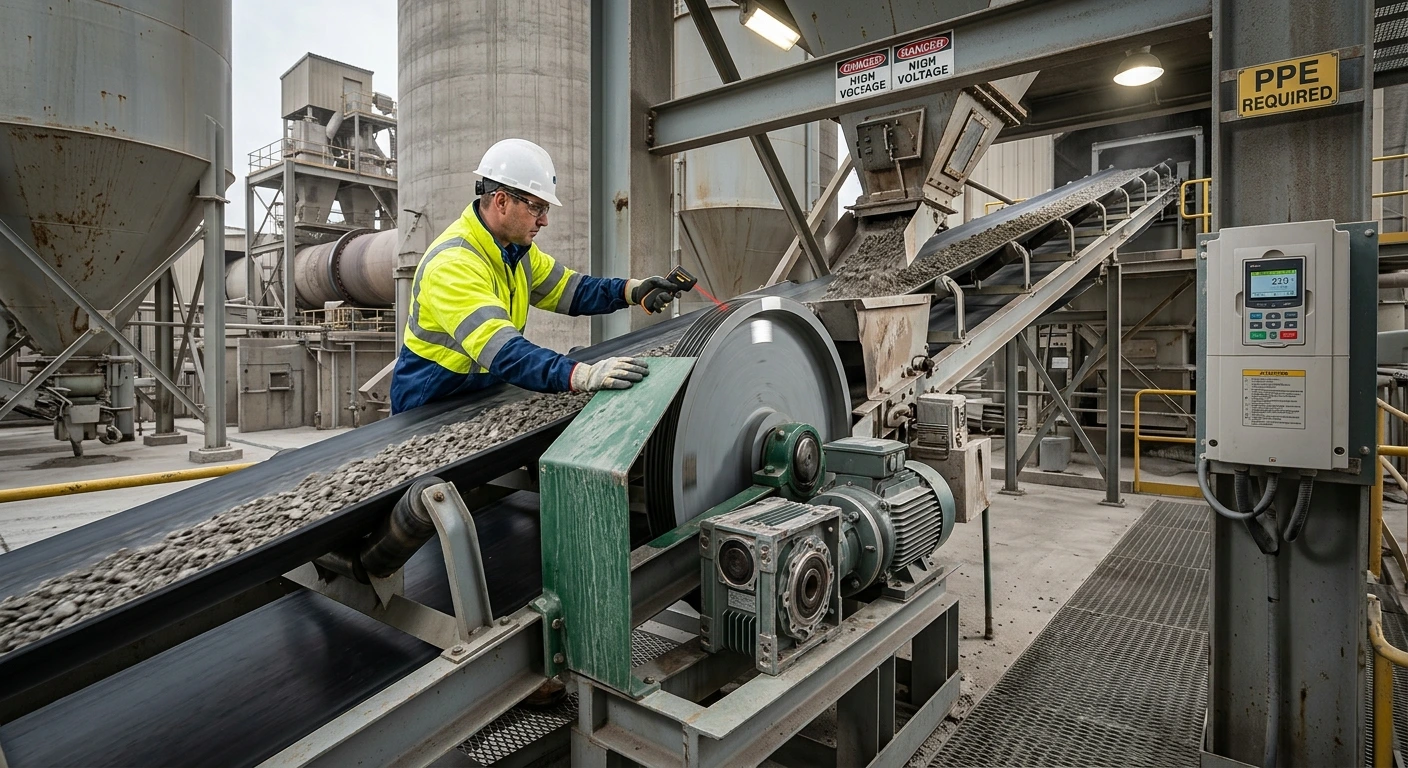
Increasing belt speed successfully requires balancing production targets with equipment reliability. Careful planning, accurate calculations, and post-modification inspections help ensure that higher throughput does not introduce new maintenance problems.
Frequently Asked Questions
What is the safest way to increase belt speed?
The safest approach is to first confirm that the conveyor is the actual production bottleneck. Depending on the application, belt speed can be increased by installing a larger driver pulley, a smaller driven pulley, adjusting a Variable Frequency Drive (VFD), or changing the gearbox ratio. Always verify that the conveyor can safely operate at the higher speed.
Can I increase belt speed without replacing the motor?
Yes. In many cases, changing pulley sizes or adjusting the motor speed through a Variable Frequency Drive (VFD) is enough to increase belt speed without installing a new motor.
Will increasing belt speed always increase production?
No. Production may still be limited by material feed rate, transfer chutes, downstream equipment, or process restrictions. Increasing belt speed without addressing these issues may increase wear without improving throughput.
How do engineers verify that a higher belt speed is safe?
Engineers calculate the new operating speed, compare it with the equipment manufacturer's recommendations, inspect the conveyor system, and monitor belt tracking, bearing temperatures, and material flow during commissioning.
Is using a Variable Frequency Drive better than changing pulley sizes?
It depends on the application. A VFD is ideal when different operating speeds are required, while pulley modifications provide a permanent and cost-effective solution for conveyors running at a fixed speed.
What should be inspected after increasing belt speed?
After any speed increase, inspect pulley alignment, belt tracking, bearing temperatures, transfer points, belt cleaners, motor load, and material flow to ensure the conveyor is operating safely and efficiently.
Conclusion
Increasing belt speed can be an effective way to improve production, but only when it is supported by proper engineering analysis and careful maintenance planning. The most successful conveyor upgrades are not the ones with the highest speed, they are the ones that achieve higher throughput while maintaining reliability, safety, and long equipment life.
In many industrial facilities, the most successful conveyor upgrades come from optimizing the complete conveying system rather than increasing speed alone. Evaluating the root cause of production limitations first leads to safer and more sustainable improvements.
Before changing pulley sizes, adjusting a Variable Frequency Drive, or modifying the gearbox, calculate the existing operating speed using the Belt Speed Calculator. Then compare your results with Maximum Recommended Belt Speed, Belt Speed vs Conveyor Capacity, and How to Reduce Belt Speed to make the right engineering decision for your conveyor system.
Recommended Next Steps
Now that you understand how to increase belt speed safely, continue with these engineering resources to troubleshoot conveyor performance, avoid calculation mistakes, and optimize belt-driven equipment without reducing reliability.