
Motor Torque Calculation Explained (Easy Method + Examples)
Motor torque calculation explained is essential for technicians working with motors, pumps, and rotating equipment.
In real maintenance work, motor overload, low performance, or unexpected shutdowns can have several causes. Incorrect torque calculation or an inadequate torque margin can be one contributing factor, but technicians should also check load conditions, motor sizing, voltage, mechanical resistance, alignment, and drive settings.
This guide will help you understand how to calculate motor torque step-by-step, with real industrial examples so you can apply it correctly in your daily work.
👉 Calculate torque instantly here: Torque Calculator (Nm to lb ft)
Motor Torque Calculation Explained in Simple Terms
Motor torque is the rotational force that a motor produces to drive mechanical loads. In simple terms, it determines whether a motor can start, move, and sustain a load.
Torque and power describe different aspects of motor performance. Torque determines the turning force available at the shaft, while power describes the rate at which mechanical work is delivered. A motor must provide sufficient torque for the required load at the operating speed.
👉 Learn basics: What is Torque in Engineering
A common mistake I’ve seen is technicians selecting motors based only on kilowatts (kW) without checking torque requirements. This leads to frequent breakdowns.
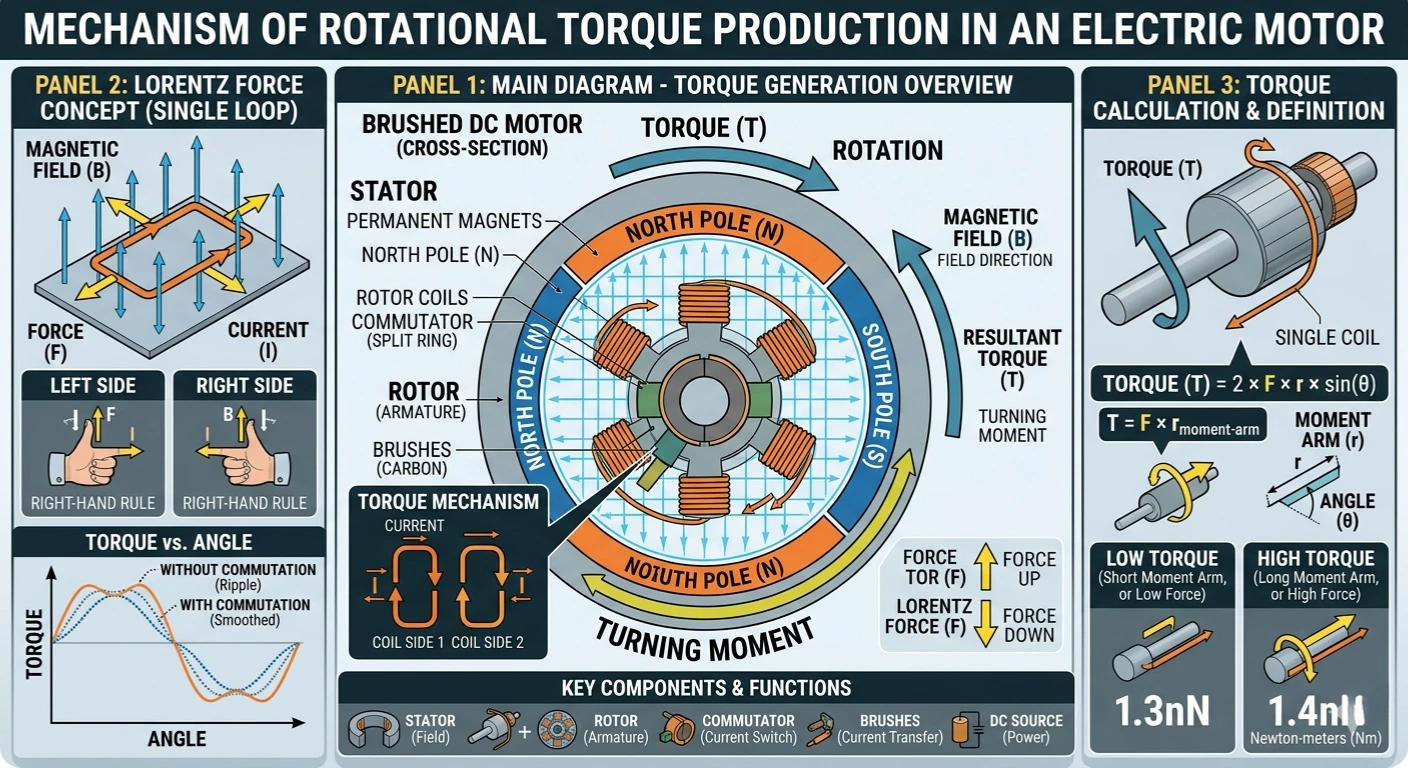
Figure: Motor torque represents rotational force required to move load.
Motor Torque Formula and How It Works
The standard formula used in motor torque calculation is:
Torque (Nm) = (Power × 60) / (2π × RPM)
When motor power is given in kilowatts, a commonly used form is:
Torque (Nm) = 9550 × Power (kW) ÷ RPM
This form is convenient for industrial motor calculations because motor nameplate power is commonly specified in kW.
Where:
- Power = motor power in watts
- RPM = speed of motor
👉 Related: Torque Formula Explained
In real maintenance work, technicians often skip understanding this formula and rely only on charts or calculators. But knowing this formula helps in troubleshooting.
Technicians often face confusion when RPM changes, because torque changes accordingly. Ignoring this leads to incorrect system design.
Step-by-Step Motor Torque Calculation Example
Let’s calculate motor torque using a practical example:
- Motor Power = 7.5 kW (7500 W)
- Speed = 1500 RPM
Using the kW-based formula:
Torque = (9550 × 7.5) ÷ 1500
Torque ≈ 47.75 Nm
The theoretical shaft torque is therefore approximately 47.8 Nm, assuming the stated power is mechanical output power at the given speed.
In real maintenance work, this helps determine if the motor can handle a pump or conveyor load.
👉 Practical examples: Torque Calculation Examples Real Life
A common mistake I’ve seen is not converting kW to watts properly before calculation, which leads to wrong results.
Motor Torque in Real Industrial Applications
In Gulf industries, motor torque is critical in systems such as:
- Water pumps
- Air compressors
- Conveyor belts
- HVAC fans
In real maintenance work, insufficient torque causes:
- Motor stalling
- Overheating
- Frequent trips
In real maintenance work, I have seen technicians select motors based only on power rating without checking torque requirements. This can result in machines running normally at light load but struggling or tripping under higher load conditions. In Gulf industries, correct motor torque calculation is important for proper performance and reliable operation.
👉 Understand units clearly: Torque Units Explained

Figure: Motor torque applied in industrial machinery.
Technicians often face startup issues due to high initial torque requirements, especially in compressors.
Motor Torque vs Speed (RPM Relationship)
For a system operating at approximately constant mechanical power, torque and RPM have an inverse relationship. As rotational speed increases, available torque decreases, while reducing speed allows higher torque for the same power level.
In real maintenance work, this becomes critical when dealing with variable speed drives (VFDs).
👉 Related: Torque vs RPM Explained
A common mistake I’ve seen is ignoring load variation with speed changes, which leads to poor system performance.
Common Motor Torque Calculation Mistakes
Technicians often make these mistakes:
- Ignoring load requirements
- Using incorrect RPM values
- Mixing units (Nm and lb-ft)
- Overloading motors
👉 Avoid these: Common Torque Mistakes
In Gulf industries, these mistakes can result in serious downtime and maintenance costs.
Motor Torque Requirements by Application
| Application | Important Torque Consideration | Typical Concern |
|---|---|---|
| Fans | Operating and starting torque must match the fan load | Speed and airflow requirements |
| Conveyors | Starting and running torque must handle the conveyed load | Acceleration and load starting |
| Compressors | Starting and operating torque can vary significantly by compressor type | Starting load and pressure conditions |
| Pumps | Torque requirement depends on pump type, speed, and system load | Load, flow, and operating speed |
This table helps technicians select motors based on load type.
Final Summary
Motor torque calculation explained is not just a formula—it is a practical skill every technician must understand. In real maintenance work, correct torque ensures smooth operation, reduces failures, and improves equipment life.
Understanding the relationship between power, speed, and torque helps technicians evaluate motor loading, verify calculations, and identify potential performance problems. The calculated torque should always be considered alongside the motor nameplate data, load requirements, starting conditions, and manufacturer's specifications.
👉 Need quick motor torque calculation? Use this: Torque Calculator Tool
Frequently Asked Questions (FAQs)
What is motor torque?
Motor torque is the rotational force produced by a motor to move a load.
How do you calculate motor torque?
Using the formula: Torque = (Power × 60) / (2π × RPM).
Why is motor torque important?
It determines whether the motor can handle the required load efficiently.
What happens if torque is too low?
The motor may stall or fail to start the load.
Where is motor torque used?
It is used in pumps, conveyors, compressors, and industrial machines.