
Bolt Torque vs Preload: How Tightening Torque Creates Clamp Force
Published: August 2026 | Last Updated: August 2026 | Reading Time: 8–10 minutes

Description: Industrial bolted joint showing how tightening torque is used to develop bolt preload and clamp force during mechanical maintenance.
Bolt torque vs preload is an important concept for engineers and maintenance technicians because the torque applied with a wrench is not the same as the preload created inside a tightened bolt. Torque is the rotational input used during tightening, while preload is the tension developed in the bolt that helps create the clamping force holding the joint together.
In industrial maintenance, this distinction matters when tightening pump flanges, motor mounting bolts, bearing housings, gearboxes, and other critical mechanical connections. The same torque setting does not always produce exactly the same preload because thread friction, lubrication, surface condition, and fastener condition affect the torque-to-tension relationship.
This guide explains the difference between bolt torque and preload, how tightening torque creates clamp force, how the torque-preload relationship is estimated, and why technicians should always consider the equipment manufacturer's specifications when working on critical joints.
Key Takeaways
- Torque is the rotational input applied during bolt tightening.
- Preload is the tension developed in the bolt after tightening.
- Preload creates the clamping force that holds bolted components together.
- Friction has a major effect on the relationship between applied torque and resulting preload.
- The torque-preload formula provides an estimate rather than a guaranteed preload value.
- Lubrication, thread condition, coatings, and surface condition can change the result.
- For critical applications, manufacturer and engineering specifications should take priority over generic calculations.
What Is Bolt Torque?
Bolt torque is the rotational force applied to a fastener while tightening it. A torque wrench allows a technician to control this rotational input according to a specified value, commonly expressed in Nm or lb-ft.
When a technician applies torque to a nut or bolt head, the fastener rotates along its threads. The tightening action causes the bolt to stretch slightly, which develops tension in the bolt and compresses the components being joined.
This is why tightening torque should not be confused with the actual clamping force in the joint. The torque value is the controlled installation input; the resulting preload depends on the characteristics and condition of the fastener and joint.
For a basic understanding of torque calculation, see Bolt Torque Calculation.
What Is Bolt Preload?
Bolt preload is the tension introduced into a bolt when it is tightened. As the bolt is tightened, it stretches slightly and behaves like a tensioned spring. At the same time, the connected components are compressed together.
The resulting preload helps maintain contact between the joined components when the assembly experiences vibration, external loads, pressure, or operating forces.
In a correctly designed bolted joint, preload is intended to keep the connected surfaces in contact while the joint is subjected to normal operating loads. The required preload depends on the joint design, fastener, materials, loading conditions, and applicable engineering specification.
Preload vs Clamp Force
Preload describes the initial tension developed in the fastener. Clamp force describes the compressive force holding the joint components together as a result of that preload.
In a properly tightened joint, sufficient preload helps prevent separation and unwanted movement. Too little preload can allow loosening, vibration, or leakage, while excessive preload can damage threads, distort components, or overstress the fastener.
Bolt Torque vs Preload: What's the Difference?
The simplest way to understand bolt torque vs preload is to remember that torque is the input and preload is the resulting bolt tension. A torque wrench controls the amount of rotational force applied during installation, but it does not directly measure the tension inside the bolt.
| Factor | Bolt Torque | Bolt Preload |
|---|---|---|
| Meaning | Applied rotational input | Resulting bolt tension |
| Typical unit | Nm / lb-ft | N / kN |
| Typical control method | Torque wrench | Direct or indirect tension measurement |
| Friction influence | Strong | Determines the resulting tension |
| Main purpose | Control tightening | Maintain joint clamping |
In practical maintenance work, the important point is that torque does not directly equal preload. Two otherwise similar fasteners tightened to the same torque can develop different preload when their friction conditions are different.
Engineering Insight: A torque wrench controls the rotational input applied to the fastener. The actual preload depends on how that torque is converted into bolt tension through the threads and bearing surfaces.
How Does Torque Create Bolt Preload?
When torque is applied to a bolt or nut, the fastener rotates along the threads.
When torque is applied to a bolt or nut, most of the applied torque is consumed in overcoming friction at the threads and under the nut or bolt head. The remaining portion contributes to turning the fastener and stretching the bolt, which develops tension and joint preload.
That tension produces the force that clamps the connected components together.
Torque Applied → Thread & Bearing Friction → Bolt Stretch → Preload → Clamp Force
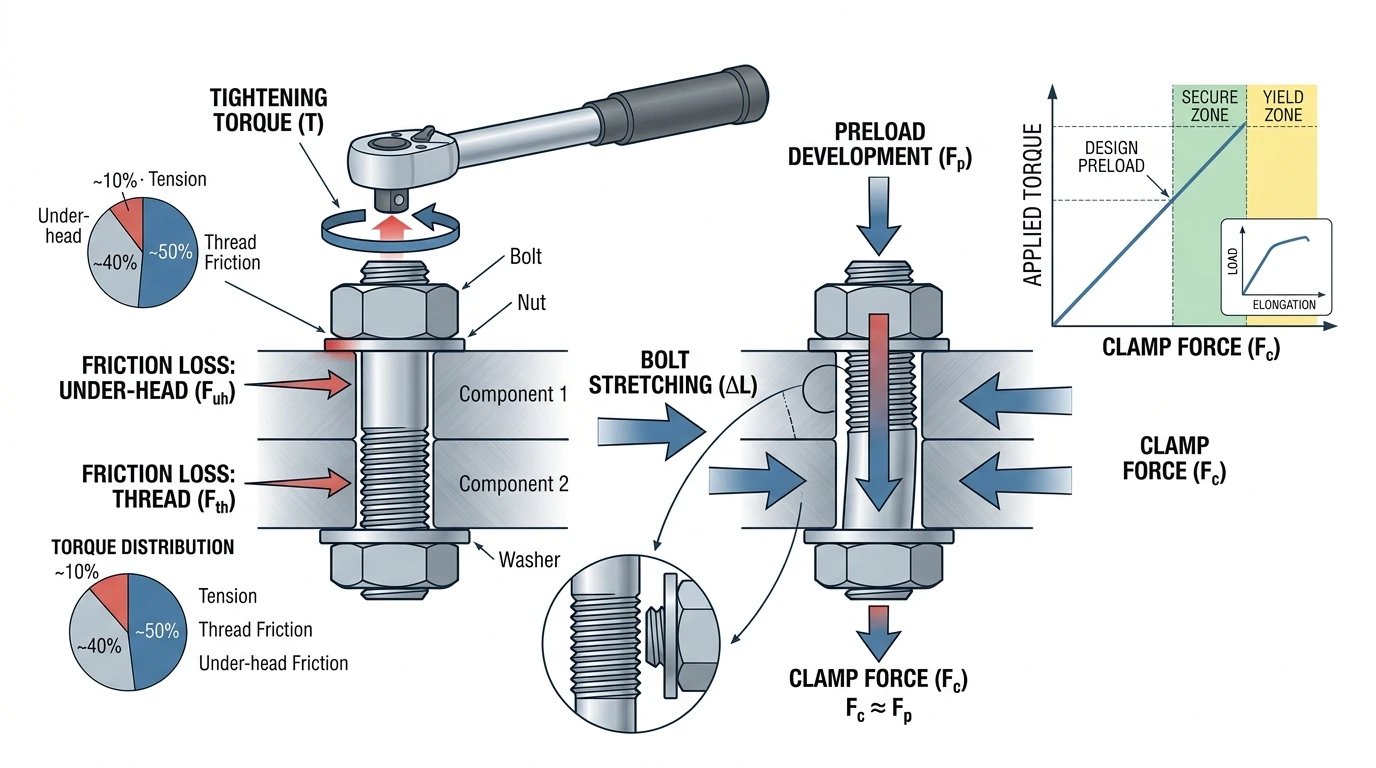
Description: Visual explanation of how applied tightening torque passes through friction and bolt stretch to create preload and clamp force in a bolted joint.
Where Does Applied Torque Go?
Not all of the applied torque becomes useful bolt tension. A substantial portion is associated with overcoming friction at the threads and under the nut or bolt head.
This is why the condition of the fastener matters. A dry, lubricated, corroded, coated, or contaminated connection can behave differently even when the torque wrench is set to exactly the same value.
Bolt Torque and Preload Formula
A commonly used engineering relationship for estimating preload from tightening torque is:
T = K × D × F
Where:
- T = tightening torque
- K = nut factor representing friction-related effects
- D = nominal bolt diameter
- F = estimated bolt preload
The relationship can also be rearranged to estimate preload:
F = T / (K × D)
Because the nut factor represents friction-related effects, the calculated preload is only as reliable as the assumed K value and the tightening conditions it represents. For this reason, a calculated preload should not be treated as an exact measurement of the tension in a specific installed bolt.
The important limitation is that K is not a universal constant. It represents the effects of friction and other tightening conditions. Therefore, this relationship should be treated as an estimation method rather than a guarantee of the exact preload produced in a particular joint.
What Does the K Factor Mean?
The K factor, often called the nut factor, is used to represent the friction-related behavior of the fastener assembly. Thread friction and friction beneath the nut or bolt head can significantly affect how much of the applied torque contributes to bolt tension.
Changes in lubrication, surface condition, coatings, thread condition, and fastener type can therefore change the relationship between torque and preload.
Worked Bolt Torque vs Preload Example
Consider a simplified example where a bolt has a nominal diameter of 20 mm, the applied tightening torque is 200 Nm, and an assumed nut factor of 0.20 is used for estimation.
Using the torque-preload relationship:
F = T / (K × D)
With the diameter expressed in meters, the estimated preload is:
F = 200 / (0.20 × 0.020) = 50,000 N
That is an estimated preload of approximately 50 kN under the assumed conditions.
This 50 kN value is an estimate based on the assumed K factor. It should not be used as a critical-joint tightening specification unless the selected K factor and calculation method are appropriate for the actual fastener and joint conditions.
This example demonstrates why the K factor matters. If the friction condition changes, the assumed K value may also change, and the resulting preload estimate will change even if the torque setting remains 200 Nm.
Need to check a torque value?
Use the Torque Calculator to quickly convert torque values between Nm and lb-ft before applying the specified tightening torque.
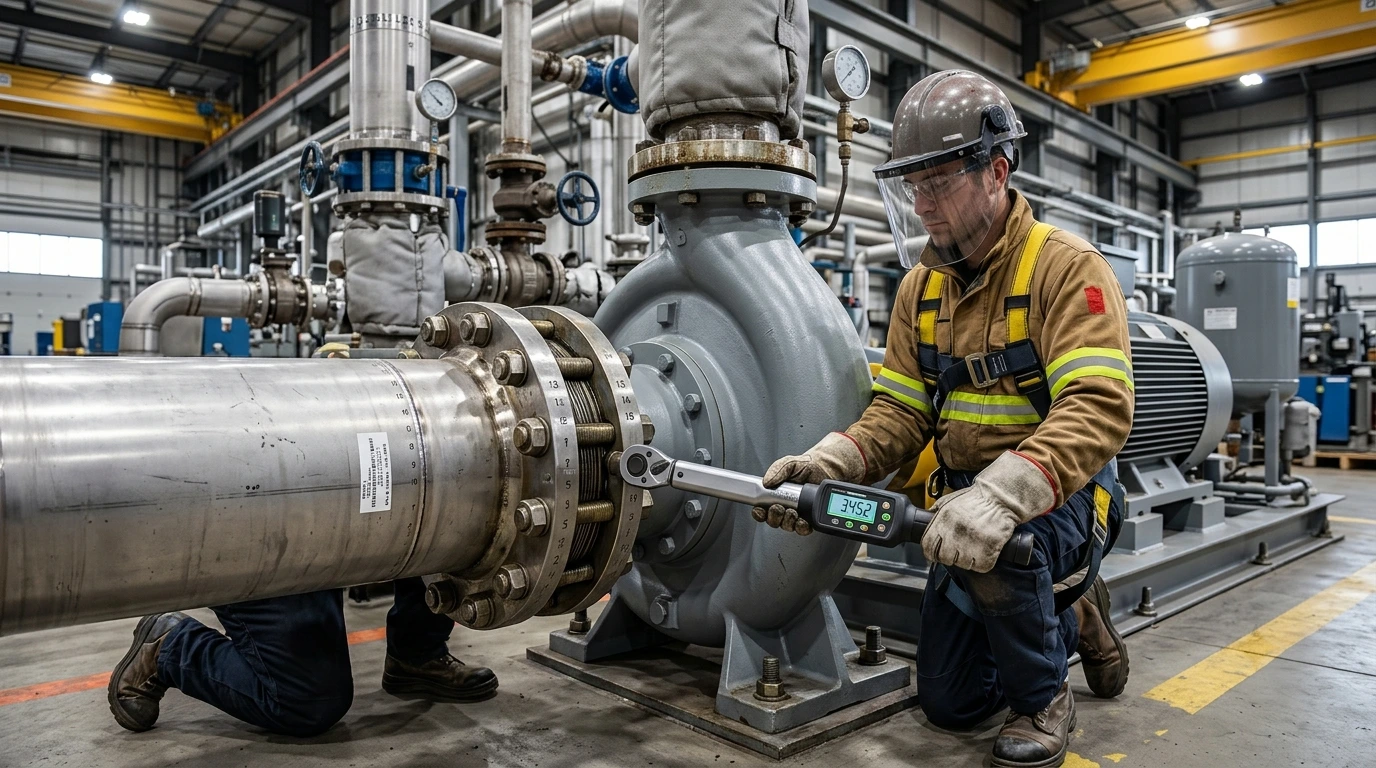
Description: Maintenance technician using a calibrated torque wrench on an industrial bolted connection where correct tightening torque helps develop the required joint preload.
Why Friction Changes Bolt Preload
Friction is one of the most important reasons why torque cannot be treated as a direct measurement of preload. When two fasteners receive the same torque setting, differences in friction can change the amount of bolt tension produced.
| Condition | Potential Effect |
|---|---|
| Dry threads | Higher friction can change the torque-to-preload relationship |
| Lubricated threads | Reduced friction can change the preload produced at the same torque |
| Corrosion or contamination | Variable friction can make preload less predictable |
| Surface coating | Changes in surface friction can affect tightening behavior |
| Thread condition | Damaged or worn threads can alter tightening characteristics |
Technician Tip: Never assume that a torque value from one lubrication or fastener condition will produce exactly the same preload under a different condition. Follow the specified tightening procedure for the actual joint.
Bolt Torque vs Preload in Industrial Maintenance
Understanding the relationship between torque and preload is particularly important in industrial maintenance because bolted joints are used throughout rotating and stationary equipment.
- Pump flange connections: Correct tightening helps maintain joint integrity and reduce leakage risk.
- Motor mounting bolts: Appropriate preload helps maintain secure mounting during operation and vibration.
- Gearbox housings: Correct tightening supports consistent joint loading.
- Bearing housings: Incorrect tightening can affect component alignment or joint integrity.
- Pipe and pressure flanges: Controlled tightening helps achieve the required joint condition.
- Rotating machinery: Proper fastener tightening helps reduce loosening and vibration-related problems.
What Happens With Too Little Preload?
Insufficient preload can allow joint movement or separation when external loads are applied. In industrial equipment, this may contribute to loosening, vibration, leakage, fretting, or fatigue-related problems.
What Happens With Excessive Preload?
Excessive preload can overstress the fastener or damage the connected components. Depending on the joint, this may result in thread damage, bolt yielding, flange distortion, or other mechanical problems.
For maintenance teams, the practical priority is not simply reaching a specified torque value, but applying the correct tightening procedure under the specified fastener and joint conditions.
Maintenance Best Practice: For critical bolted joints, verify the specified torque, fastener condition, tightening sequence, lubrication requirements, and torque wrench calibration before starting the job.
Common Bolt Preload and Torque Mistakes
Many tightening problems are caused not by the torque wrench itself, but by incorrect assumptions about the joint and fastener condition.
- Using the wrong torque specification: A generic value may not apply to the actual equipment.
- Ignoring lubrication: Changing lubrication can change friction and therefore the resulting preload.
- Assuming torque equals preload: Torque is the input, while preload is the resulting bolt tension.
- Using generic charts for critical joints: Critical equipment should follow the applicable engineering or manufacturer specification.
- Using an inaccurate torque wrench: Calibration condition directly affects the torque being applied.
- Ignoring fastener condition: Damaged, corroded, or contaminated threads can affect tightening behavior.
- Ignoring OEM instructions: Equipment-specific tightening procedures should take priority.
Before tightening critical fasteners, technicians should verify the required torque unit, torque value, fastener condition, lubrication requirements, and tool calibration. See the Torque Wrench Calibration Guide for more information about tool accuracy.
When Torque Alone Is Not Enough
Torque is a convenient and widely used method for controlling fastener installation, but it is still an indirect way of controlling preload. The actual relationship can vary because of friction and joint conditions.
For critical bolted connections, an engineering procedure may specify alternative or additional methods such as direct tension measurement, direct tension indicators, hydraulic bolt tensioning, turn-of-nut procedures, or other controlled tightening methods.
The correct method depends on the joint design, fastener requirements, equipment specifications, and applicable engineering standards.
Always check the applicable Torque Specifications Explained guidance before relying on a generic torque value.
Professional Recommendation: Use generic torque-preload calculations for understanding and estimation, but do not replace an equipment manufacturer's or engineering specification with a generic calculation when tightening critical joints.
Frequently Asked Questions (FAQs)
What is the difference between bolt torque and preload?
Bolt torque is the rotational input applied during tightening, while preload is the tension developed inside the bolt. The resulting preload creates the clamping force that holds the joint together.
Does higher torque always mean higher preload?
Increasing torque generally increases bolt tension under the same conditions, but the relationship is affected by friction, lubrication, fastener condition, and other factors. Therefore, torque does not provide a perfectly direct measurement of preload.
How does friction affect bolt preload?
Thread and bearing-surface friction consume a significant portion of the applied torque. Changes in lubrication, surface condition, coatings, or thread condition can therefore change the preload produced at the same torque value.
What is the bolt torque preload formula?
A commonly used estimation relationship is T = K × D × F, where T is tightening torque, K is the nut factor, D is nominal bolt diameter, and F is estimated preload.
What is the K factor in bolt torque calculations?
The K factor, or nut factor, represents friction-related effects in the torque-to-preload relationship. It can vary with lubrication, surface condition, coatings, fastener type, and other tightening conditions.
Can torque accurately measure bolt preload?
Torque provides an indirect method of controlling preload rather than a direct measurement of bolt tension. For critical joints, more direct tension-control methods may be specified by the equipment manufacturer or engineering procedure.
Should I use a generic torque chart for critical bolts?
Generic torque charts can provide useful reference information, but critical bolted joints should be tightened according to the applicable manufacturer, engineering, or equipment specification.
Continue Your Learning
Explore related Maitenics resources to strengthen your understanding of industrial torque and fastener maintenance:
About the Author
Wasim Shahzad is the founder of Maitenics, where he publishes practical engineering guides, industrial maintenance calculators, and troubleshooting resources for maintenance engineers, technicians, and reliability professionals. His work focuses on simplifying real-world mechanical maintenance challenges through practical, field-oriented guidance.