
Motor Pulley Sizing Guide for Belt Driven Industrial Systems
Motor Pulley Sizing Guide is essential for technicians and maintenance engineers working with belt driven machines in industrial plants, HVAC systems, pumps, and workshop equipment. Selecting the wrong pulley size can create airflow problems, motor overloading, excessive vibration, bearing damage, and inefficient machine performance.
In real maintenance work, I have seen technicians replace motors without recalculating pulley diameter, assuming the old pulley setup would still work correctly. In many cases, the motor RPM changes, causing incorrect fan speed or conveyor output. To avoid these issues, technicians should always verify pulley sizing using the Pulley RPM Calculator before installation.
Understanding motor pulley sizing helps maintain proper shaft speed, belt tension, airflow, torque transfer, and machine reliability in industrial environments.
What is Motor Pulley Sizing
Motor pulley sizing is the process of selecting the correct pulley diameter for a motor shaft to achieve the required output RPM in a belt drive system. The pulley size directly controls speed transfer between the driver pulley and the driven pulley.
In industrial systems, technicians use pulley sizing to match machine operating conditions. A larger driver pulley increases driven shaft RPM, while a smaller driver pulley reduces output speed.
This process is commonly used in:
- HVAC air handling units
- Cooling tower fan systems
- Water pump assemblies
- Industrial conveyor systems
- Lathe and drilling machines
- Compressor belt drives
Motor pulley sizing is closely connected with Pulley Speed Ratio Formula because pulley ratio determines the final operating RPM.
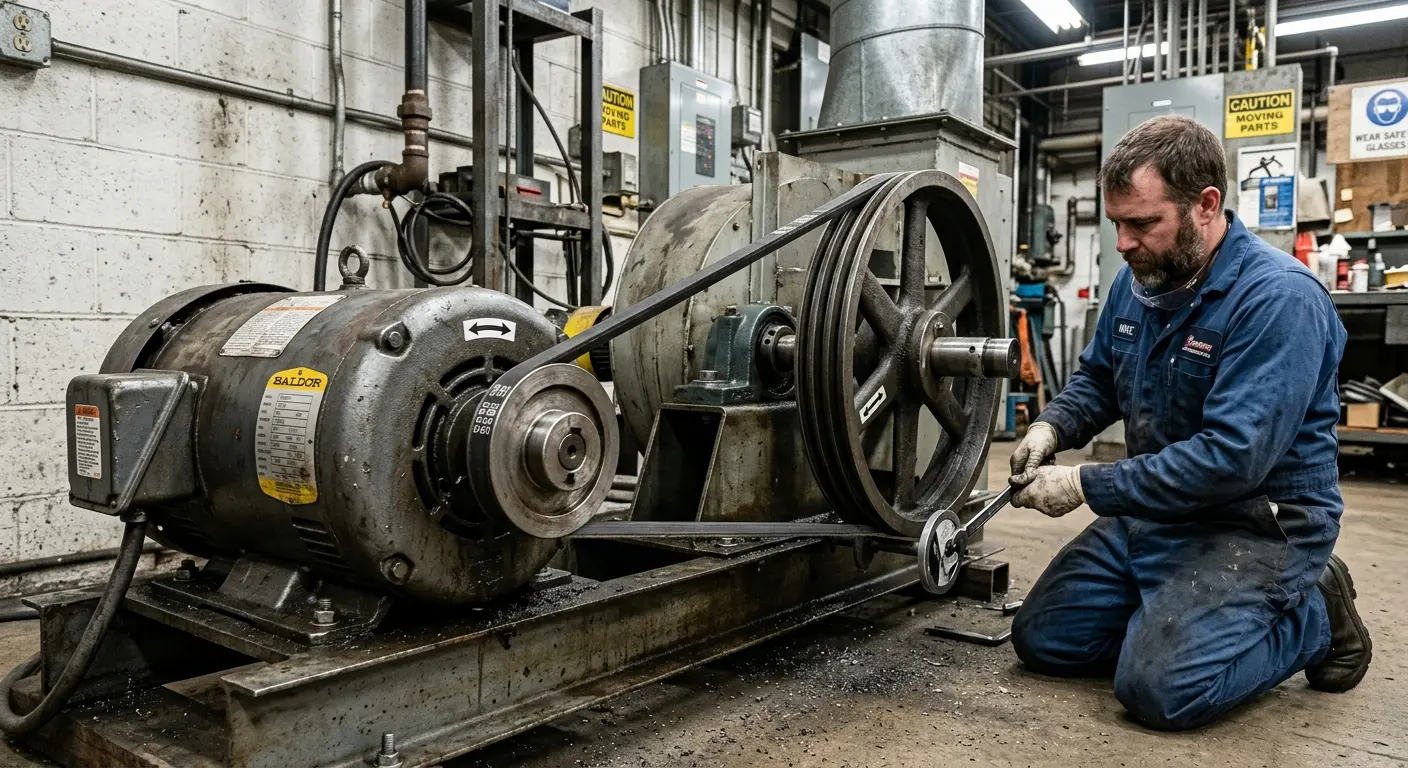
How Motor Pulley Size Affects RPM and Torque
Every pulley system transfers both rotational speed and torque through the belt. When technicians change pulley diameter, they also change shaft speed and mechanical load behavior.
Basic pulley behavior:
- Larger driver pulley increases output RPM
- Smaller driver pulley reduces output RPM
- Larger driven pulley lowers final speed
- Smaller driven pulley increases final speed
For example, if a 1440 RPM motor uses a large driver pulley connected to a smaller driven pulley, the output shaft rotates faster than the motor itself.
Technicians must also understand that increasing speed reduces available torque. In high-load applications such as pumps and compressors, incorrect pulley sizing may overload bearings, belts, or motor windings.
These calculations are commonly verified with Belt Drive RPM Calculation during installation and troubleshooting.
Motor Pulley Sizing Formula
The standard formula used for motor pulley sizing is:
Motor RPM × Driver Pulley Diameter = Driven RPM × Driven Pulley Diameter
To calculate the required driver pulley size:
Driver Pulley Diameter = (Driven RPM × Driven Pulley Diameter) ÷ Motor RPM
This formula allows technicians to determine proper pulley diameter before installation.
In many Gulf industrial plants, maintenance teams use this calculation during shutdown maintenance when replacing motors or upgrading airflow systems.
Technicians also combine pulley sizing with How to Calculate Belt RPM to verify actual operating conditions after startup.
Practical Motor Pulley Sizing Example
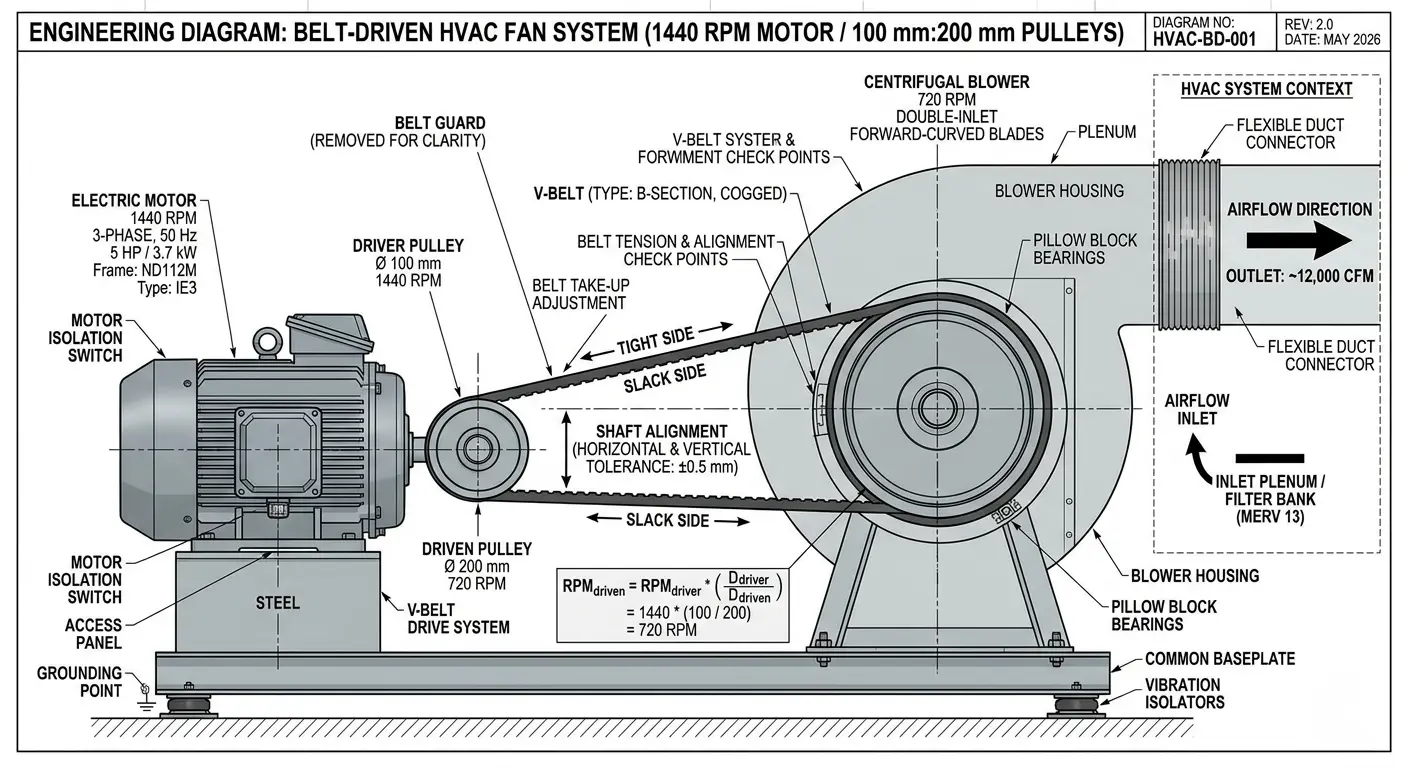
Suppose an HVAC fan requires 720 RPM output speed.
- Motor speed = 1440 RPM
- Driven pulley diameter = 200 mm
- Required output = 720 RPM
Using the formula:
Driver Pulley Diameter = (720 × 200) ÷ 1440
Driver Pulley Diameter = 100 mm
This means the technician should install a 100 mm driver pulley on the motor shaft to achieve the required fan speed.
In real maintenance environments, this type of calculation is extremely common during AHU balancing, cooling tower optimization, and airflow correction projects.
Motor Pulley Sizing Reference Table
| Motor RPM | Driver Pulley Size | Driven Pulley Size | Output RPM | Industrial Application |
|---|---|---|---|---|
| 1440 RPM | 100 mm | 200 mm | 720 RPM | Cooling tower fan speed reduction |
| 1440 RPM | 150 mm | 150 mm | 1440 RPM | Direct drive airflow system |
| 1750 RPM | 200 mm | 100 mm | 3500 RPM | Workshop drilling machine |
| 960 RPM | 90 mm | 180 mm | 480 RPM | Conveyor speed reduction |
Common Motor Pulley Sizing Mistakes
One of the biggest problems technicians face is selecting pulley sizes based only on visual estimation. This often creates serious operational issues after startup.
Common mistakes include:
- Using incorrect motor RPM values
- Ignoring belt slip under load
- Choosing oversized pulleys
- Incorrect shaft alignment
- Using worn pulleys with changed diameter
- Ignoring motor load requirements
A common mistake I’ve seen during shutdown work is installing larger pulleys to increase airflow without checking motor ampere load. This often causes overheating and premature motor failure.
These problems are also related to belt slip and RPM loss, pulley alignment procedure, industrial shaft balancing guide, belt tension adjustment guide, and fan airflow troubleshooting.
How to Select the Correct Motor Pulley
Technicians should always follow a structured process before replacing or installing pulleys.
- Verify motor RPM from nameplate
- Determine required output RPM
- Calculate pulley ratio
- Check shaft diameter compatibility
- Inspect belt profile and belt condition
- Measure available installation space
- Verify load requirements
For accurate belt installation, technicians should also confirm proper belt length using the Belt Length Calculator.
In high-load systems, pulley sizing directly affects torque transfer. Maintenance engineers often use the Torque Calculator to verify operating conditions after changing pulley diameter.
Real World Engineering Insight
In Gulf industries, motor pulley sizing is extremely important in HVAC and cooling tower systems because airflow directly affects plant temperature and process stability.
I worked on a cooling tower maintenance project where technicians replaced a failed motor but reused the old pulley setup without checking RPM compatibility. The replacement motor operated at a different speed, causing excessive fan RPM and severe vibration inside the tower assembly.
After recalculating pulley sizing and installing the correct driver pulley, vibration reduced immediately and airflow stabilized.
Experienced maintenance technicians never assume pulley compatibility. They always verify:
- Motor speed
- Pulley ratio
- Belt condition
- Shaft alignment
- Fan load
- Bearing temperature
Even a small pulley diameter change can significantly affect airflow, machine efficiency, vibration levels, and motor reliability.
Frequently Asked Questions
What is motor pulley sizing?
Motor pulley sizing is the process of selecting the correct pulley diameter to achieve the required output RPM in a belt-driven system.
How does pulley size affect RPM?
Larger driver pulleys increase output speed, while larger driven pulleys reduce output speed.
Why is pulley sizing important in HVAC systems?
Correct pulley sizing ensures proper airflow, stable motor load, and efficient fan performance.
Can incorrect pulley sizing damage a motor?
Yes. Incorrect pulley sizing can overload the motor, increase vibration, and reduce equipment lifespan.
What tools help with motor pulley sizing?
Technicians commonly use RPM calculators, belt length calculators, tachometers, and pulley ratio formulas.