
How to Calculate Belt RPM Step by Step Guide for Technicians
How to calculate belt RPM is one of the most important skills technicians need when working with belt-driven systems. In real industrial environments, incorrect RPM calculation can lead to poor machine performance, overheating, and even equipment failure.
In industrial maintenance, incorrect pulley ratios can cause equipment to operate at an unintended speed. Before replacing a motor, technicians should verify the driver RPM, pulley diameters, belt condition, and actual driven RPM. You can also simplify the calculation using the Pulley RPM Calculator.
What Does Belt RPM Mean in Real Systems
In a belt-driven system, RPM refers to the rotational speed of the driver or driven pulley shaft. Belt RPM calculations are used to determine the expected speed of the driven pulley from the driver RPM and pulley diameters.
The speed depends on pulley diameters and motor RPM. A smaller driver pulley increases speed, while a larger driven pulley reduces it. This relationship is also covered in Driver vs Driven Pulley.
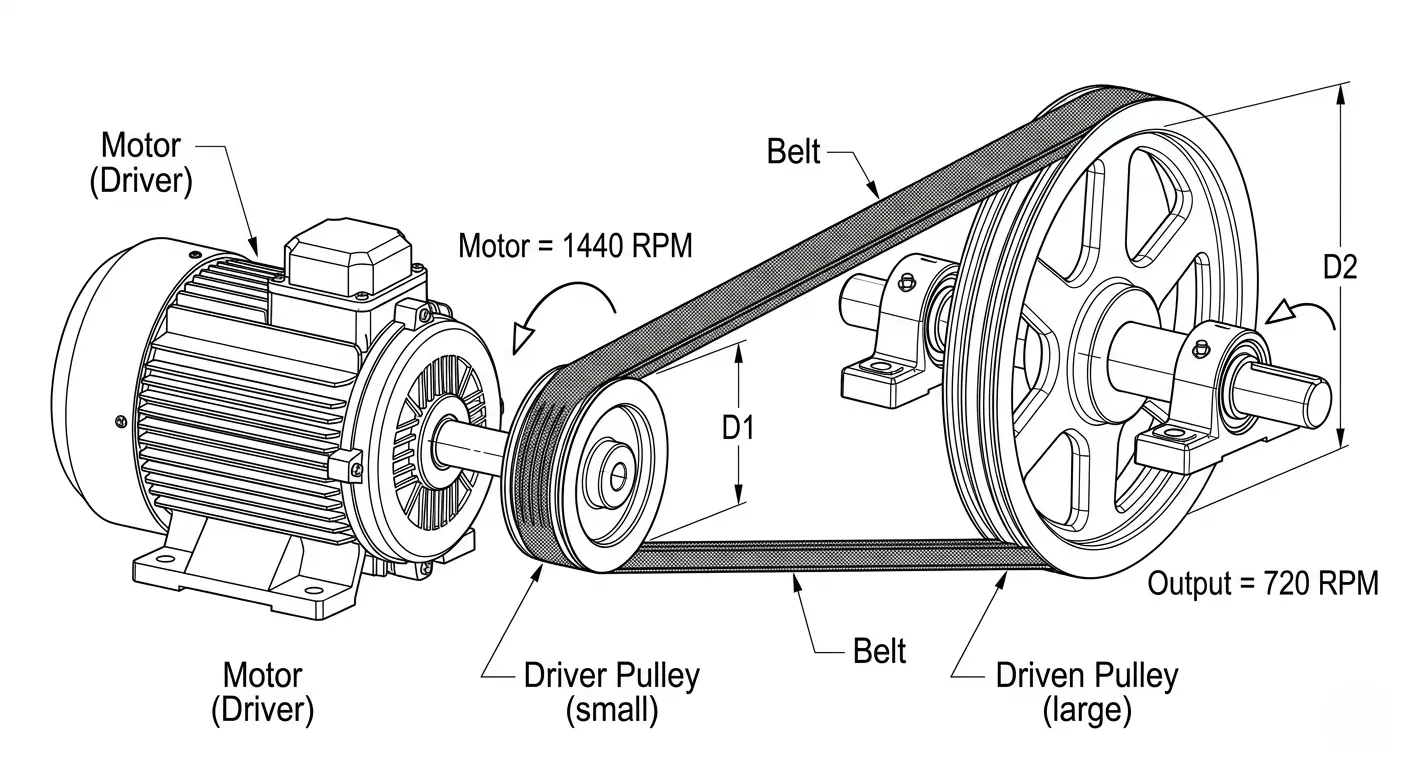
Formula to Calculate Belt RPM
The calculation is based on a simple mechanical relationship:
Driven RPM = (Driver RPM × Driver Diameter) ÷ Driven Diameter
This formula gives the theoretical driven RPM when significant belt slip is absent. Actual shaft speed can differ because of belt slip, pulley wear, measurement errors, alignment, and other operating conditions.
For the underlying diameter relationship, see our Pulley Speed Ratio Formula.
Step by Step Calculation Example
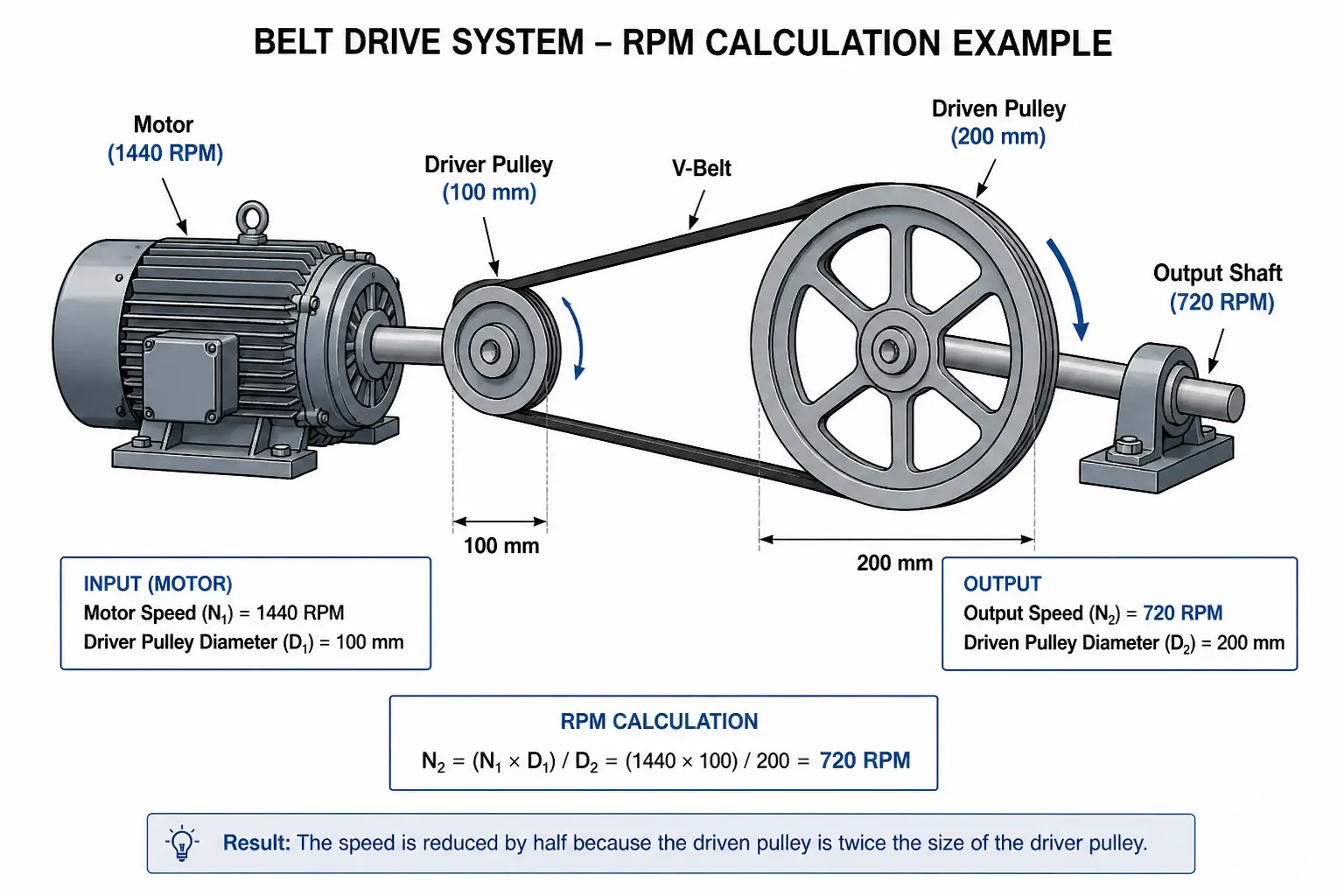
Let’s take a practical example from workshop machinery:
- Motor speed = 1440 RPM
- Driver pulley diameter = 100 mm
- Driven pulley diameter = 200 mm
Calculation:
Driven RPM = (1440 × 100) ÷ 200 = 720 RPM
The calculated driven speed is 720 RPM, which is 50% of the 1440 RPM driver speed. This type of calculation is useful when checking the expected speed of fans, pumps, conveyors, and other belt-driven equipment.
Instead of manual calculation, technicians often use the Pulley RPM Calculator for faster and more accurate results.
Where Belt RPM Calculation Is Used in Industry
- HVAC systems to control airflow
- Pump systems to adjust flow rate
- Conveyor belts for production control
- Workshop machines for speed adjustment
In systems involving load and torque, technicians also rely on the Torque Calculator to ensure proper system balance.
Common Mistakes When Calculating Belt RPM
- Using incorrect pulley diameter
- Confusing driver and driven pulleys
- Ignoring belt slip
- Not measuring actual pulley size
These issues are often related to pulley ratio explained, belt slip and RPM loss, and pulley alignment problems.
Troubleshooting RPM Issues in Real Machines
Even when calculations are correct, actual RPM can vary due to real-world conditions:
- Belt tension issues
- Pulley wear
- Misalignment
- Environmental factors like heat and dust
Always verify RPM using measuring tools after installation.
Quick Belt RPM Comparison Table
| Driver Pulley | Driven Pulley | Driver RPM | Theoretical Driven RPM | Effect |
|---|---|---|---|---|
| 100 mm | 200 mm | 1440 RPM | 720 RPM | Speed reduction |
| 150 mm | 150 mm | 1440 RPM | 1440 RPM | Same speed |
| 200 mm | 100 mm | 1440 RPM | 2880 RPM | Speed increase |
These are theoretical values based on the ideal belt-drive relationship and assume significant belt slip is absent. Actual RPM should be verified when precise machine speed is required.
Real-World Engineering Insight
In practical maintenance, technicians should verify the expected belt-driven RPM before assuming that a motor or driven machine has a fault. A difference between calculated and actual RPM can point to belt slip, incorrect pulley dimensions, wear, or alignment problems.
Always verify the actual pulley diameter rather than relying only on nominal values. After installation or pulley replacement, measuring the actual shaft RPM provides an additional check against the theoretical calculation.
Correct RPM helps equipment operate closer to its intended operating condition and can affect airflow, production speed, load, efficiency, and equipment performance.
Frequently Asked Questions
How do you calculate belt RPM?
Multiply the driver RPM by the driver pulley diameter and divide by the driven pulley diameter. For example, 1440 RPM × 100 mm ÷ 200 mm gives a theoretical driven speed of 720 RPM.
Does pulley size affect RPM?
Yes. With driver speed held constant, a larger driven pulley reduces driven RPM, while a smaller driven pulley increases driven RPM.
Why is actual RPM different from calculated RPM?
Actual RPM can differ from the theoretical calculation because of belt slip, pulley wear, measurement errors, alignment problems, and other operating conditions.
Can RPM be changed without changing the motor?
In many belt-driven systems, changing pulley sizes can change the driven RPM without changing the motor. The selected pulley sizes must remain within the equipment, belt, and manufacturer's operating limits.
Is the Pulley RPM Calculator accurate?
The Pulley RPM Calculator can provide an accurate theoretical result when the correct RPM and pulley measurements are entered. Actual machine speed may differ because of belt slip and other operating conditions.