
Belt Drive RPM Calculation for Industrial Machines and Pulley Systems
Belt Drive RPM Calculation is one of the most important tasks technicians perform when working with motors, pulleys, fans, pumps, and conveyor systems. Incorrect RPM calculation can reduce airflow, damage bearings, overload motors, or create serious production issues in industrial plants.
In real maintenance work, technicians often change pulley sizes during troubleshooting or shutdown activities without recalculating final shaft RPM. This creates performance problems that are difficult to diagnose later. To avoid calculation mistakes, you can use our Pulley RPM Calculator for quick speed verification before modifying the system.
Understanding belt drive RPM calculation helps technicians correctly adjust rotational speed, maintain equipment efficiency, and avoid unnecessary machine failures.
What is Belt Drive RPM Calculation
Belt drive RPM calculation is the process of determining the rotational speed transferred from a driver pulley to a driven pulley through a belt system. This calculation is commonly used in HVAC systems, water pumps, workshop machines, conveyors, compressors, and industrial fans.
In mechanical systems, the electric motor rotates the driver pulley mounted on the motor shaft. The belt transfers motion to the driven pulley connected to another shaft or machine component. The pulley diameter relationship controls the final RPM.
Technicians use RPM calculation to:
- Control machine speed
- Adjust airflow in HVAC systems
- Optimize pump performance
- Reduce vibration and overheating
- Match equipment operating requirements
This calculation also connects closely with Pulley Speed Ratio Formula and Pulley Ratio Explained because pulley diameter directly affects rotational speed.
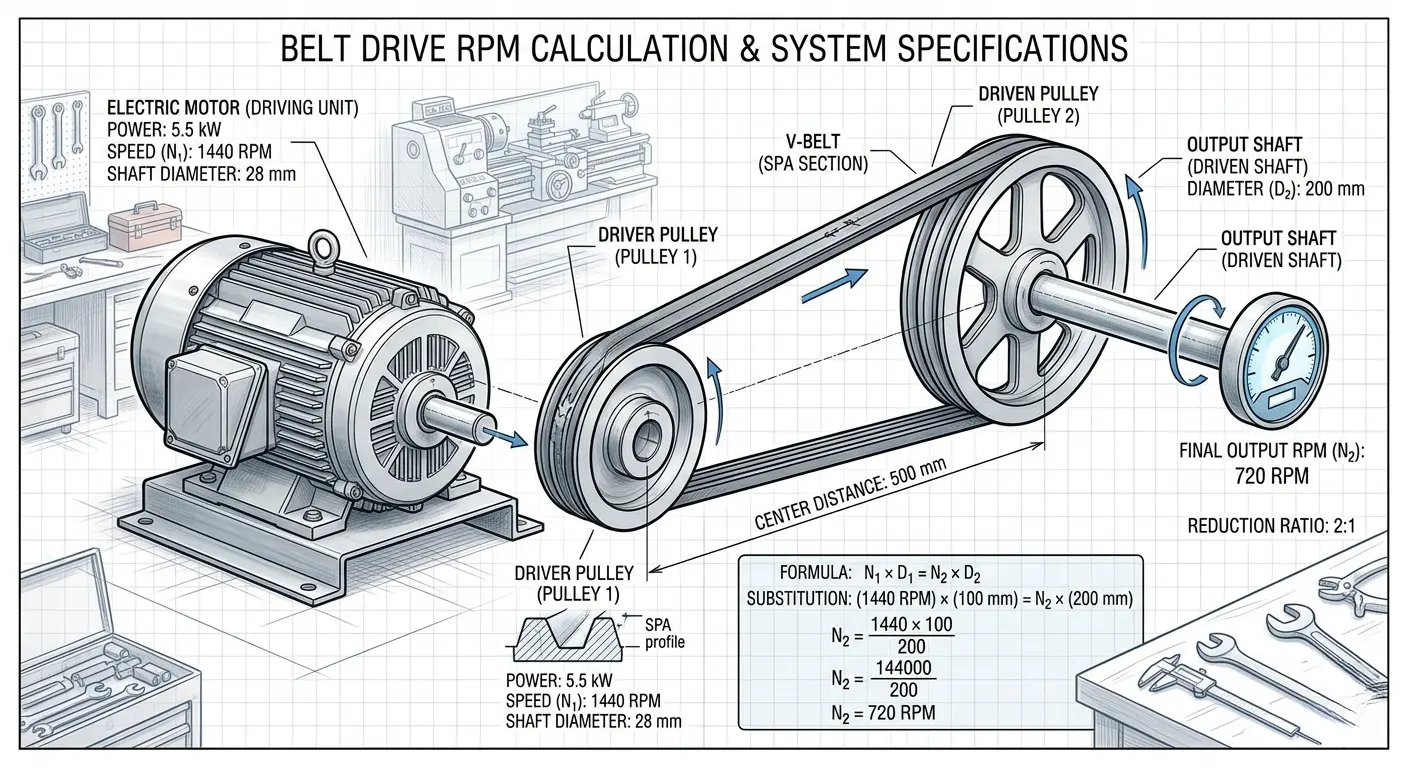
How Belt Drive RPM Calculation Works
When two pulleys are connected with a V-belt, the rotational speed changes depending on pulley diameter. A smaller driven pulley rotates faster, while a larger driven pulley rotates slower.
The standard formula used in industrial maintenance is:
Driver RPM × Driver Pulley Diameter = Driven RPM × Driven Pulley Diameter
To calculate final RPM:
Driven RPM = (Driver RPM × Driver Pulley Diameter) ÷ Driven Pulley Diameter
This formula allows maintenance engineers and technicians to calculate theoretical shaft speed before changing pulley sizes. It assumes significant belt slip is absent. Actual shaft speed can differ because of belt slip, pulley wear, measurement differences, alignment, and other operating conditions.
Technicians also combine this calculation with How to Calculate Belt RPM to verify actual field conditions after installation.
Step by Step Belt Drive RPM Calculation Example
Let’s use a practical example from a real industrial fan system.
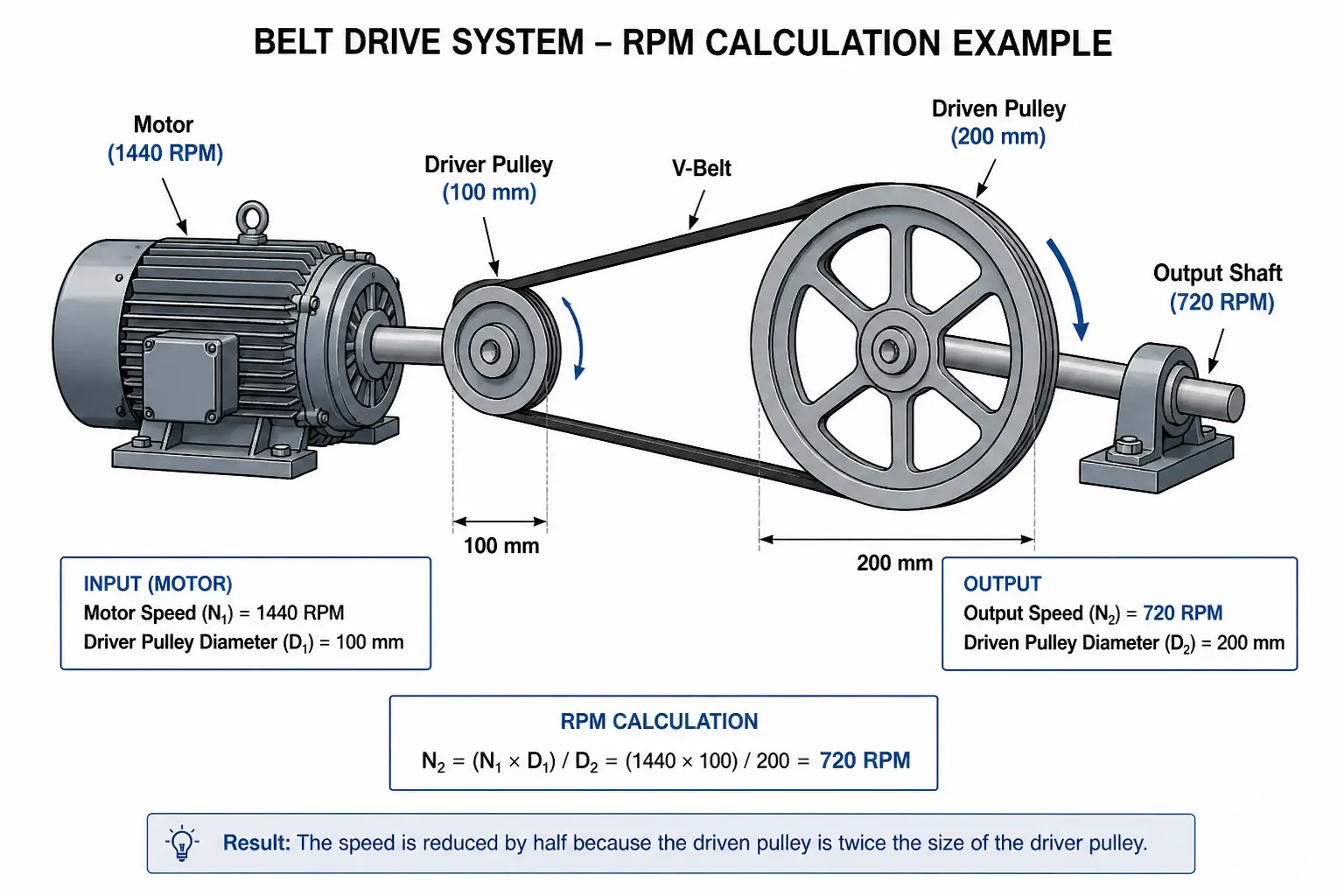
- Motor speed = 1440 RPM
- Driver pulley = 100 mm
- Driven pulley = 200 mm
Using the formula:
Driven RPM = (1440 × 100) ÷ 200
Driven RPM = 720 RPM
This means the fan shaft rotates at half the motor speed because the driven pulley is larger than the driver pulley.
In HVAC systems across Gulf industries, this setup is commonly used to reduce fan speed and improve airflow control.
Quick Belt Drive RPM Reference Table
| Motor RPM | Driver Pulley | Driven Pulley | Final RPM | Industrial Use |
|---|---|---|---|---|
| 1440 | 100 mm | 200 mm | 720 RPM | HVAC airflow reduction |
| 1440 | 150 mm | 150 mm | 1440 RPM | Direct speed transfer |
| 1440 | 200 mm | 100 mm | 2880 RPM | Workshop machine speed increase |
Industrial Applications of Belt Drive RPM Calculation
Belt drive systems are widely used in industrial equipment because they can transmit power between shafts and provide practical speed adjustment through pulley selection without changing the motor itself.
Common industrial applications include:
- HVAC blower systems
- Cooling tower fans
- Water pump systems
- Conveyor belt drives
- Lathe and drilling machines
- Air handling units
In industrial plants, technicians may modify pulley ratios during planned maintenance or equipment optimization to achieve the required airflow, machine speed, or production performance, subject to the equipment manufacturer's specifications.
When pulley diameter changes, technicians also need to verify belt length. For accurate belt selection, you can use the Belt Length Calculator to avoid incorrect belt installation.
Common Problems During Belt Drive RPM Calculation
In real maintenance environments, theoretical RPM and actual RPM are not always identical. Several field conditions affect performance.
Common issues include:
- Belt slip under heavy load
- Incorrect pulley measurement
- Pulley wear changing effective diameter
- Improper shaft alignment
- Loose belt tension
- Bearing vibration affecting rotation
A common mistake I’ve seen in industrial maintenance is technicians using nominal pulley size instead of actual measured diameter. Even small measurement errors can significantly affect RPM.
These problems are also closely related to belt slip and RPM loss and pulley alignment problems.
How to Improve RPM Accuracy in Belt Drive Systems
Technicians can improve RPM calculation accuracy by following proper maintenance practices.
- Always measure actual pulley diameter
- Inspect belt wear before calculation
- Verify motor nameplate RPM
- Check shaft alignment condition
- Measure RPM using tachometer after installation
- Use correct V-belt profile
When changing pulley size, technicians should also evaluate torque load on the motor. For load verification, you can use the Torque Calculator to understand system behavior after speed changes.
Real World Engineering Insight
Belt drive RPM calculation becomes especially important during shutdown and maintenance work on cooling towers, fans, pumps, and other belt-driven equipment. A pulley replacement that changes the driver-to-driven diameter relationship can cause the driven shaft to operate at an unintended speed.
For example, if a driven pulley is larger than specified, the resulting shaft RPM will be lower than the theoretical target. This can affect airflow or other equipment performance depending on the application.
Before returning equipment to service, technicians should verify:
- Motor or driver RPM
- Pulley diameters
- Belt condition
- Machine load requirements
- Actual driven shaft RPM
Verifying these values helps prevent incorrect speed assumptions and provides a more reliable basis for troubleshooting.
Frequently Asked Questions
What is belt drive RPM calculation?
It is the process of calculating rotational speed transferred between pulleys using pulley diameters and driver RPM.
Why is pulley diameter important in RPM calculation?
Pulley diameter directly affects driven speed. With driver speed held constant, a larger driven pulley reduces RPM while a smaller driven pulley increases RPM.
Can belt slip affect actual RPM?
Yes. Belt slip can cause the actual driven RPM to be lower than the theoretical calculated RPM.
Where is belt drive RPM calculation used?
It is commonly used in HVAC systems, pumps, conveyors, compressors, fans, and workshop machinery.
Why should technicians verify RPM after pulley replacement?
Because changing pulley size changes the theoretical driven speed. Verifying the actual shaft RPM after replacement helps confirm that the machine is operating at the intended speed.