
How to Calculate Pulley Ratio
How to calculate pulley ratio is one of the most important skills for maintenance technicians and engineers working with belt-driven equipment. A simple pulley ratio change can significantly affect RPM, belt speed, airflow, conveyor throughput, torque transmission, and overall equipment performance. Incorrect pulley ratio calculations often lead to production losses, poor machine performance, and unnecessary troubleshooting efforts.
In industrial facilities, pulley ratios are frequently used when modifying conveyor systems, adjusting fan speeds, replacing pulleys, optimizing equipment performance, or solving speed-related problems. Understanding how pulley ratios work helps maintenance teams predict equipment behavior before changes are made.
This guide explains the pulley ratio formula, how to calculate pulley ratio step by step, how pulley ratios affect RPM and belt speed, and the common mistakes technicians should avoid during maintenance and troubleshooting activities.
Before performing calculations, many engineers verify pulley dimensions using the guidance provided in How to Measure Pulley Diameter Correctly and use the Belt Speed Calculator to evaluate the impact of pulley changes on equipment performance.
What Is Pulley Ratio?
Pulley ratio describes the relationship between the diameter of the driving pulley and the diameter of the driven pulley in a belt-driven system. This ratio determines how rotational speed is transferred from one shaft to another.
A pulley ratio allows technicians to predict whether equipment speed will increase, decrease, or remain unchanged after modifying pulley sizes.
For example:
- A larger driven pulley generally reduces output RPM.
- A smaller driven pulley generally increases output RPM.
- Equal pulley diameters typically maintain the same RPM.
Because pulley ratio directly influences machine speed, it plays a critical role in conveyor systems, HVAC fan drives, pumps, compressors, packaging equipment, and many other industrial applications.
Maintenance engineers often review Pulley Diameter and Belt Speed Relationship when evaluating how pulley size changes influence equipment performance.
Pulley Ratio Formula
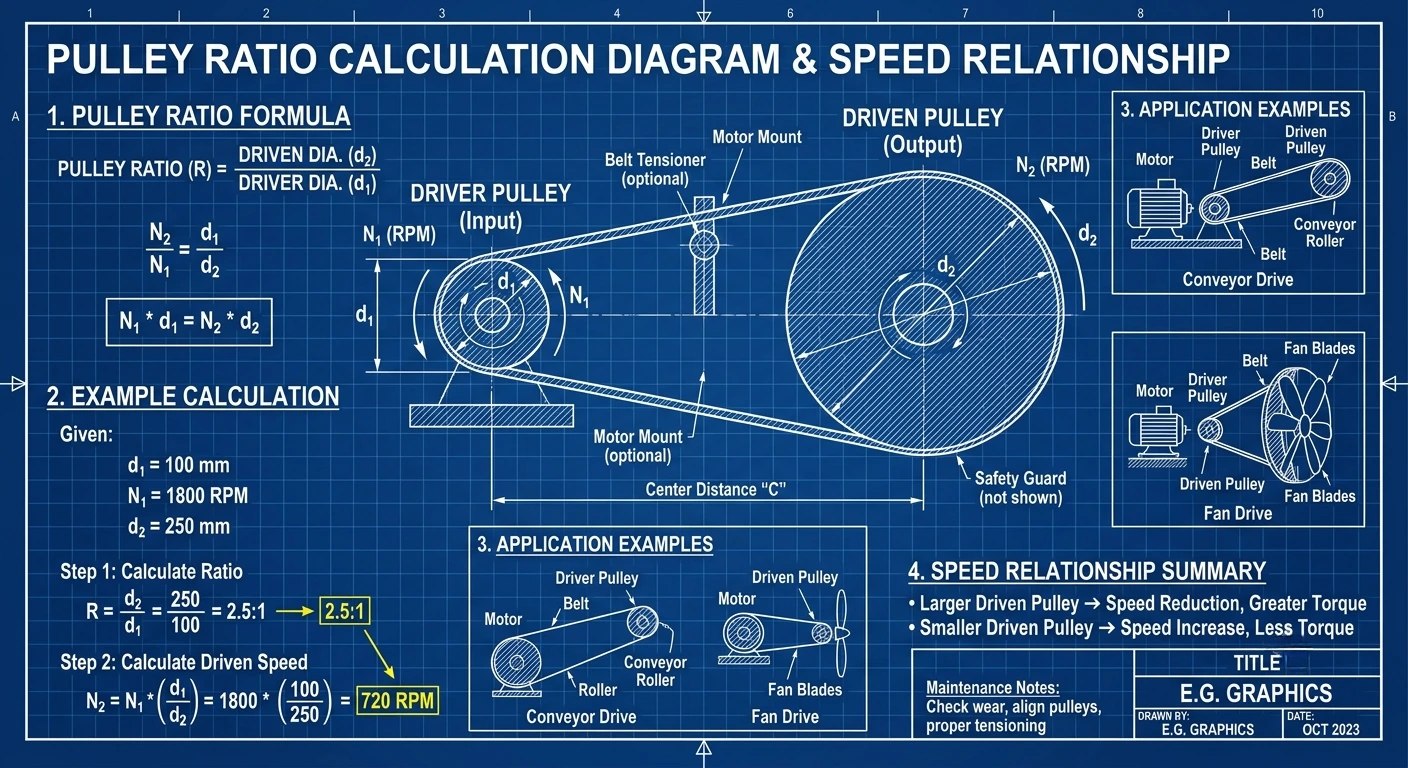
The pulley ratio is calculated by dividing the diameter of the driven pulley by the diameter of the driver pulley.
This formula allows technicians to quickly determine the speed relationship between two pulleys and predict the effect of pulley size changes before modifications are made.
The standard pulley ratio formula is:
Pulley Ratio = Driven Pulley Diameter ÷ Driver Pulley Diameter
Where:
- Driver Pulley = Pulley connected directly to the motor or power source.
- Driven Pulley = Pulley receiving power from the driver pulley.
If you are unsure which pulley is the driver or driven component, review Driver vs Driven Pulley Explained before performing ratio calculations.
Accurate pulley measurements are essential because even small diameter errors can affect calculated ratios and resulting speed predictions.
Technicians who encounter inconsistent results often revisit Common Belt Speed Calculation Mistakes to identify measurement and calculation errors before modifying equipment.
To calculate pulley ratio, divide the driven pulley diameter by the driver pulley diameter. A ratio greater than 1 generally reduces output RPM, while a ratio below 1 generally increases output RPM.
How to Calculate Pulley Ratio Step by Step
Calculating pulley ratio is straightforward when accurate pulley dimensions are available. However, successful troubleshooting requires more than simply applying a formula. Engineers should first verify pulley dimensions, inspect belt condition, and confirm equipment configuration before making calculations.
A practical step-by-step process includes:
- Identify the driver pulley.
- Identify the driven pulley.
- Measure pulley diameters accurately.
- Confirm measurement units.
- Divide driven pulley diameter by driver pulley diameter.
- Record the resulting ratio.
- Evaluate how the ratio affects equipment speed.
For example, if:
- Driver Pulley Diameter = 4 inches
- Driven Pulley Diameter = 8 inches
Pulley Ratio = 8 ÷ 4 = 2:1
This indicates that the driven pulley rotates at half the speed of the driver pulley.
| Driver Pulley | Driven Pulley | Ratio | RPM Effect |
|---|---|---|---|
| 4 in | 8 in | 2:1 | RPM Reduced |
| 5 in | 10 in | 2:1 | RPM Reduced |
| 6 in | 3 in | 0.5:1 | RPM Increased |
Related Calculators and Troubleshooting Guides
Pulley ratio calculations are most effective when combined with accurate RPM measurements, pulley inspections, belt speed analysis, and equipment performance reviews. The following resources can help engineers and technicians make better maintenance decisions.
- Pulley RPM Calculator
- Belt Speed Calculator
- Mechanical Calculators Hub
- How to Measure Pulley Diameter Correctly
- Pulley Diameter and Belt Speed Relationship
- RPM to Belt Speed Formula and Calculation
- Conveyor Belt Speed Calculation
- Common Belt Speed Calculation Mistakes
- What Is a Good Belt Speed
Maintenance teams involved in drive system upgrades often continue their research into Driver vs Driven Pulley Explained to better understand speed relationships and pulley selection decisions.
Real-World Engineering Insight
During maintenance shutdowns in Gulf manufacturing plants, HVAC facilities, cement factories, and material handling systems, pulley ratio changes are often introduced with the goal of improving performance.
When production targets require higher equipment speed, engineers often evaluate the methods discussed in How to Increase RPM Using Pulleys before modifying pulley sizes.
However, many speed-related problems begin when pulley modifications are made without properly calculating the resulting ratio.One common scenario involves increasing conveyor throughput by installing a smaller driven pulley. While production may initially improve, technicians sometimes overlook the impact on bearings, belt wear, vibration levels, and overall system reliability.
Another frequent issue occurs when replacement pulleys are ordered using estimated dimensions rather than verified measurements. A small diameter difference can alter pulley ratio enough to affect RPM, belt speed, airflow performance, and process output.
Experienced reliability engineers therefore verify pulley dimensions, review Original Equipment Manufacturer (OEM) specifications, confirm expected RPM changes, and evaluate downstream equipment impacts before approving modifications.
Because pulley ratio changes can influence transmitted torque, engineers often verify load requirements using the Torque Calculator before implementing drive modifications.
The most successful maintenance teams understand that pulley ratio is not simply a calculation. It is a decision-making tool that influences equipment performance, maintenance costs, and long-term reliability.

Frequently Asked Questions
What is a pulley ratio?
A pulley ratio is the relationship between the diameter of the driven pulley and the driver pulley. It determines how rotational speed is transferred between shafts.
How do you calculate pulley ratio?
Pulley ratio is calculated by dividing the driven pulley diameter by the driver pulley diameter. The result indicates how speed will change between pulleys.
Does pulley ratio affect RPM?
Yes. A larger driven pulley generally reduces RPM, while a smaller driven pulley generally increases RPM.
Does pulley ratio affect belt speed?
Yes. Pulley ratio influences belt speed because pulley diameter and rotational speed both affect belt movement through the system.
Can incorrect pulley ratio calculations cause equipment problems?
Yes. Incorrect calculations can lead to unexpected RPM changes, reduced production output, increased vibration, excessive wear, and troubleshooting difficulties.
Should pulley ratio be verified before replacing pulleys?
Absolutely. Verifying pulley ratio before replacement helps ensure equipment continues operating at the intended speed and performance level.