
Driver vs Driven Pulley Explained: Which One Controls Speed?
Driver vs driven pulley is a fundamental concept in belt-driven systems. Understanding which pulley receives power from the motor and which pulley transfers power to the driven machine helps technicians determine speed changes, troubleshoot performance problems, and select the correct pulley sizes.
To avoid these mistakes, you can quickly verify your system using the Pulley RPM Calculator, which helps you calculate speed changes accurately without manual errors.
Understanding Driver vs Driven Pulley in Simple Terms
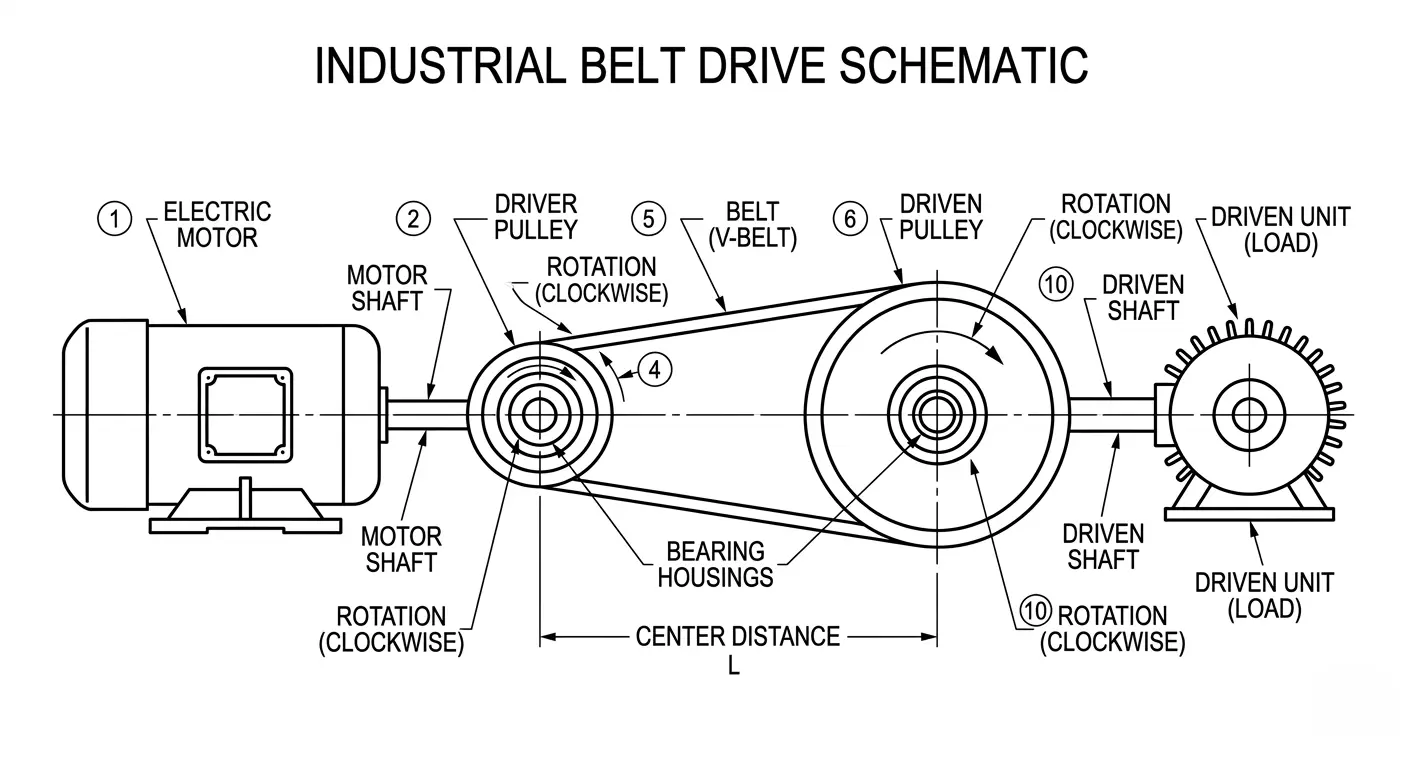
In any belt-driven system, two pulleys work together. The driver pulley is connected to the motor and provides motion, while the driven pulley receives motion and transfers it to the machine.
The entire system depends on how these two pulleys interact. If the driver pulley rotates faster or has a different diameter, it directly affects the output speed.
How Motion Transfers Between Driver and Driven Pulley
The driver pulley rotates using motor power, and through the belt, this motion is transferred to the driven pulley. The belt acts as a medium that maintains speed relationship.
The driver pulley size affects output speed together with the driven pulley size. With driver RPM held constant, a larger driver pulley generally increases driven RPM, while a smaller driver pulley generally decreases driven RPM when the driven pulley remains unchanged.
This concept is closely related to our Pulley Ratio Explained guide, which covers how pulley size changes affect speed and theoretical torque.
Which Pulley Should You Change to Increase RPM?
This is one of the most common questions asked by maintenance technicians during equipment upgrades and troubleshooting projects.
If the goal is to increase output RPM, technicians typically install a larger driver pulley or a smaller driven pulley. Both changes increase the speed transferred through the belt system.
If the goal is to reduce RPM, the opposite approach is used. A smaller driver pulley or larger driven pulley will decrease output speed.
Before making modifications, engineers should calculate the expected speed change using the Pulley RPM Calculator and verify pulley dimensions using How to Measure Pulley Diameter Correctly.
Formula Behind Driver and Driven Pulley Speed
The relationship is calculated using this equation:
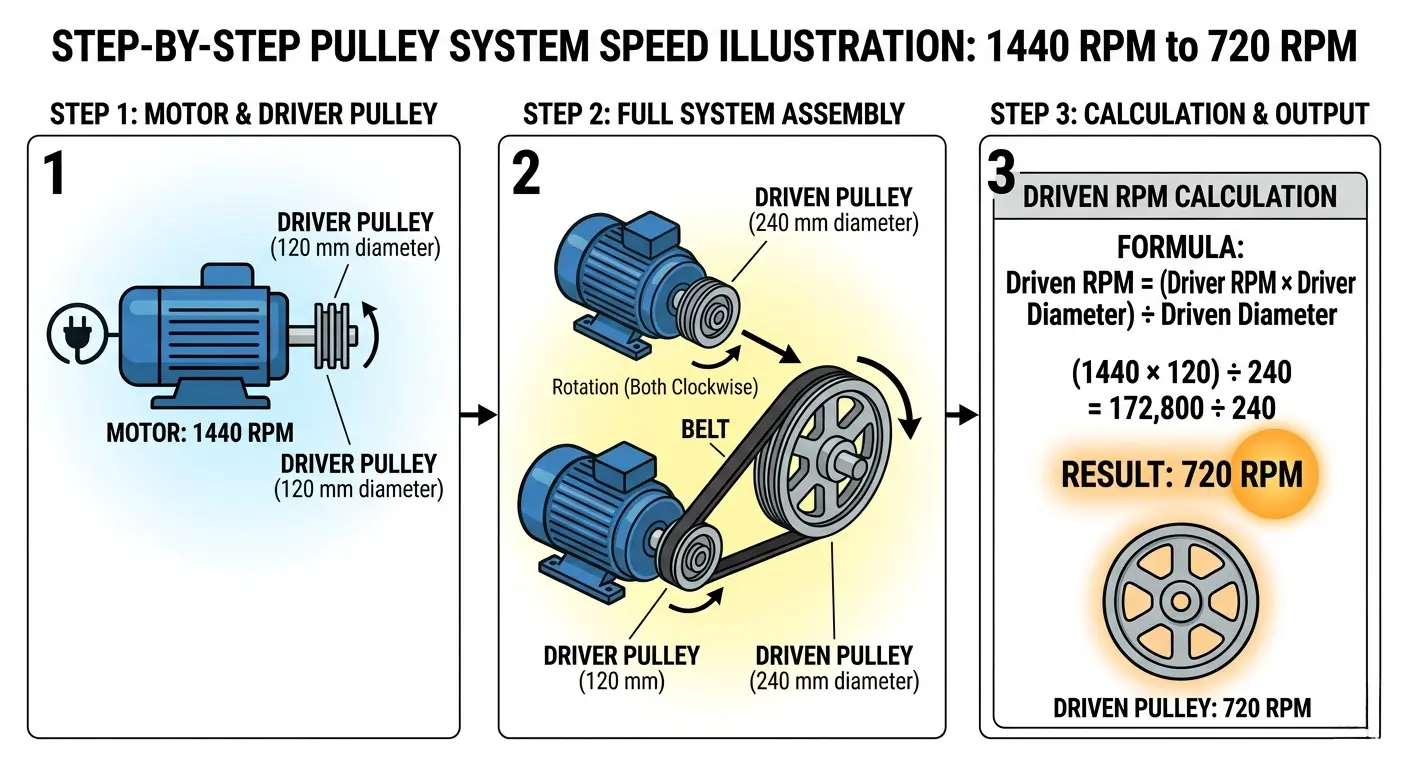
Driver RPM × Driver Diameter = Driven RPM × Driven Diameter
This relationship allows technicians to determine the expected driven speed from the driver RPM and pulley diameters. For a practical step-by-step calculation, see our Belt Drive RPM Calculation guide.
- How to calculate belt RPM – step-by-step method used in real maintenance work
Step-by-Step Example from Industrial Setup
Consider a real workshop machine:
- Motor speed = 1440 RPM
- Driver pulley = 100 mm
- Driven pulley = 200 mm
Driven RPM = (1440 × 100) ÷ 200 = 720 RPM
The theoretical driven speed is 720 RPM, which is 50% of the 1440 RPM driver speed. Actual shaft speed may vary because of belt slip, pulley condition, measurement differences, and other operating factors.
For quick calculation, technicians prefer using the Pulley RPM Calculator instead of manual calculation.
Where Driver and Driven Pulleys Are Used
- HVAC systems for airflow control
- Water pumps for pressure adjustment
- Conveyor systems for speed control
- Workshop machines for cutting and drilling
For load and force calculations, technicians also use the Torque Calculator.
How Driver and Driven Pulleys Affect Belt Speed
Driver and driven pulleys directly influence belt speed because pulley diameter and RPM work together to determine belt movement. A larger pulley moves more belt per revolution, while a smaller pulley moves less.
For this reason, engineers often evaluate pulley size changes together with belt speed calculations before making equipment modifications.
The relationship between pulley size and belt velocity is explained in Pulley Diameter and Belt Speed Relationship and can be verified using the Belt Speed Calculator.
In conveyor systems, incorrect pulley selection can change production throughput without creating obvious mechanical faults. This is one reason why pulley identification should always be confirmed before troubleshooting speed-related problems.
Common Mistakes Technicians Make
- Confusing driver and driven pulley
- Using incorrect diameter values
- Ignoring belt slip
- Poor alignment setup
These issues are often linked to belt slip and rpm loss and pulley alignment problems.
Troubleshooting Real Field Issues
In real industrial conditions, calculated RPM may differ due to wear and environmental factors.
- Belt tension affects speed
- Pulley wear changes diameter
- Dust and heat reduce efficiency
Technicians should always verify actual RPM using instruments.
Real-World Engineering Insight
In practical maintenance, a machine operating at the wrong speed does not always have a motor problem. Technicians should first verify the driver and driven pulley sizes, expected RPM, belt condition, and actual shaft speed before deciding whether major equipment changes are required.
Where the equipment design permits pulley adjustment, selecting an appropriate pulley combination can change driven speed without replacing the motor. The final pulley selection should remain within the equipment and belt manufacturer's specifications.
Always measure the actual pulley diameter and verify the resulting shaft RPM after installation or pulley replacement.
Driver vs Driven Pulley Comparison
| Driver Pulley | Driven Pulley | Driven Speed | Typical Effect |
|---|---|---|---|
| Smaller | Larger | Decreases | Speed reduction |
| Equal | Equal | Approximately unchanged | 1:1 speed relationship |
| Larger | Smaller | Increases | Speed increase |
The actual driven RPM depends on both pulley diameters and driver RPM. Belt slip and other mechanical conditions can cause the measured speed to differ from the theoretical value.
Frequently Asked Questions
What is a driver pulley?
The driver pulley is connected to the motor or other power source and transfers rotational motion through the belt to the driven pulley.
What is a driven pulley?
The driven pulley receives rotational motion from the belt and transfers that motion to the driven shaft or machine component.
Which pulley controls speed?
Both pulley diameters affect the driven speed. With driver RPM held constant, changing the driver or driven pulley size changes the speed relationship between the two shafts.
Can speed be changed without replacing the motor?
In many belt-driven systems, changing pulley sizes can change the driven RPM without replacing the motor. The selected pulley sizes must remain within the equipment, belt, and manufacturer's operating limits.
Why is actual RPM different from calculated RPM?
Actual RPM can differ from the theoretical calculation because of belt slip, pulley wear, measurement errors, alignment problems, and other operating conditions.