
How to Calculate Pulley RPM Step by Step Guide for Technicians
How to calculate pulley RPM is one of the most common questions technicians face when working with belt driven systems. Whether you are adjusting fan speed in an HVAC unit or troubleshooting a pump in an industrial plant, getting RPM wrong can lead to serious performance issues.
In real maintenance work, I have seen machines running inefficiently for weeks just because pulley speed was calculated incorrectly. The motor was working fine, the belt was in good condition, but the output RPM was completely off. This leads to low airflow, pressure issues, and unnecessary load on equipment.
This guide will show you exactly how to calculate pulley RPM step by step using practical examples, real industrial scenarios, and field experience from Gulf maintenance environments.
If you want accurate results instantly, you can also use our Pulley RPM Calculator to avoid manual errors.
What is Pulley RPM and Why It Matters
Pulley RPM refers to how fast a pulley rotates in a belt driven system. It directly controls how fast the connected machine operates. This includes fans, pumps, compressors, and conveyor systems.
In industrial environments across Saudi Arabia, UAE, and other Gulf regions, pulley systems are widely used in HVAC and pumping applications. Even a small error in RPM can affect system performance.
- A smaller pulley increases speed
- A larger pulley reduces speed
A common situation technicians face is replacing a pulley without recalculating RPM. This often results in airflow imbalance or reduced system efficiency.
To fully understand how speed changes between pulleys, it is also important to learn about pulley ratio explained and belt speed calculation formula, especially when working with multi pulley systems in industrial setups.
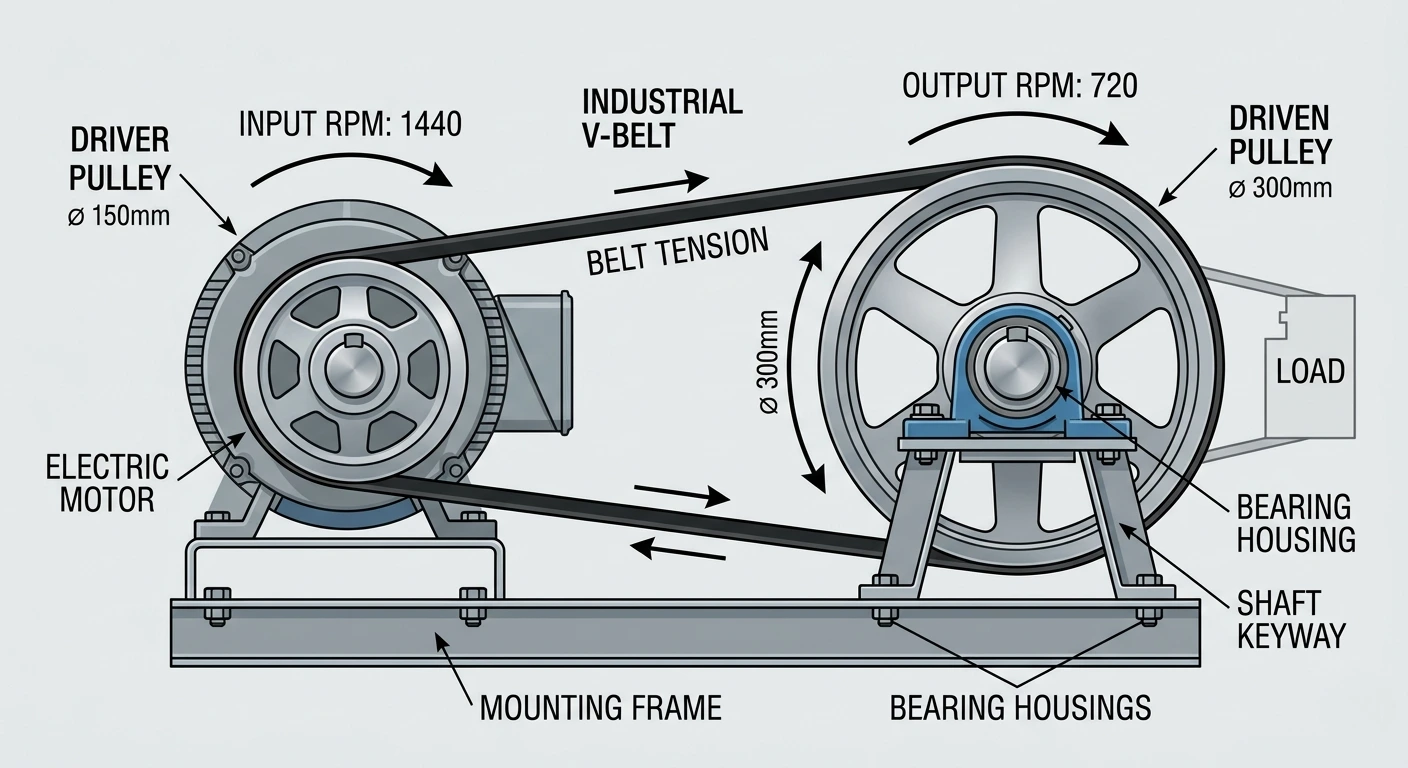
Pulley RPM Formula Explained
To understand how to calculate pulley RPM, you need to know the basic relationship between pulleys.
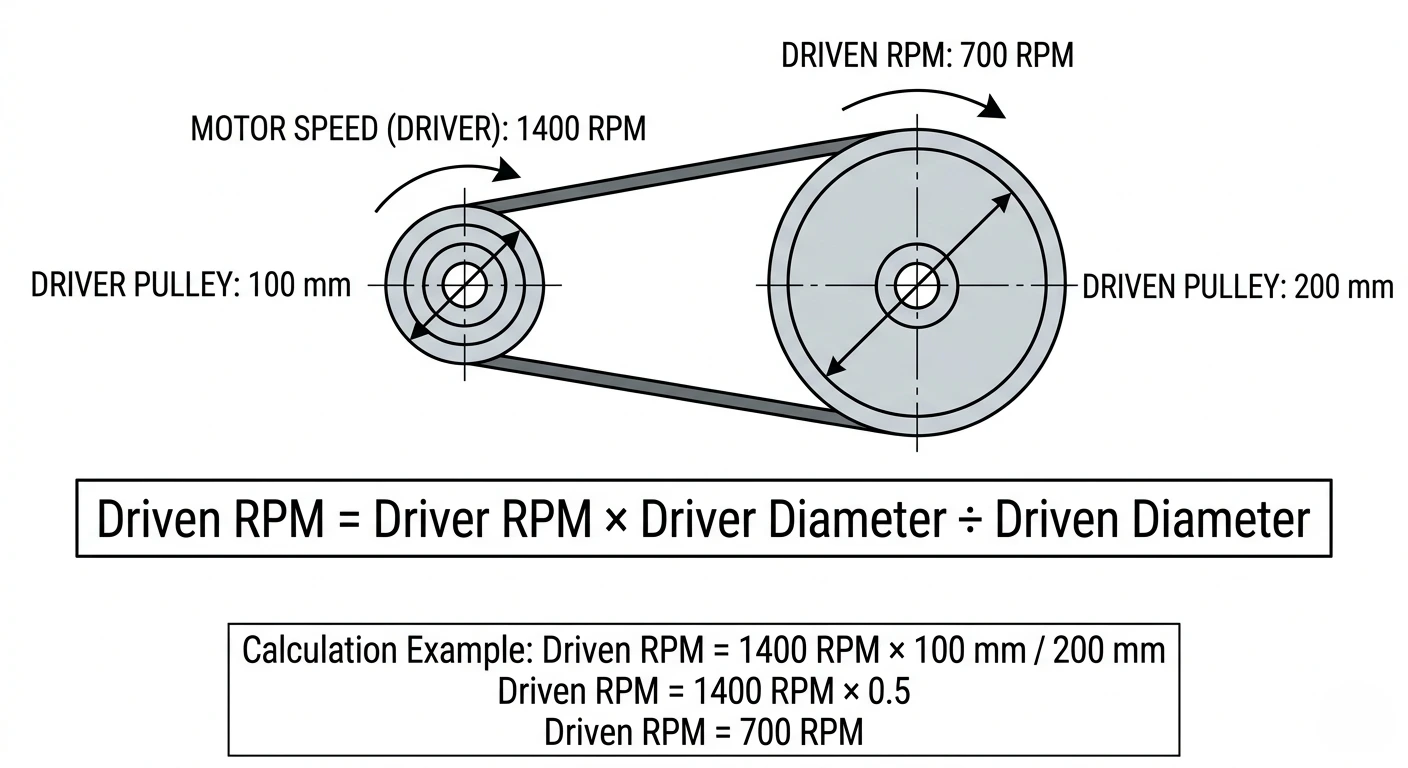
Driver RPM multiplied by Driver Diameter equals Driven RPM multiplied by Driven Diameter
To find the driven pulley speed:
Driven RPM equals Driver RPM multiplied by Driver Diameter divided by Driven Diameter
The formula is based on the ideal assumption that the belt has the same linear speed at both pulleys and that significant belt slip is absent. In real systems, belt slip, pulley wear, measurement errors, and other operating conditions can cause the actual RPM to differ from the theoretical result.
In simple terms, if you increase the driven pulley diameter while driver speed remains constant, driven speed decreases. If you reduce the driven pulley diameter, driven speed increases.
Step by Step Method to Calculate Pulley RPM
Let us go through a practical method used in real maintenance work.
- Check the motor RPM from the nameplate
- Measure the driver pulley diameter
- Measure the driven pulley diameter
- Apply the formula
Example calculation
- Motor speed is 1400 RPM
- Driver pulley is 100 mm
- Driven pulley is 200 mm
Driven RPM = 1400 × 100 ÷ 200 = 700 RPM
In real maintenance work, you can verify the calculation quickly with our Pulley RPM Calculator. This helps reduce arithmetic errors and speeds up routine checks.
For deeper understanding, technicians should also study how pulley diameter affects RPM and the difference between driver and driven pulley to avoid incorrect assumptions during maintenance work.
Real Industrial Scenario from Field Experience
A typical HVAC troubleshooting scenario involves low airflow even though the motor, filters, and belt appear to be operating normally. Checking the pulley sizes and calculating the expected fan RPM can reveal that the driven pulley is producing a lower speed than required.
If the driven pulley is larger than required, the fan or other driven equipment may operate below its intended speed. Where permitted by the equipment design and manufacturer specifications, selecting the appropriate pulley size can help restore the required operating speed without unnecessarily replacing the motor.
This example shows why technicians should calculate and verify pulley RPM before assuming that the motor or other components are the source of a performance problem.
In real industrial environments, advanced topics such as pulley systems in HVAC and motor pulley sizing guide are essential for improving system efficiency and long term performance.
Where Pulley RPM Calculation is Used
You will use pulley RPM calculations in many real situations.
- HVAC systems to control airflow
- Water pumps to maintain pressure and flow
- Workshop machines to adjust cutting speed
- Conveyor systems to control production rate
In Gulf industries, these systems operate for long hours. Incorrect RPM can lead to energy loss and equipment damage.
Common Mistakes Technicians Make
A common mistake I have seen is relying on assumptions instead of measurement.
- Ignoring belt slip which reduces actual RPM
- Using estimated pulley size instead of actual measurement
- Not verifying motor RPM
- Skipping recalculation after pulley replacement
These mistakes can cause overheating, vibration, and inefficient performance.
Many of these issues are closely related to belt slip and RPM loss and pulley alignment problems, which are frequently observed in heavy duty industrial systems.
Practical Comparison Table for Field Use
| Parameter | Meaning | Typical Use | Application |
|---|---|---|---|
| Driver RPM | Motor speed | Standard motor value | Base input for calculation |
| Driver Pulley | Motor pulley size | Speed control input | HVAC and pump systems |
| Driven Pulley | Machine pulley size | Output control | Fans and conveyors |
| Driven RPM | Final output speed | Performance result | System efficiency |
Technician Tips Based on Real Experience
In real maintenance work, these tips help avoid repeated issues.
- Always measure the actual pulley diameters
- Verify the actual motor or driver RPM
- Consider belt slip and operating conditions
- Verify actual RPM after any pulley adjustment
These small steps can significantly improve system performance.
Related Tools for Complete Analysis
To fully understand your system, use these tools:
Pulley RPM Calculator
Torque Calculator
Belt Length Calculator
Before moving to common questions, it is also useful to understand pulley speed ratio formula and belt drive RPM calculation to build a complete understanding of pulley systems.
Frequently Asked Questions
How do you calculate pulley RPM manually?
Multiply the driver RPM by the driver pulley diameter and divide by the driven pulley diameter. For example, 1400 RPM × 100 mm ÷ 200 mm gives a theoretical driven speed of 700 RPM.
Does pulley size affect speed?
Yes. With driver speed held constant, a larger driven pulley reduces driven speed, while a smaller driven pulley increases driven speed.
Why is actual RPM different from calculated RPM?
Actual RPM can differ from the theoretical calculation because of belt slip, pulley wear, measurement errors, alignment problems, speed variation, and other operating conditions.
Can I calculate pulley RPM without doing the formula manually?
Yes. You can use the Pulley RPM Calculator for a quick theoretical result, then verify the actual machine speed when required.
What happens if pulley RPM is incorrect?
Incorrect RPM can affect airflow, flow, production speed, load, efficiency, and equipment performance. The actual effect depends on the machine and its operating requirements.