
Pulley Speed Ratio Formula Explained with Real Industrial Examples
Pulley Speed Ratio Formula is an important calculation in belt-driven systems when you need to determine how pulley sizes affect rotational speed. If a fan, pump, conveyor, or other driven machine is operating at the wrong speed, pulley ratio is one of the factors that should be checked alongside belt condition, alignment, load, and other operating conditions.
Incorrect pulley ratios can cause belt-driven equipment to operate at an unintended speed, affecting airflow, process performance, and equipment efficiency. Before making physical changes, technicians can verify the expected speed using the Pulley RPM Calculator.
This guide explains everything in a simple and practical way so you can apply it directly in real industrial environments.
What is Pulley Speed Ratio Formula
Pulley speed ratio formula defines how speed changes between driver pulley and driven pulley. It helps you understand whether speed will increase or decrease based on pulley size.
- If driven pulley is larger then speed decreases
- If driven pulley is smaller then speed increases
Pulley speed calculations are commonly relevant to HVAC fan systems, pumps, conveyors, and other belt-driven equipment where the driven speed must match the equipment's operating requirements. In HVAC applications, an incorrect fan speed can affect airflow and system performance.
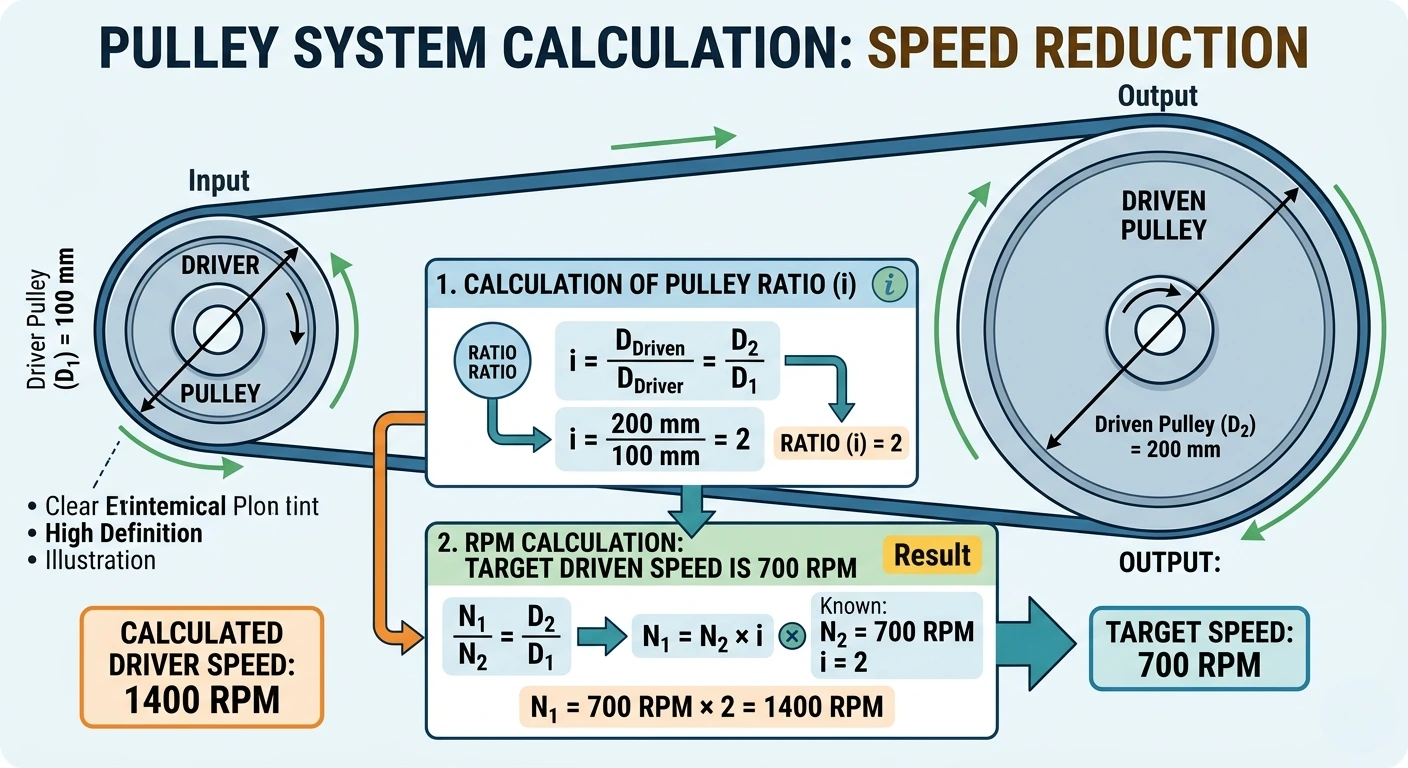
Pulley Speed Ratio Formula Explained
In a belt drive, pulley diameter and rotational speed are inversely related when belt slip is neglected. A larger driven pulley produces a lower driven speed, while a smaller driven pulley produces a higher driven speed.
The basic pulley diameter ratio can be expressed as:
Pulley Diameter Ratio = Driven Pulley Diameter ÷ Driver Pulley Diameter
For calculating the driven pulley speed, use:
Driven RPM = Driver RPM × Driver Pulley Diameter ÷ Driven Pulley Diameter
For example, if a 100 mm driver pulley operates at 1400 RPM and drives a 200 mm pulley, the ideal driven speed is 700 RPM. In this case, the pulley diameter ratio is 2:1, while the driven speed is 50% of the driver speed.
You can verify pulley speed calculations quickly with our Pulley RPM Calculator.
For a deeper understanding, you can also learn how to calculate pulley RPM and review our belt drive RPM calculation.
Step by Step Example Calculation
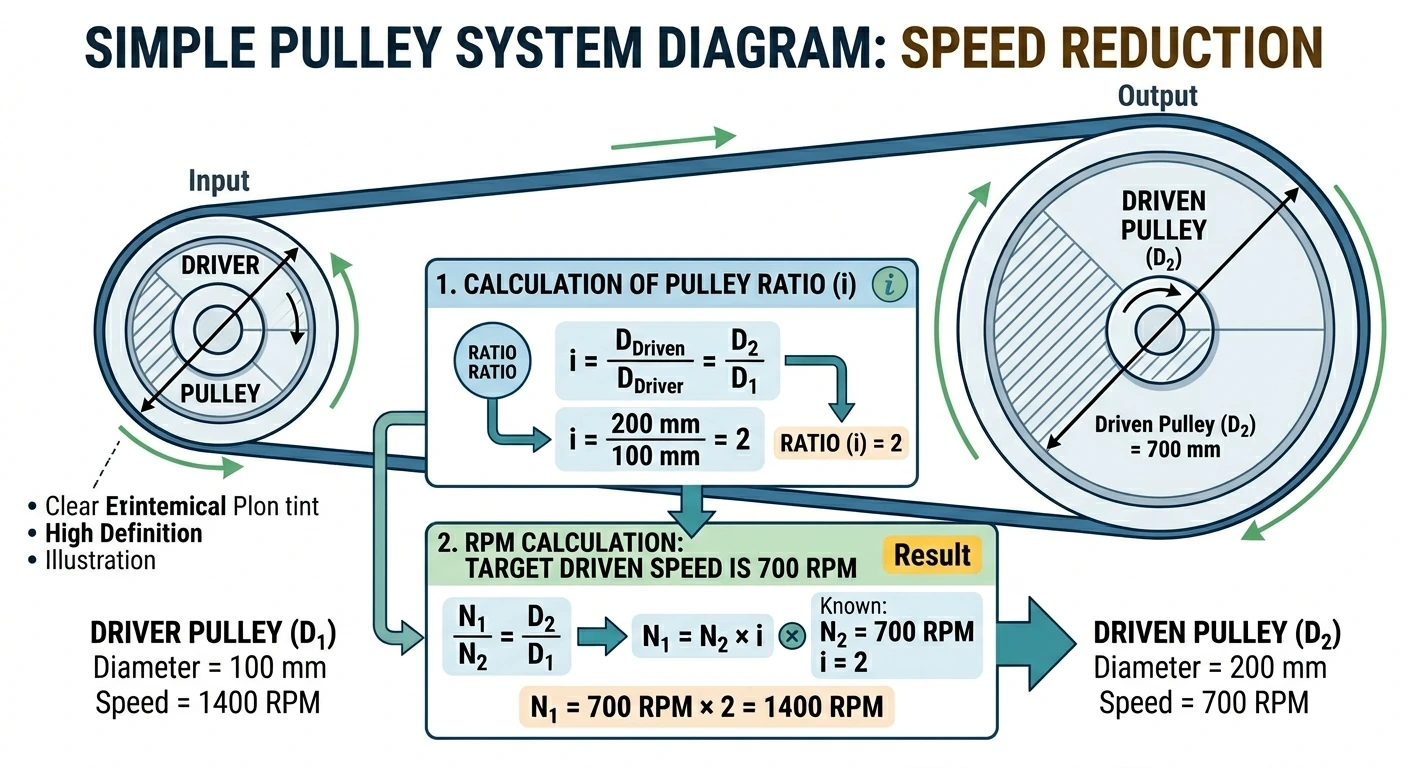
Let us take a real example:
- Motor speed is 1400 RPM
- Driver pulley is 100 mm
- Driven pulley is 200 mm
Driven RPM equals 1400 multiplied by 100 divided by 200
Final speed equals 700 RPM
This means speed is reduced to half.
Applications of Pulley Speed Ratio in Industry
Pulley ratio calculations are commonly used in industrial belt-driven equipment such as:
- HVAC systems for fan speed control
- Water pumps for pressure adjustment
- Workshop machines for speed variation
- Conveyor systems for production flow
Incorrect pulley ratios can contribute to unwanted operating conditions such as excessive speed, insufficient speed, reduced airflow, or increased mechanical loading. You can also use our Torque Calculator when evaluating torque requirements alongside pulley speed changes.
Advanced topics like pulley systems in HVAC and motor pulley sizing guide are also important for system optimization.
Common Mistakes in Pulley Ratio Calculation
A common calculation mistake is using an incorrect or assumed pulley diameter instead of verifying the actual pulley dimensions.
- Ignoring belt slip
- Wrong pulley measurement
- Incorrect alignment
- Not recalculating after replacement
These issues are closely related to belt slip and RPM loss and pulley alignment problems.
Troubleshooting and Practical Insights
In real industrial environments, troubleshooting is more important than theory.
- If airflow is low, verify fan speed and pulley ratio along with filters, dampers, and other system conditions
- If vibration occurs, inspect pulley alignment, belt condition, bearings, and mounting condition
- If speed fluctuates, inspect belt condition, tension, pulley condition, and actual shaft RPM
Understanding the pulley diameter vs RPM relationship helps predict how changing pulley sizes can affect driven speed before making mechanical changes.
Real-World Engineering Insight
In real maintenance work, pulley calculations are not just theoretical. An incorrect pulley ratio can cause a fan or other driven equipment to operate away from its intended speed, which can affect airflow, process performance, and energy use.
Technicians often focus on motor issues, but the real problem is usually speed mismatch. Correct pulley selection and calculation can improve efficiency without replacing equipment.
This is why using tools like pulley RPM calculator and understanding ratio formulas is critical in field conditions.
Practical Pulley Ratio Table
| Driver Pulley | Driven Pulley | Pulley Diameter Ratio | Ideal Driven Speed | Effect |
|---|---|---|---|---|
| 100 mm | 200 mm | 2:1 | 50% of driver RPM | Speed reduction |
| 150 mm | 150 mm | 1:1 | 100% of driver RPM | Same speed |
| 200 mm | 100 mm | 1:2 | 200% of driver RPM | Speed increase |
These values assume an ideal belt drive without significant belt slip. Actual operating speed can vary because of belt slip, pulley condition, measurement differences, and other mechanical factors.
Related Mechanical Resources
- Pulley RPM Calculator
- Belt Length Calculator
- Torque Calculator
- how to calculate belt RPM – step-by-step method used in real maintenance work
Frequently Asked Questions
What is the pulley speed ratio formula?
The pulley speed relationship can be calculated using the driver and driven pulley diameters. For an ideal belt drive, driven RPM equals driver RPM multiplied by driver pulley diameter divided by driven pulley diameter.
How does pulley ratio affect speed?
A larger driven pulley reduces driven speed, while a smaller driven pulley increases driven speed, assuming the driver speed remains constant and significant belt slip is absent.
Can I change machine speed without changing the motor?
In many belt-driven systems, changing the pulley sizes can change the driven speed without changing the motor. The new pulley selection must still remain within the machine, belt, and manufacturer's operating limits.
Why is my RPM different from the calculated value?
Actual RPM can differ from the theoretical calculation because of belt slip, incorrect pulley measurements, pulley wear, alignment problems, speed variation, or other mechanical conditions.
Is a pulley RPM calculator accurate?
A pulley RPM calculator can provide an accurate theoretical result when the correct formula and measurements are used. Actual machine speed can differ because of belt slip, pulley condition, measurement errors, and other operating factors.