
Pulley Diameter vs RPM Relationship Explained (Practical Guide for Technicians)
Pulley diameter vs RPM directly affects airflow performance, conveyor speed, machine efficiency, and equipment reliability in industrial belt-driven systems. In many industrial plants, incorrect pulley sizing gradually creates vibration, overheating, unstable RPM transfer, airflow imbalance, and unnecessary mechanical stress long before technicians identify the real operating problem.
Pulley diameter changes can significantly affect driven speed in belt-driven systems. Understanding this relationship is important when troubleshooting HVAC fans, pumps, conveyors, and workshop machines because an incorrect pulley size can cause the driven equipment to operate above or below its intended speed.
If you want accurate results instantly, you can also use our Pulley RPM Calculator to avoid manual errors. Technicians also verify speed transfer behavior using the How to Calculate Belt RPM guide because pulley diameter changes directly affect conveyor speed, airflow, and machine efficiency.
What is the Relationship Between Pulley Diameter and RPM
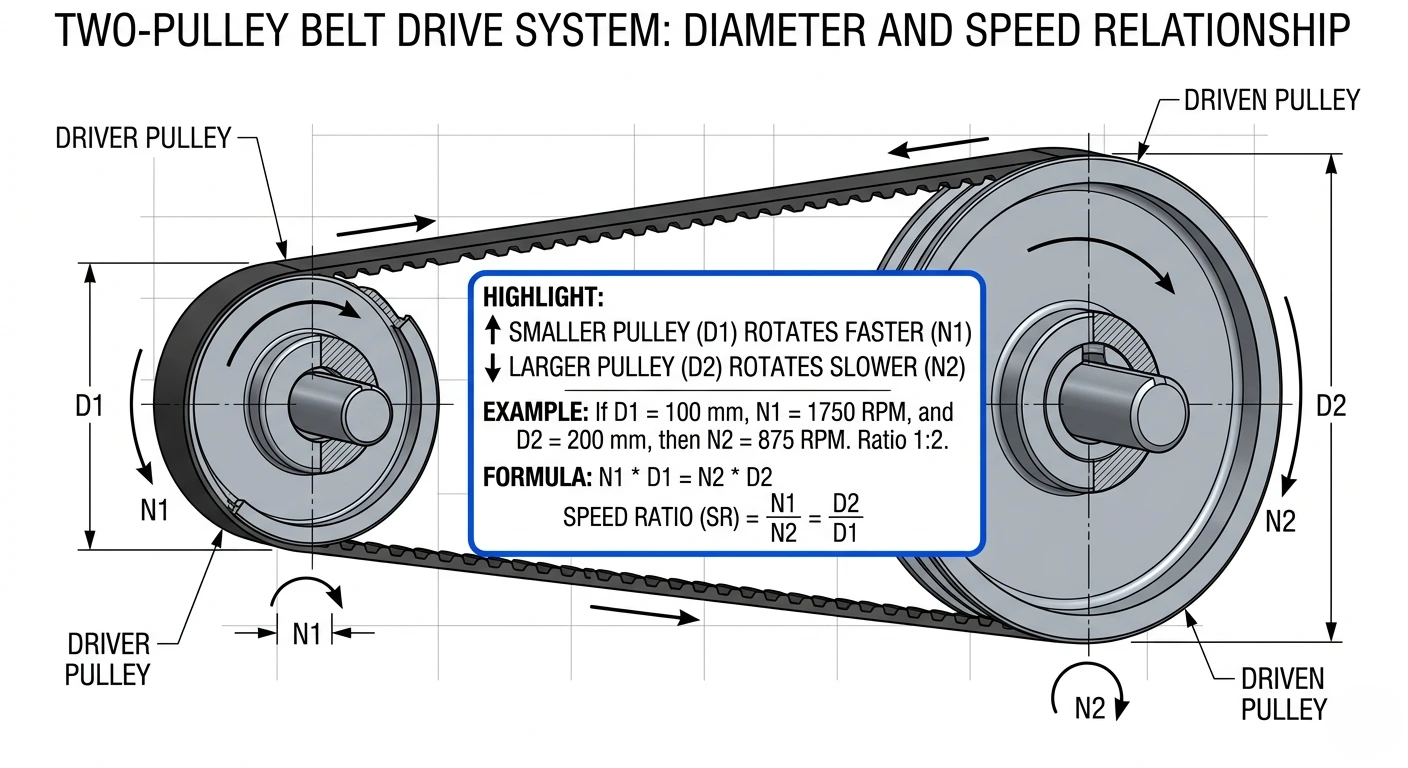
The relationship between pulley diameter and RPM is inversely proportional. This means when the pulley diameter increases, the RPM decreases, and when the diameter decreases, the RPM increases.
This principle works because the belt transfers motion based on circumference. A larger pulley travels more distance per rotation, so it rotates slower. A smaller pulley rotates faster to maintain the same belt speed.
- Smaller pulley → Higher RPM
- Larger pulley → Lower RPM
Technicians often use this principle to adjust speed without changing the motor. Instead of replacing expensive equipment, they simply change pulley size.
In HVAC systems, conveyors, and industrial fans, incorrect pulley diameter selection often creates hidden performance problems such as unstable airflow, excessive motor load, rising vibration levels, and repeated belt wear during long-term operation.
Pulley Diameter vs RPM Formula Explained
The relationship between pulley diameter and speed is calculated using a simple formula:
Driver RPM × Driver Diameter = Driven RPM × Driven Diameter
From this, you can calculate the driven RPM:
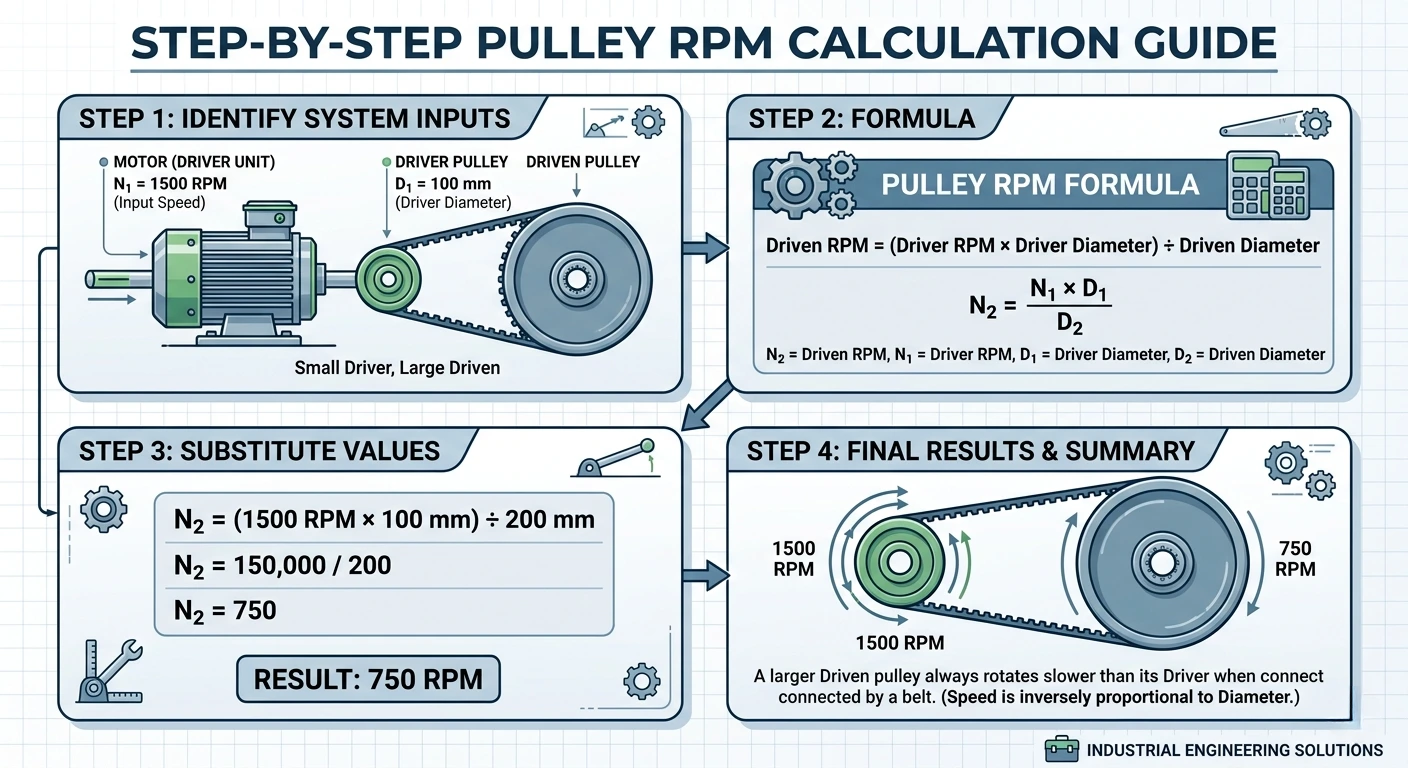
Driven RPM = (Driver RPM × Driver Diameter) ÷ Driven Diameter
This formula is the foundation of all belt-driven calculations. It is also explained in detail in Belt Drive RPM Calculation and Pulley Ratio Explained.
In real industrial environments, this formula helps technicians quickly adjust machine speed based on production needs. Engineers frequently combine these calculations with Belt Speed Calculation Formula analysis when troubleshooting conveyor systems, HVAC blowers, and process machinery.
Experienced maintenance teams also verify motor amperage, vibration behavior, and airflow performance because pulley diameter changes can slowly affect overall system stability without creating immediate visible mechanical failure.
This concept is closely related to our detailed guide on Pulley Speed Ratio Formula, where you can understand how pulley sizes affect speed in real systems.
Step-by-Step Example (Real Industrial Scenario)
Let’s take a practical example from a workshop machine:
- Motor speed = 1500 RPM
- Driver pulley = 100 mm
- Driven pulley = 200 mm
Now apply the formula:
Driven RPM = (1500 × 100) ÷ 200 = 750 RPM
This means the output shaft rotates at 750 RPM, which is exactly half of the motor speed.
If you are new to calculations, follow our step-by-step guide on How to Calculate Pulley RPM for practical understanding.
In Gulf industries, this setup is commonly used in fan systems where lower speed is required for controlled airflow. Maintenance engineers also compare these RPM changes using the Fan Speed vs Airflow guide because incorrect pulley sizing can reduce cooling efficiency significantly.
When pulley diameter changes are made without verifying final RPM behavior, HVAC systems often experience airflow instability, increased motor temperature, excessive vibration, and reduced cooling efficiency during peak summer operation.
Where This Relationship is Used in Real Applications
The pulley diameter vs RPM relationship is widely used in different industrial systems:
HVAC Systems
Used to control fan speed and airflow. Incorrect pulley size can reduce cooling efficiency.
Water Pump Systems
Helps adjust pump speed to maintain proper pressure and flow rate.
Conveyor Systems
Controls belt speed and production output.
Workshop Machines
Used in drilling, cutting, and lathe machines to adjust operational speed.
Technicians often combine this with the Torque Calculator to ensure proper force and performance.
During conveyor troubleshooting, technicians also use the Conveyor Belt Speed Calculation method to verify output speed and identify production slowdowns caused by incorrect pulley diameter selection.
Common Mistakes Technicians Make
A common mistake is assuming that increasing pulley size directly increases motor power. Pulley diameter primarily changes the speed and torque relationship between the driver and driven shafts; available motor power remains determined by the motor and system conditions.
- Using nominal diameter instead of actual diameter
- Ignoring belt slip
- Incorrect pulley alignment
- Wrong tension setup
These mistakes lead to incorrect RPM calculations and poor machine performance.
For deeper understanding, refer to driver vs driven pulley guide and common pulley mistakes article.
Troubleshooting RPM Issues in Real Systems
Even if your calculation is correct, real-world results may differ due to several factors.
Maintenance teams often discover these problems late because small RPM changes may continue affecting machine efficiency and mechanical stability long before visible failure symptoms appear.
- Belt slippage reduces actual RPM
- Pulley wear changes effective diameter
- Misalignment causes vibration and speed loss
- Improper tension affects efficiency
In real maintenance work, always verify RPM using a tachometer instead of relying only on calculations.
You can also analyze issues using Belt Slip and RPM Loss, Pulley Alignment Problems, Pulley Wear Symptoms, and industrial vibration troubleshooting procedure.
Quick Reference Table for Pulley Diameter vs RPM
| Driver Pulley | Driven Pulley | Ratio | Use Case |
|---|---|---|---|
| 100 mm | 200 mm | 2 | Reduce fan speed |
| 150 mm | 150 mm | 1 | Same speed transfer |
| 200 mm | 100 mm | 0.5 | Increase machine speed |
Most pulley RPM problems develop gradually during continuous operation. Early pulley ratio verification and RPM inspection help technicians identify unstable operating conditions before they create larger mechanical or production issues.
Real-World Engineering Insight
In industrial maintenance, pulley diameter adjustments can be useful when equipment speed needs to be corrected without replacing the motor, provided the equipment and belt system are designed to accommodate the change.
The key is to determine whether the machine requires a higher or lower driven speed and then select pulley sizes that achieve the required ratio while remaining within manufacturer limits.
Always measure the actual pulley diameter and verify the resulting shaft RPM after installation. Small measurement or ratio errors can affect airflow, conveyor speed, vibration, and overall equipment performance.
For additional understanding, see our Pulley Speed Ratio Formula.
Related Tools and Resources
For deeper understanding of pulley sizing, measurement, and belt-drive troubleshooting, see our Motor Pulley Sizing Guide, Pulley Measurement Guide, and Pulley Systems in HVAC.
Frequently Asked Questions
How does pulley diameter affect RPM?
With driver speed held constant, a smaller driven pulley results in higher driven RPM, while a larger driven pulley results in lower driven RPM.
Can I change machine speed without changing the motor?
In many belt-driven systems, changing pulley diameter can change the driven speed without replacing the motor. The selected pulley sizes must remain within the equipment, belt, and manufacturer's operating limits.
Is pulley diameter more important than RPM?
Pulley diameter and RPM are directly related in a belt-driven system. Changing one pulley diameter changes the speed relationship between the driver and driven shafts.
Why is my RPM different from the calculated value?
Actual RPM can differ from the theoretical calculation because of belt slip, pulley wear, measurement errors, alignment problems, and other operating conditions.
Is the pulley diameter and RPM formula accurate for all machines?
The formula provides the theoretical speed relationship for belt-driven systems when the correct pulley diameters and driver RPM are used. Actual machine speed can vary because of belt slip, pulley condition, alignment, and other operating factors.
Use Pulley RPM Tools for Accurate Speed Verification
For accurate pulley speed verification and RPM calculations, technicians should use the Pulley RPM Calculator to analyze pulley diameter changes, RPM transfer behavior, and machine speed stability during maintenance work. Engineers also use the Pulley Speed Ratio Formula guide and the Conveyor Belt Speed Calculation resource to troubleshoot airflow imbalance, conveyor slowdown, and unstable industrial belt drive performance more accurately.