
Pulley Measurement Guide for Accurate Belt Drive Maintenance
Pulley Measurement Guide is one of the most important topics in industrial maintenance because incorrect pulley dimensions can create RPM loss, belt slip, vibration, airflow imbalance, and premature bearing failure. In real maintenance work, many technicians replace pulleys without properly measuring diameter, groove profile, shaft bore, or belt section, which leads to repeated operational problems.
Before replacing a pulley, maintenance teams often verify rotational speed and pulley ratio using the Pulley RPM Calculator to ensure the new pulley maintains correct equipment performance. Engineers also compare pulley dimensions using the Pulley Diameter vs RPM guide because even small pulley size changes can significantly affect blower speed, conveyor RPM, and belt drive efficiency.
Proper pulley measurement helps technicians maintain accurate RPM transfer, improve power transmission efficiency, reduce downtime, and prevent unnecessary motor overload in HVAC systems, conveyors, compressors, pumps, and industrial fan assemblies.
Why Accurate Pulley Measurement Matters
Industrial pulley systems depend on accurate mechanical dimensions. Even small errors in pulley diameter or groove angle can affect belt tracking and shaft speed.
Technicians commonly measure pulleys during:
- Motor replacement
- Belt drive upgrades
- Shutdown maintenance
- HVAC airflow balancing
- RPM troubleshooting
- Bearing replacement
- Conveyor repair work
Incorrect pulley measurement can create:
- Reduced airflow
- Improper blower RPM
- Belt vibration
- Excessive belt wear
- Motor overheating
- Pulley misalignment
- Energy efficiency loss
In Gulf industrial facilities, technicians frequently face pulley replacement challenges because many old pulleys lose original size markings due to dust, corrosion, and long operating hours.
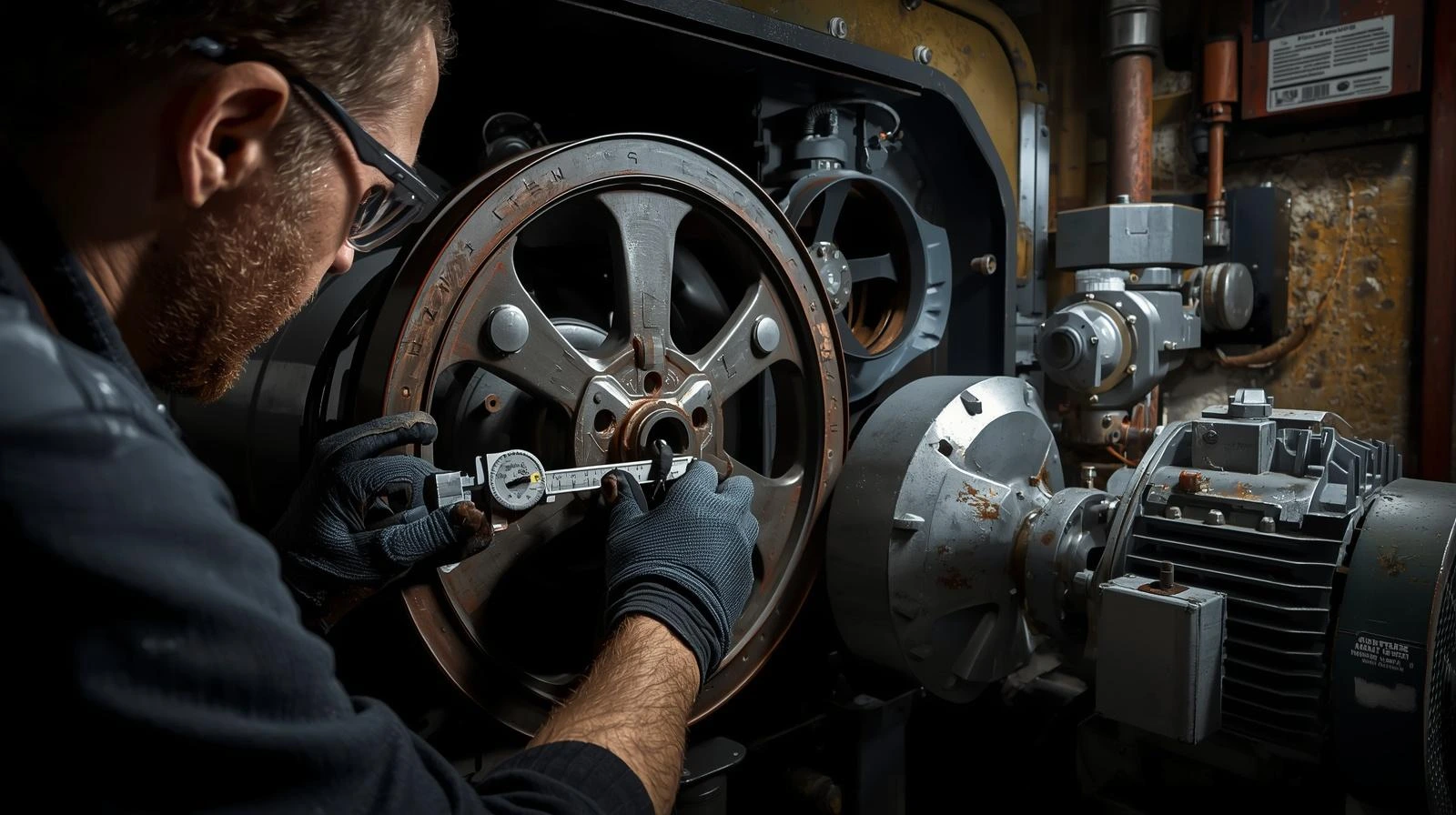
Key Pulley Dimensions Technicians Must Measure
Accurate pulley inspection requires multiple measurements instead of checking only outside diameter.
The most important pulley dimensions include:
- Outside diameter
- Pitch diameter
- Groove width
- Groove angle
- Shaft bore size
- Keyway dimensions
- Face width
- Number of grooves
Pitch diameter is especially important because it directly affects RPM transfer inside belt drive systems.
This relationship is closely connected to Pulley Ratio Explained because pulley diameter determines output shaft speed. Maintenance technicians also use the Pulley Speed Ratio Formula to verify whether pulley size changes will increase or reduce final RPM.
Tools Used for Pulley Measurement
Experienced technicians use different measuring tools depending on pulley size and industrial application.
Common pulley measurement tools include:
- Vernier caliper
- Outside micrometer
- Steel ruler
- Tape measure
- Pitch gauge
- Laser alignment tool
- Dial indicator
For precision applications such as compressors and high-speed HVAC blowers, vernier calipers and pitch gauges provide more accurate measurements than manual tape methods.
Technicians also inspect pulley grooves carefully because worn grooves reduce belt grip and increase slippage.
How to Measure Pulley Diameter Correctly
Many maintenance errors occur because technicians measure only the outside edge of the pulley instead of identifying the correct pitch diameter.
Basic pulley measurement procedure:
- Shut down and isolate equipment
- Remove belt tension
- Clean pulley surface
- Measure outside diameter
- Check groove dimensions
- Verify bore size
- Inspect shaft alignment
- Compare RPM requirements
When measuring variable speed pulleys, technicians must also verify adjustable flange positioning because flange movement changes operating pitch diameter.
These measurements are often related to Motor Pulley Sizing Guide, Belt Speed Calculation Formula, belt drive efficiency calculation, shaft speed calculation basics, and industrial pulley balancing procedure.
Pulley Measurement Reference Table
| Pulley Component | Measurement Tool | Purpose | Industrial Example | Common Error |
|---|---|---|---|---|
| Outside Diameter | Tape Measure | Basic pulley sizing | HVAC blower system | Ignoring pitch diameter |
| Groove Width | Vernier Caliper | Belt compatibility | Industrial compressor | Wrong belt section |
| Bore Size | Inside Micrometer | Shaft fitting | Cooling tower fan | Loose shaft fitting |
| Keyway Width | Vernier Caliper | Torque transfer | Conveyor drive system | Incorrect key fit |
Common Pulley Measurement Mistakes
Technicians often face repeated pulley problems because of inaccurate measurements or incomplete inspection.
The most common mistakes include:
- Measuring dirty pulleys
- Ignoring groove wear
- Using outside diameter only
- Skipping bore inspection
- Ignoring pulley alignment
- Using incorrect belt section
- Replacing only one pulley
These problems are often related to Pulley Alignment Problems, Belt Slip and RPM Loss, Pulley Wear Symptoms, industrial belt inspection procedure, and conveyor vibration troubleshooting.

How Pulley Measurement Affects RPM and Airflow
In industrial belt drive systems, pulley measurement directly affects rotational speed and airflow performance.
For example:
- Larger driver pulley increases output RPM
- Larger driven pulley reduces blower speed
- Incorrect groove size causes belt slip
- Improper bore size creates shaft vibration
HVAC systems are especially sensitive to pulley dimension changes because airflow depends heavily on blower RPM.
Technicians often compare RPM values using How to Calculate Belt RPM before installing replacement pulleys. Engineers also verify pulley ratio behavior using the Belt Drive RPM Calculation method because incorrect pulley diameter selection can cause airflow imbalance, conveyor speed instability, and excessive motor loading.
For deeper understanding, technicians should also study Belt Tension Calculation, Fan Speed vs Airflow, pulley wear inspection guide, belt tension adjustment guide, industrial shaft balancing guide, fan airflow troubleshooting, and belt drive vibration analysis.
Real World Engineering Insight
In Gulf industrial environments, pulley measurement errors become very common during emergency shutdown maintenance because technicians often replace damaged pulleys quickly to restore production.
One common issue I’ve seen in HVAC maintenance is technicians installing replacement pulleys with incorrect groove profiles. The blower initially operates normally, but after several weeks, the V belt begins slipping and airflow performance drops significantly.
In one cooling tower system, the maintenance team replaced a pulley using only outside diameter measurement. Later we discovered the pitch diameter and groove angle were different from the original pulley. This caused RPM variation and excessive belt vibration.
After installing the correctly measured pulley and aligning the shaft assembly properly, the system returned to stable operation.
During troubleshooting, engineers also verified RPM transfer behavior using the Conveyor Belt Speed Calculation method because incorrect pulley sizing was affecting conveyor throughput and airflow performance simultaneously.
Experienced technicians understand that proper pulley measurement is not just about physical dimensions. It directly affects RPM transfer, airflow, torque transmission, vibration stability, and overall equipment reliability.
Frequently Asked Questions
What is the most important pulley measurement?
Pitch diameter is one of the most important pulley measurements because it directly affects RPM transfer and pulley ratio.
Can incorrect pulley measurement cause belt slip?
Yes. Incorrect groove size, pulley diameter, or alignment can create belt slip and RPM loss.
What tools are used to measure pulleys?
Technicians commonly use vernier calipers, tape measures, pitch gauges, micrometers, and dial indicators.
Why should technicians inspect pulley grooves?
Worn pulley grooves reduce belt grip, increase slippage, and reduce power transmission efficiency.
How does pulley measurement affect HVAC airflow?
Pulley size changes blower RPM, which directly affects airflow volume and cooling performance.
Use Pulley RPM Tools Before Replacing Industrial Pulleys
For accurate pulley replacement and RPM verification, technicians can use the Pulley RPM Calculator to compare pulley ratios, calculate shaft speed, and prevent airflow or conveyor performance problems during maintenance work. Engineers also use the Pulley Diameter vs RPM guide to understand how pulley size changes affect equipment speed and mechanical efficiency.